Latest Updates
This comparison is regularly updated with new testing data and performance insights.
🔄
:
Revamped the entire article with a new format—adding bar charts for test results, a detailed “How We Tested” section, a “What Matters for Hardwood” guide, an FAQ, and more—to help readers better understand which models perform best on this surface.
🔄
:
Posted a new video and rewrote the article with the latest results from the 33 tested models.
Quick Comparison
These picks are based on real hardwood floor testing—not specs or brand claims. Each vacuum was evaluated for fine dust pickup, debris scatter, and everyday usability to help you quickly find the right fit.
Swipe on mobile or scroll horizontally to see all picks.
⚡ Quick Verdict
👉 Choose the Dyson V12 Detect if: you want the best overall balance for hardwood floors—strong fine dust pickup, no debris scatter, and a lightweight design that’s easy to use daily.
👉 Choose the Shark Vertex Pro IZ682H if: you want the best value for the price with solid pickup on both fine debris and larger particles, and don’t mind a bit more weight.
👉 Choose the Dyson Omni Glide if: you want the lightest, most effortless vacuum for quick cleanups and small spaces with mostly hard floors.
Bottom line:
For hardwood floors, soft roller heads make the biggest difference. The V12 delivers the best all-around performance, the Vertex Pro gives you the most value, and the Omni-glide is perfect for quick, everyday cleaning.
🧠 How We Tested?
Every cordless vacuum here was tested on real hardwood floors using the same methods—measuring debris, sand, and hair pickup, as well as key factors such as nozzle efficiency on bare floors, maneuverability, and any performance issues observed during testing.
The goal is simple: show how these vacuums actually perform in real homes—not just on paper.
1. Standard Debris Pick Up Tests
I test every cordless vacuum using four standardized debris types—Quaker Oats, quinoa, pet litter, and coffee grounds—across both hard floors and carpets.
For this article, however, we’ll focus exclusively on hard floor performance.

It’s a three-step process. First, I weigh the vacuum (or dustbin) empty.
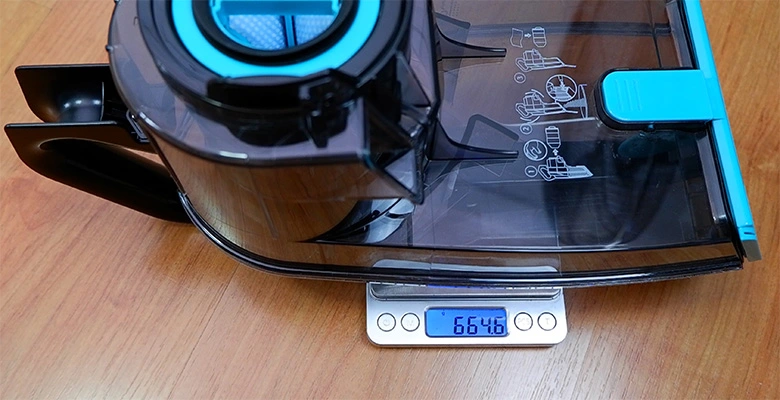
Next, I run the vacuum over a controlled test area with evenly scattered debris. Finally, I weigh the dustbin with the collected debris and divide that weight by 50 to calculate the pickup percentage.
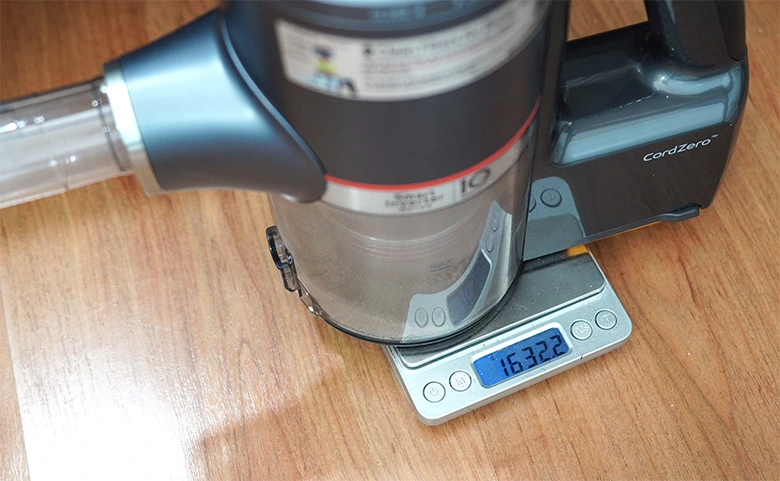
Each debris type is included to highlight potential weaknesses in nozzle design that may show up during everyday use, depending on what you typically clean.
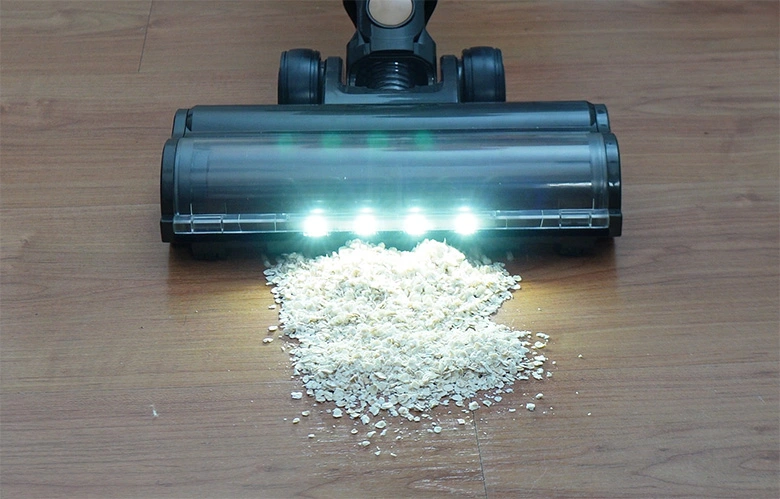
For example, 50 grams of Quaker Oats creates a large debris pile that low-profile nozzles—commonly found in budget cordless vacuums—often struggle to handle.
These designs typically use standard cleaner heads with limited clearance, making it harder to pick up bulkier debris in a single pass, often pushing a good chunk of it forward.
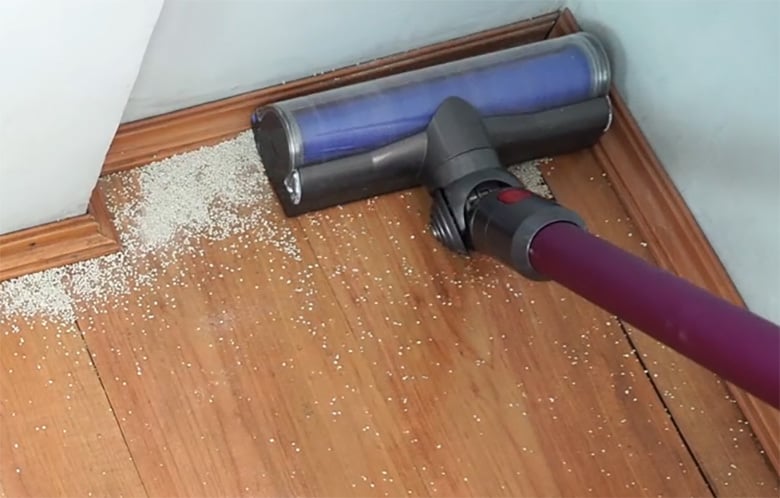
Pet litter is another type of debris that standard cleaner heads often struggle with on hard floors. With fast-spinning bristles designed to agitate carpet fibers, these brush rolls can scatter debris backward, creating more mess—especially if the nozzle lacks a proper seal behind the brush.
2. Sand on Hard Floor Test

The next experiment follows a similar process, but this time I use sand. In my testing, this is the ultimate differentiator of a cordless vacuum’s performance on hard floors.
Sand is dense and heavy, making it ideal for exposing weaknesses in a brush roll system that might go unnoticed in standard debris tests.
The only difference is that I use 100 grams of sand for this test, run it twice, and take the average of the results.
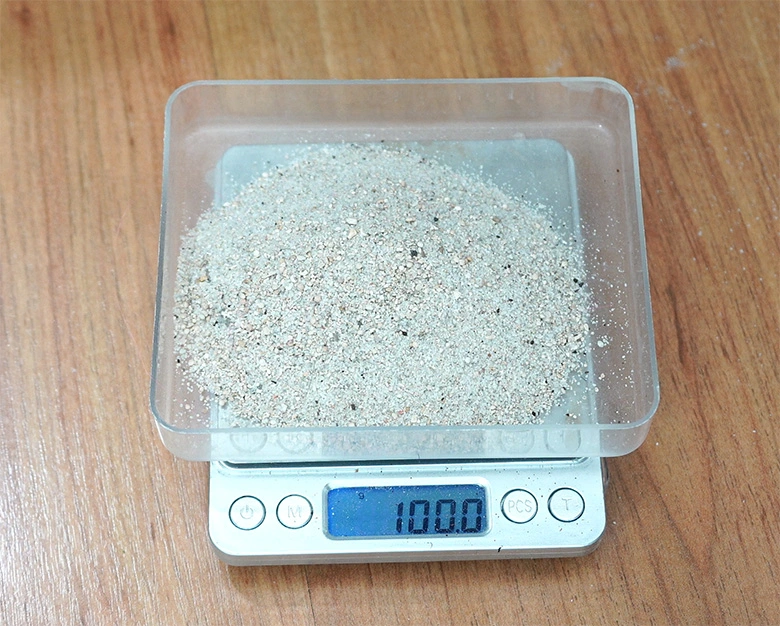
Through this test, I found that bristled brush designs—commonly used in older-generation cordless vacuums—tend to leave debris behind during a forward pass. These brushes are designed to agitate dirt embedded in carpet fibers, but they’re less efficient on bare floor surfaces.
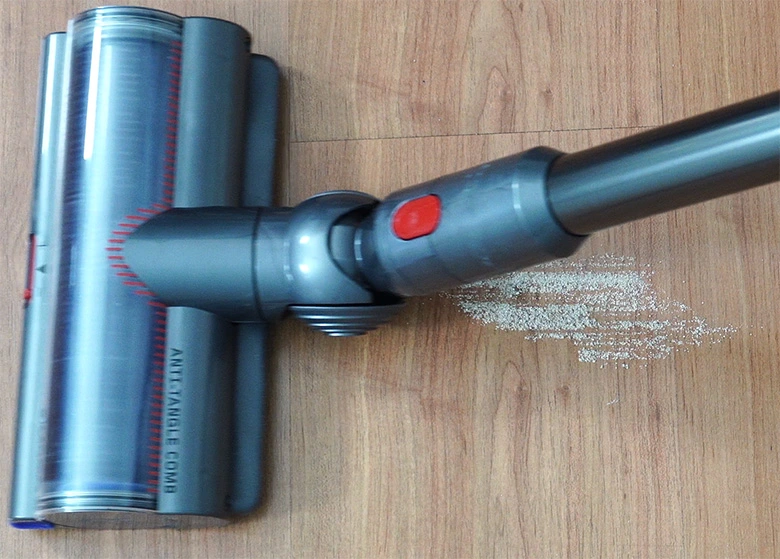
You could see a sand trail behind the brush roll after the forward pass.
3. Hair Wrap Test
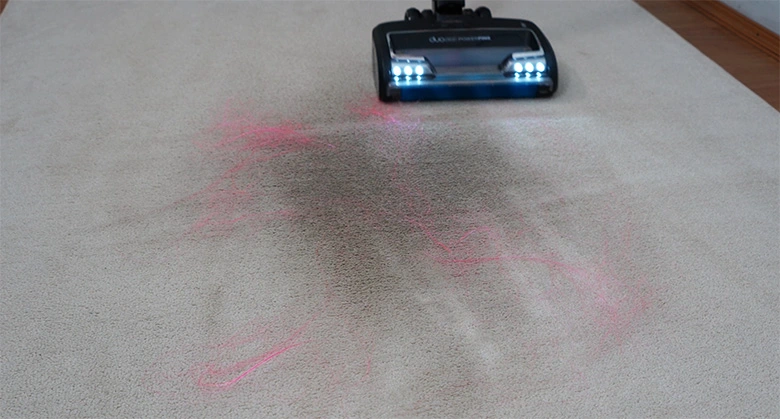
Each vacuum is tested using standardized hair lengths of 5, 7, 9, 11, and 12 inches to evaluate hair wrap resistance.
For each length, I measure one gram of hair (sometimes more), vacuum it within a controlled test area, and then recover and reweigh the collected hair to determine pickup efficiency.
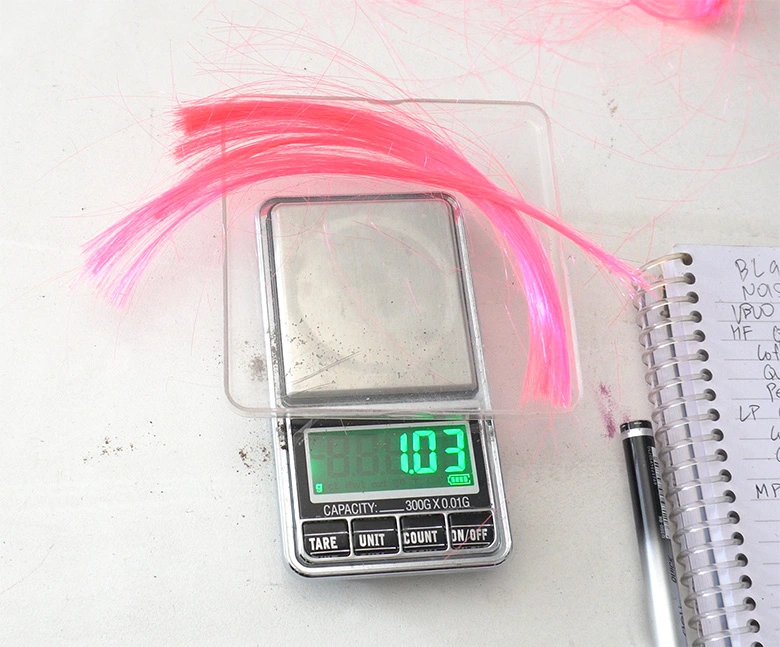
Hair was weighed on the mini scale before the test
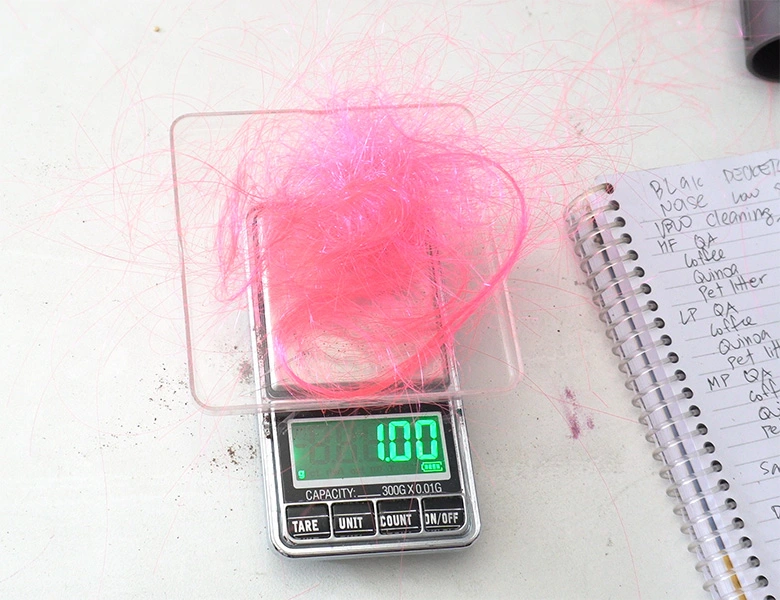
Weighing hair collected from the dustbin after the test.
If a model shows significant tangling with shorter strands, it does not advance to the 12-inch test.

This test reveals whether a cordless vacuum resists hair tangles through sheer airflow or relies on an effective anti-tangle brush roll design.
Some low-airflow models, like the Shark Vertex Pro, were particularly surprising. Despite its lower airflow, only a small percentage of 12-inch hair wrapped around the brush roll.
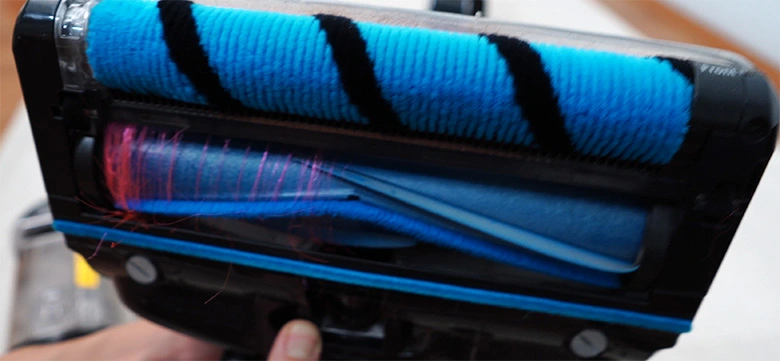
The most effective cordless vacuums for hair pickup combine a well-designed brush roll with an integrated comb system that works together to prevent tangling, along with enough airflow to pull hair from the brush roll into the dustbin.
4. Edge Cleaning Test
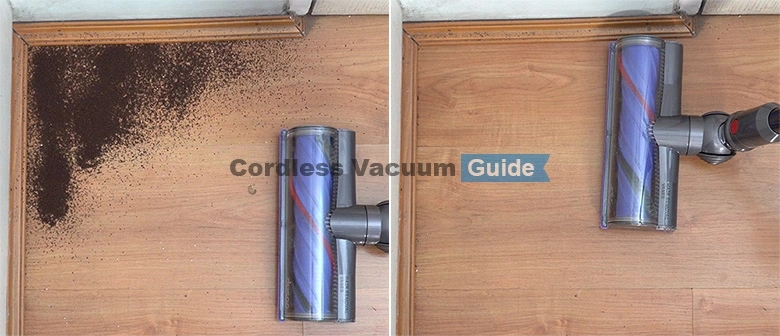
To evaluate edge cleaning performance, I scatter debris in a corner test area and observe how effectively each vacuum handles tight spaces.
Key factors include cleaner head efficiency, pass count, and whether the brush roll scatters debris—particularly backward —which is a known limitation of standard brush roll designs.
Initially, this test used pet litter, but it has since been updated to use coffee grounds, as they more accurately simulate lighter, real-world debris.

5. Crevice Test

I scatter debris into a crevice in my home office—approximately a quarter inch deep—to evaluate whether a cordless vacuum has enough airflow and agitation to lift debris from recessed areas.
This is a visual test rather than a measured one. I assess how much debris the vacuum picks up to determine whether it has enough power to clean crevices in the flooring effectively.
🧪 What Matters For Hardwood Floors?

Testing shows that not all vacuums perform equally well on hardwood floors.
Factors such as debris scatter, fine-dust pickup, and cleaner head design make a significant difference. Here’s what to look for based on real-world performance.
1. Soft Roller vs Traditional Brushroll

The type of cleaner head makes a huge difference in hardwood floors.
Soft rollers are designed to pick up fine dust and prevent debris from being pushed around on bare surfaces, while traditional brushrolls can sometimes scatter particles or struggle with heavier debris like sand.

The Miele Triflex HX1 nozzle struggled to pick up 50 grams of Quaker Oats, likely due to its low-profile design and a brush roll optimized for carpet agitation rather than hard-floor pickup.

Even high-airflow vacuums like the Dyson Outsize struggle with heavy debris like sand unless you use max power.
One major advantage of a soft roller nozzle is its ability to pick up large debris on hard floors without requiring a higher power setting.

This helps extend battery life, as using max power can increase heat buildup and accelerate battery wear.


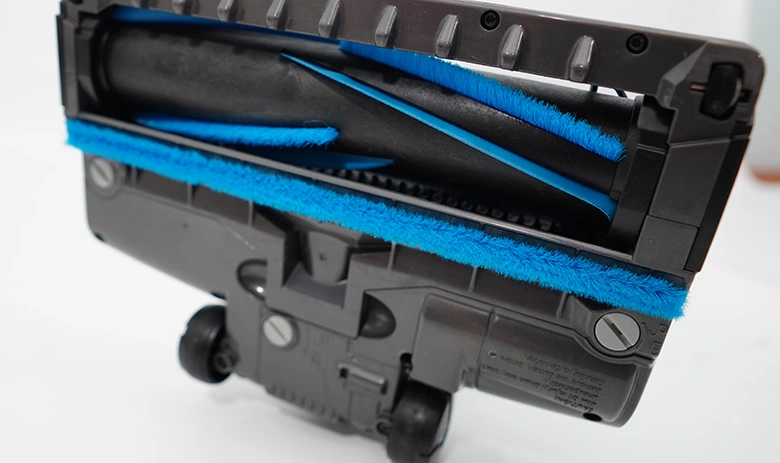
The Shark Vertex Pro combines a soft roller and a standard brush roll into a single cleaner head, allowing it to clean both hard floors and carpets with one tool.
Some manufacturers, like Shark, have taken this a step further by combining these nozzle types into a single cleaner head—allowing seamless cleaning across hard floors and carpets without switching tools.

One downside of these nozzles is their large footprint. The cleaner heads are quite bulky, which can make it harder to fit into tight spaces and reduce maneuverability under low-clearance furniture compared to smaller, more compact designs.

The Dyson Omni-Glide uses dual soft rollers and four caster wheels, allowing 360-degree steering. This design significantly improves maneuverability compared to traditional cleaner heads.
Others, like Dyson, use twin-roller nozzles paired with a design that enables 360-degree steering—an industry-first at the time.
2. Debris Scatter
Debris scatter is one of the most common issues when cleaning hardwood floors—and one that many reviews overlook.

Instead of picking up debris, some vacuums actually push it forward or fling it backward, especially when dealing with lighter particles like dust, rice, or coffee grounds.
Why does it matter?
On hardwood floors, there’s nothing for debris to “hold onto,” so if the cleaner head isn’t designed properly, particles can easily get pushed out of the suction path.
This leads to:
- More passes are needed to clean the same area
- Debris is getting stuck along edges and corners
- Need to use a higher power setting to achieve the same results with a soft roller nozzle
- Frustrating cleaning experience overall
3. Battery Life

Battery life matters—but not in the same way as it does for carpet cleaning.
Hardwood floors typically require less power, so most cordless vacuums can run longer on lower settings.
What matters more is whether the vacuum can maintain consistent performance without switching to higher-power modes too often, since that quickly drains the battery.
This is where choosing a sub-model with a soft roller helps with maximizing run time. Since you don’t need to use a higher power setting, you could maximize run time without sacrificing cleaning performance.
4. Weight & Maneuverability
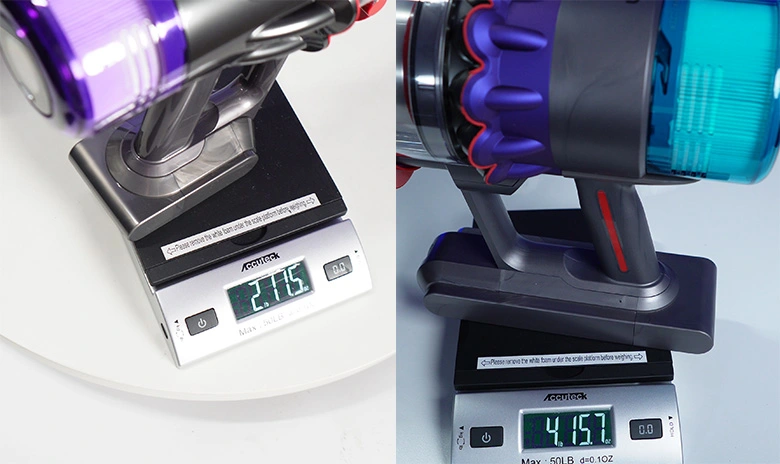
Hardwood floors are typically cleaned more often than carpets, so weight and maneuverability play a bigger role than you might expect.
A lighter vacuum with smooth steering is easier to use for quick, everyday cleaning—especially around furniture, tight spaces, and edges.
Hard floor cleaning generally places less demand on dustbin capacity than carpet cleaning. This is because it primarily involves fine dust and hair, which occupy less volume than the denser debris often extracted from carpets.
From testing, lighter models tend to feel more effortless on hard floors, especially when paired with soft roller heads that glide smoothly.

Heavier vacuums can still perform well, but they may be more tiring to use during longer sessions or in homes with many obstacles.
What to Look For:
- Lightweight design (easier for daily use)
- Smooth steering or swivel head
- Low-profile cleaner head (fits under furniture)
- Balanced weight distribution (not too top-heavy)
🏆 Full Reviews
After testing multiple cordless vacuums on hardwood floors, these models delivered the best overall performance in real-world use.
Each one stands out in a specific area—whether it’s fine dust pickup, ease of use, or overall value—so you can choose the best fit for your home.
Best Overall for Hardwood Floors: Dyson V12 Detect

Why does it stand out? It strikes a strong balance between powerful cleaning performance and a compact, lightweight design—something I rarely see from other brands. While there are lighter, more nimble cordless vacuums available, they often come with noticeable trade-offs in cleaning performance or dustbin capacity, making them harder to confidently recommend as the best overall option. One standout
feature of the V12 is its bright green laser, which reveals fine, nearly invisible dust on hard floors—helping users see exactly where to clean and making each pass more efficient.
Pros
- Best balance powerful cleaning performance and a compact, lightweight design
- Bright green laser reveals fine, almost invisible dust
- Some variants come with two detachable batteries, doubling the run time
- Efficient hard floor pick up even in the lowest setting
- Lightweight design
Cons
- Hair tends to wrap around the laser roller axle because it lacks an active anti-tangle system
- Most expensive option
- Small dustbin
Best For: This is ideal for users who want a lightweight cordless vacuum for small- to mid-sized homes, primarily on hard floors with some carpet. It delivers excellent hard floor performance without sacrificing overall cleaning capability. An added bonus is another Dyson innovation—the green laser illumination, which reveals fine dust that’s often invisible under standard lighting. This feature has influenced the industry, with other brands now adopting similar technology, and it helps users clean more efficiently by clearly showing where dust remains and where surfaces are already clean.
Best Value Option: Shark Vertex Pro

Why does it stand out? The
Shark Vertex Pro offers excellent value, delivering strong cleaning performance without the premium price of a Dyson. It builds on the original Vertex by improving runtime, refining the handle controls, and enhancing hair-wrapping resistance through its dual-brush-roll system. It also retains its standout debris pickup performance, thanks to the dual rollers, which feel more robust and capable than the cleaner head on models like the V12, especially on large debris piles. An added advantage of the Shark Vertex Pro is its extra-large dustbin, with a capacity of over one liter—meaning fewer trips to empty it.
Pros
- Duo Clean nozzle is fully capable of cleaning large debris piles better than the V12
- Large dustbin capacity
- Decent run time of over 50 minutes per battery
- Excellent anti-hair tangle capability with the combs and fins around the brush roll
- Easy to empty the dustbin with its wide opening
Cons
- Bulky nozzle will struggle to fit in tight spaces
- Inferior illumination compared to the V12
- More top-heavy design
Best for: Budget-conscious shoppers who want strong cleaning performance without paying a premium. The Shark Vertex Pro is especially effective on hard floors and can handle large debris with ease, thanks to its durable dual-brush-roll system. While it has a bulkier, more top-heavy design, it makes up for it with powerful pickup and a large 1+ liter dustbin—making it a great choice for cleaning bigger messes or larger homes with fewer interruptions.
Best Lightweight Option: Dyson Omni Glide

Why does it stand out? The Dyson Omni-Glide introduces true 360-degree steering—an industry-first—thanks to its dual-roller cleaner head (with rollers at the front and rear) and four rotating caster wheels. This design allows the vacuum to move in any direction, delivering a level of maneuverability I haven’t seen in other models I’ve tested. Its cylindrical handle also enables a broom-like grip, making it feel intuitive and easy to control. That said, there are some trade-offs. The nozzle doesn’t spin on carpet—even low-pile—making it unsuitable for carpeted surfaces. It also has one of the smallest dustbin capacities I’ve tested at just 0.18 liters (even smaller than the V12 Detect), and a relatively short runtime of just over 23 minutes.
Pros
- Industry-first 360-degree steering
- Lightest option of the bunch
- Easiest to use for vacuuming stairs
- Excellent for cleaning underneath low clearance furniture
- Superb maneuverability around furniture
Cons
- Extremely small dustbin capacity
- Unusable on rugs or carpet
- Almost useless for cleaning moderately long hair strands
Best for: Small homes or apartments where lightweight handling and maneuverability matter most. The Dyson Omni-Glide excels in tight spaces and under low furniture, thanks to its compact design. Its twin-roller cleaner head allows debris pickup in both forward and backward passes, while four caster wheels enable true 360-degree steering—something rarely seen in other models. That said, this is a purpose-built design with trade-offs. It has a very small dustbin, doesn’t work on carpet, and isn’t ideal for picking up large amounts of hair.
🧪 Performance Comparison Table
Here’s a side-by-side comparison of how each vacuum performed on different experiments based on real-world testing. Use this table to quickly compare key metrics like pickup performance, fine dust handling, and overall usability.
Hardwood Test Results Breakdown
Below is a detailed breakdown of the hardwood floor test results, based on controlled, repeatable testing methods.
Each category highlights a different aspect of performance, allowing you to compare how each vacuum performs in real-world experiments against the field.
First, we’ll compare how the Dyson V12, Shark Vertex Pro, and Omni-Glide perform against the broader field of cordless vacuums I’ve tested on hard floors.
The bar graphs below show the average pickup performance across multiple debris types—including Quaker Oats, coffee grounds, quinoa, and pet litter—providing a more complete picture of real-world cleaning performance. You’ll notice that the difference between the top-performing models is less than one percent.
Next, we’ll look at the sand-on-hard-floor results—one of my key benchmarks in the selection process—and how the top picks performed compared to the rest of the field.
Hair wrap is another key consideration—especially for pet owners. Here’s how the top picks performed compared to the rest of the field.
The scores below represent the average results from the 5-, 7-, 9-, 11-, and 12-inch hair tests. Note that not all models were tested at every length; some sub-models were excluded from longer-hair tests if they already struggled with shorter strands, as was the case with the Dyson Omni-Glide.
I didn’t conduct quantitative tests for the edge cleaning experiment; instead, I used a visual assessment. Below are before-and-after shots of the category winners.

Dyson V12 before and after edge cleaning photos

Shark Vertex Pro edge cleaning: before-and-after photos.

Dyson Omni Glide before-and-after edge-cleaning photos.
❌ Cordless Vacuums To Avoid on Hardwood Floors
Not every cordless vacuum is designed for hardwood floors—and some can actually make cleaning more frustrating.
From testing, certain models struggle with common hard-floor issues such as debris scattering, poor fine-dust pickup, or an inefficient cleaner head design. These problems can lead to more passes, missed dirt, and an overall less efficient cleaning experience.
Based on my tests, the Miele Triflex HX1, Dyson V7 Motorhead, Roborock H7 (discontinued), and Roidmi NEX20 (discontinued) struggled to pick up debris on this surface. A key limitation across these models is the absence of a soft-roller nozzle.
The Miele Triflex HX1 and Dyson V7 Motorhead, in particular, had difficulty with larger debris like Quaker Oats—tending to snowplow it forward due to their low-clearance nozzle design.

However, manufacturers have continued refining brush roll designs, and newer models like the Shark WandVac have shown improved performance—even without a dedicated soft roller attachment.
💡Buyer’s Guide
If you’re still unsure which vacuum is right for your home, this quick guide breaks down the key factors to consider when choosing a cordless vacuum for hardwood floors.
The goal is simple: help you match the right vacuum to your cleaning needs without overcomplicating the decision.
When it comes to hardwood floors, a few features make a bigger difference than others.
1. Soft Roller A Must-Have Feature
I can’t emphasize the importance of a soft-roller nozzle enough—it’s the most efficient tool for this surface. It allows you to use lower power settings while still achieving excellent pickup.
In contrast, models without a soft roller often require higher power modes to deliver similar results, which reduces runtime and can accelerate battery wear over time.
2. High Airflow Isn’t Mandatory
High airflow isn’t essential for cleaning hardwood floors, since most debris sits on the surface and doesn’t require deep extraction. However, it becomes more important if your flooring has many crevices—especially deeper ones—where debris can settle and require additional airflow to lift out effectively.
3. Run Time Matters
Look for a model with a solid claimed runtime. In my tests, most manufacturers’ estimates are fairly accurate—and in some cases, even conservative. For example, the Dyson V15 Detect is rated for 60 minutes, but exceeded that by over 20 minutes in testing.
Battery design is another key factor. Models with detachable batteries make it easy to extend runtime by swapping in a spare—especially useful for cleaning larger homes.
❓FAQ
Here are answers to the most common questions about cordless vacuums for hardwood floors, based on real-world testing and usage.
What is the best type of vacuum for hardwood floors?
The best cordless vacuums for hardwood floors typically use a soft-roller cleaner head, designed to capture fine dust while preventing debris from being pushed around. Based on testing, soft rollers consistently outperform traditional brushrolls on hard surfaces—delivering more efficient pickup while requiring less power.
Do you need strong suction for hardwood floors?
Not necessarily.
Hardwood floors don’t require as much suction as carpet since debris sits on the surface. Factors such as airflow, cleaner head design, and debris handling play a greater role in overall performance.
Can cordless vacuums scratch hardwood floors?
There’s always a risk of scratching hard floors—even with soft-roller attachments—since some parts of the cleaner head still make contact with the surface.
To minimize this risk, keep the nozzle clean. Regularly removing debris buildup helps prevent abrasive particles from being dragged across the floor.
Why do some vacuums push debris instead of picking it up?
This is called debris scatter, and it usually happens when the cleaner head isn’t designed for hard floors.
Brushrolls with limited clearance and airflow tend to push debris forward rather than lift it—especially when dealing with larger particles.
What’s the biggest weakness of most cordless vacuums on hardwood floors?
There are two main issues. First, the lack of a properly designed nozzle—either one not optimized for this surface or with insufficient clearance. Second, an inferior brushroll design that lacks proper sealing, causing debris to be pushed backward instead of being drawn in.
Are lightweight vacuums better for hardwood floors?
In most cases, yes.
Hardwood floors typically require more frequent cleaning, so a lightweight, maneuverable vacuum makes daily use easier—especially around furniture and in tight spaces.
Since you’ll be vacuuming more often, a large dustbin isn’t as critical, as you’re mostly picking up dust and hair. The exception is if you live in a sandy environment or have multiple heavy-shedding pets, where a larger bin can still be beneficial.
How much battery life do you need for hardwood floors?
For most homes, 20–40 minutes of usable runtime is enough for hardwood floors.
However, larger homes or whole-house cleaning may benefit from longer runtime or removable batteries.
Are Dyson vacuums better for hardwood floors?
Dyson models with soft-roller heads—like the Dyson V12 Detect Slim and Dyson V15 Detect—tend to perform exceptionally well on hardwood floors, especially when it comes to fine dust pickup. One standout feature is the green laser, which reveals dust particles that are nearly invisible to the naked eye—helping you clean more efficiently by showing exactly where debris remains.
That said, other brands can still deliver strong performance—often at a lower price—making them a solid alternative to more premium Dyson models.
