Quick Comparison: Dyson V9 vs V12 Detect
Key differences based on real-world performance testing.
Swipe on mobile or scroll horizontally to see all picks.
Update: Added a “Quick Comparison” section to highlight the key differences based on real-world testing. Redesigned layout for airflow, cleaning, noise, and runtime results.
In this comparison, I take a deep dive into the Dyson V9 MotorBar and the Dyson V12 Detect—two of Dyson’s lightest full-sized cordless stick vacuums, designed for very different buyers.
The big question is simple: is the V12 Detect worth the extra cost, or does the V9 MotorBar deliver everything most people actually need for less money?
Instead of leaning on spec sheets or marketing buzzwords, this comparison focuses on real-world testing. After spending hours testing both vacuums, measuring suction, airflow, runtime, noise, and cleaning performance across multiple surfaces.
I break down where each model shines, where it falls short, and which one makes more sense for your home.
Similarities Between The Dyson V9 and V12
Next, we’ll break down the key similarities between the Dyson V9 and V12.
1. Lightweight Frame
The first similarity is their lightweight design, which makes both models well-suited to smaller homes. While the V9 is lighter overall, the V12 Detect isn’t far behind, weighing only about one pound more.
2. Dustbin Alignment and Capacity
Another key similarity between the Dyson V9 MotorBar and V12 Detect is the horizontally aligned dustbin with Dyson’s hygienic ejection system. Both models share the same 0.35-liter dustbin capacity.

Even though the V9 appears smaller, it retains the same dustbin capacity as the V12 Detect.
3. Detachable Battery

Both of these lightweight Dyson stick vacuums feature a detachable battery, allowing you to extend runtime by swapping in a spare and making battery replacement much easier if it degrades over time.
4. Sealed Filtration System
I tested the filtration systems of both the Dyson V9 and V12 Detect using a fog machine, and both passed with no visible leaks.
Differences Between The Dyson V9 and V12 Detect
Next, we’ll break down the key differences between the Dyson V9 MotorBar and the V12 Detect.
1. Floor Nozzles

The first major difference comes down to nozzle selection and design. The Dyson V12 Detect includes two floor heads out of the box: the Laser Slim Roller for hard floors and a standard brush head similar to the V8, but without anti-tangle combs.
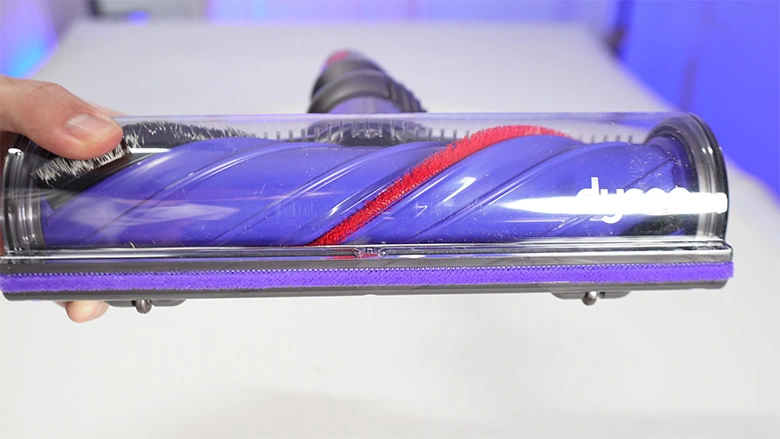
The V9 MotorBar, on the other hand, ships with just one floor head—the MotorBar nozzle. It features integrated combs above the brush roll to help untangle long hair and reduce wrap during cleaning.
2. LCD Screen

Another key difference is the LCD display. The Dyson V12 Detect uses a screen similar to the V15 Detect, showing real-time feedback on how much debris is being picked up and the remaining runtime.
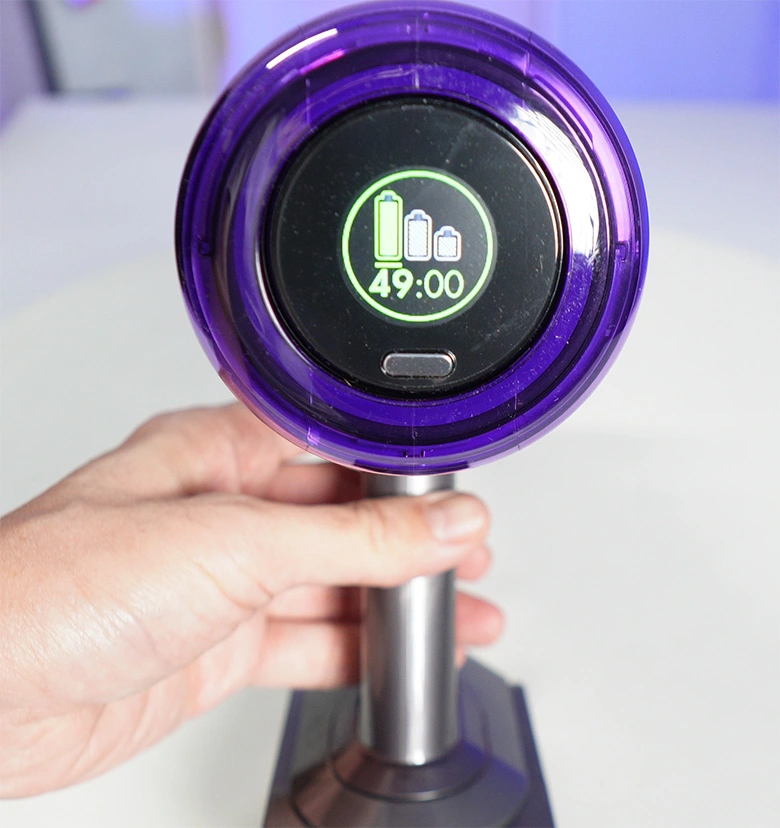
The Dyson V9 MotorBar, by contrast, lacks this feature and uses a more basic, V11-style LCD that displays only remaining battery time.
3. Body Weight
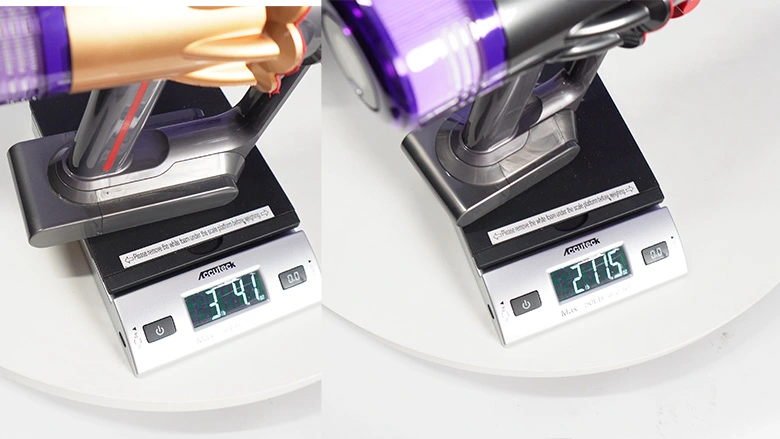
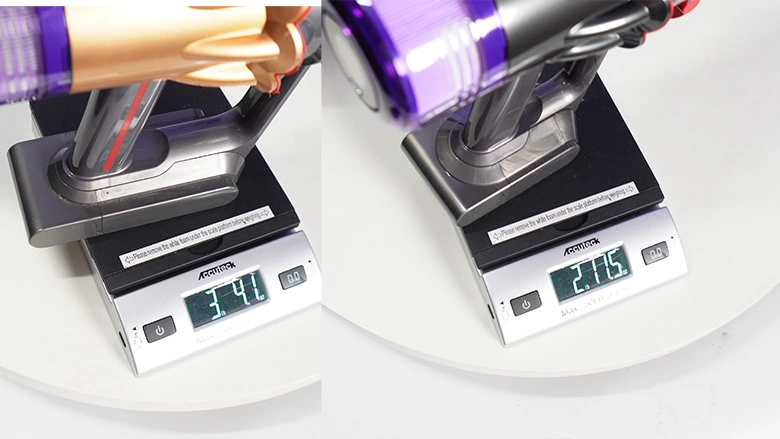
While both the Dyson V9 MotorBar and V12 Detect are considered lightweight models, the V9 is roughly one pound lighter, giving it a noticeable advantage in handheld ergonomics.
4. Tools
The V12 Detect definitely wins when it comes to included accessories. My unit even came with two batteries, so you’re getting a lot for the money.

- Dyson V12 unit
- Motorbar cleaner head
- Laser slim fluffy
- Hair screw tool
- Light pipe crevice tool
- Mini soft dusting brush
- Stiff bristled brush
- Combination tool
- Under-bed attachment
- Extra battery
- Extension wand
- Two battery chargers
The V9, on the other hand, is more barebones—I only received three tools with the version I bought.
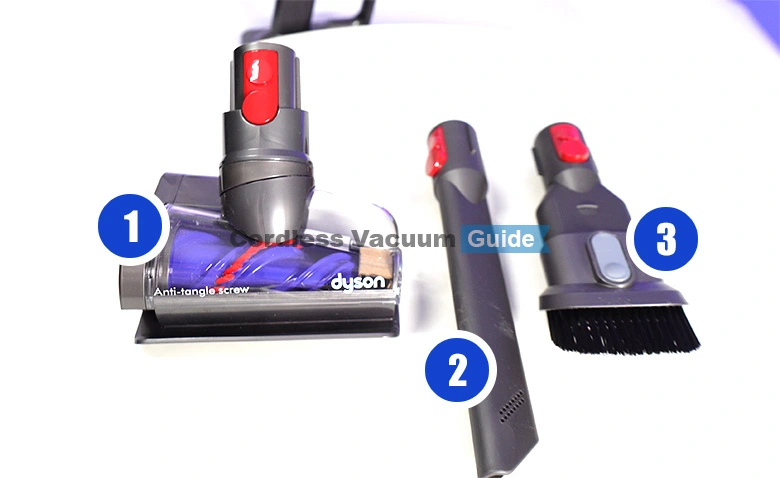
- Hair screw tool
- Crevice tool
- Combination tool
5. Power Switch
Another difference is the power control design.
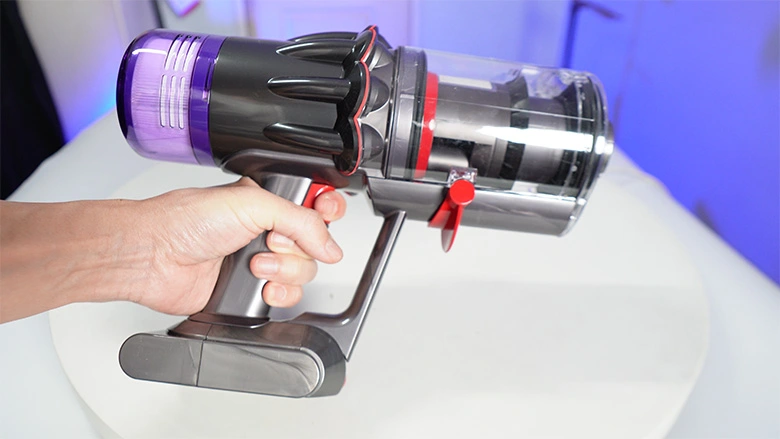
The Dyson V9 MotorBar uses a trigger-style switch similar to the V11, meaning you need to hold it down to keep the vacuum running.

The V12 Detect, on the other hand, features a top-mounted push-button, which is less fatiguing during longer cleaning sessions.
That said, the trigger offers a power-on-demand feel that some users may prefer for quick bursts of cleaning. Ultimately, this comes down to personal preference.
Ergonomic Comparison
From an ergonomics standpoint, the Dyson V9 MotorBar has the edge thanks to its lighter weight.
At more than one pound lighter than the V12 Detect (without tools attached), it’s less tiring to use—especially in handheld mode or during quick cleanups.
That said, the V12 Detect does offer one ergonomic advantage: its push-button power switch.
Unlike the V9’s trigger, the V12 doesn’t require continuous squeezing for power, making it more comfortable during longer cleaning sessions.
Steering is another area where the V12 pulls ahead on hard floors. Its laser slim roller glides and pivots more smoothly than the V9’s standard MotorBar nozzle. On carpet, however, both vacuums steer similarly.
Interface Comparison
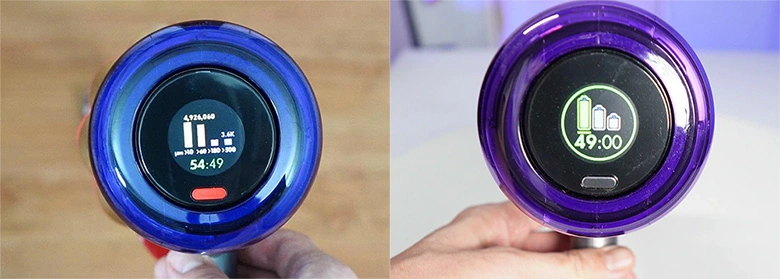
While both the Dyson V9 MotorBar and V12 Detect feature LCD screens, what they display is very different.
The V12 Detect, as the more premium model, includes a Piezo sensor readout that shows real-time feedback on how much of each of the four debris types is being picked up.
The V9, by comparison, uses a simpler interface that displays only the remaining runtime and the current power setting.
Run Time Comparison
The Dyson V12 Detect clearly wins on runtime, delivering over 60 minutes with the nozzle attached—nearly double the V9’s runtime. If you purchase a bundle with two batteries, the total runtime can range from roughly 2x to nearly 4x that of the V9.
Dyson rates the V9 MotorBar for up to 40 minutes, and in testing, it exceeded that claim when used without the nozzle, running close to 50 minutes. With the nozzle attached, however, runtime drops to around 38 minutes, reinforcing that the V9 is best suited for smaller homes and shorter cleaning sessions.
Airflow Comparison
Once again, the Dyson V12 Detect outperforms the V9 MotorBar in airflow across all power settings, thanks to its larger motor and battery.
At the highest power level, the V12 delivers over 23% more airflow at the wand and over 24% more at the nozzle. This airflow advantage translates directly to better pickup of embedded dirt on carpet and more efficient coverage of larger areas.
Cleaning Comparison
Despite its lower airflow, the Dyson V9 MotorBar held its own against the V12 Detect in the cleaning tests. Performance differences were minimal—especially for surface-level dirt, where the gap between the two was less than 1%.
Which Option Is Better On Hard Floors?
Even though the scores are close, the Dyson V12 Detect comes out ahead thanks to its Laser Slim Roller, which is significantly more efficient than the V9’s MotorBar nozzle on this surface.
An added benefit of the Laser Slim Roller is the bright green laser, which makes fine dust that’s normally invisible much easier to see.
This helps users vacuum more efficiently by clearly showing which areas still need attention and which have already been cleaned.

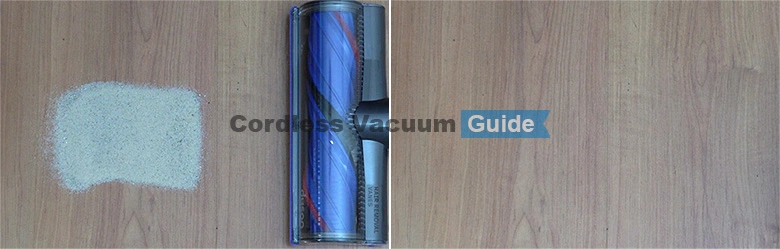
Both the Dyson V9 MotorBar and V12 Detect achieved 99.9% sand pickup on hard floors, but they did so in different ways.
The V9 required the mid power setting to hit this score, while the V12 achieved nearly complete pickup using Eco mode.
Hair Wrap on Hard Floors Experiment
Next, I tested how well each vacuum handled one gram of hair scattered across lengths ranging from five to twelve inches.
Here are the results for the Dyson V9 MotorBar, followed by the results for the Dyson V12 Detect.
Dyson V9 Results
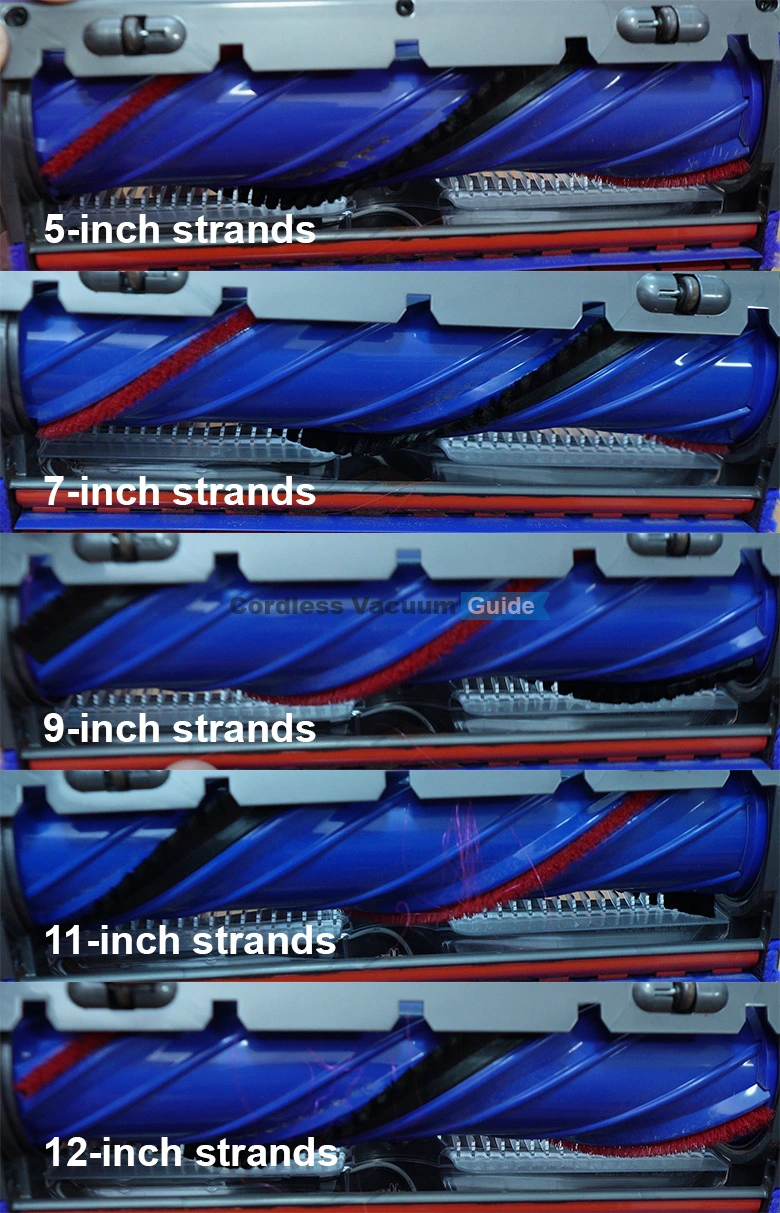
- 5-inch hair: 100%
- 7-inch hair: 100%
- 9-inch hair: 100%
- 11-inch hair: 97%
- 12-inch hair: 98%
The Dyson V9 MotorBar performed nearly perfectly in this test, achieving an almost flawless hair pickup score on hard floors.
A big reason for this result is the combs positioned behind the brush roll, which help lift and guide hair into the nozzle instead of letting it wrap.
That said, even with strong results, the MotorBar nozzle still isn’t as efficient on hard floors as a dedicated soft-roller head. For hair pickup specifically, however, it performs very well.
Dyson V12 Detect Results

- 5-inch strands: 96%
- 7-inch strands: 100%
- 9-inch strands: 92.5%
- 11-inch strands: 98%
- 13-inch strands: 100%
The Dyson V12 Detect also delivered strong hair pickup on this surface. In one of the tests, however, pickup dropped to 92% because hair wrapped around the axle.

This issue isn’t unique to the V12 Detect—it’s a known limitation of the Laser Slim Roller, where gaps at both axle ends can allow hair to wrap.
Edge Cleaning Comparison
To test edge-cleaning performance, I scattered coffee grounds along the edges and measured how efficiently and quickly the Dyson V9 MotorBar and V12 Detect picked them up.
Here are the before-and-after photos and the Dyson V9.
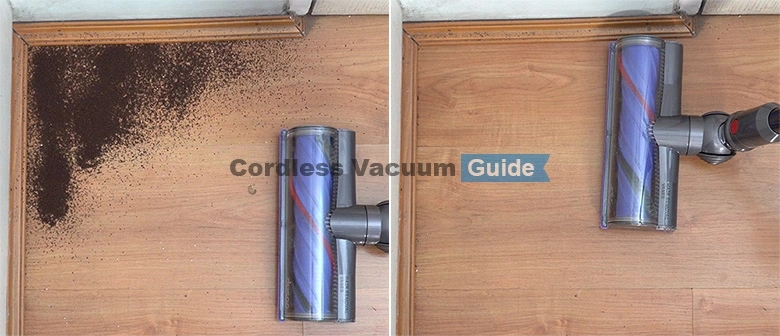
And the Dyson V12 Detect.

While both vacuums cleaned effectively in this test, the V12 Detect came out ahead thanks to its Laser Slim Roller.
It picked up nearly every coffee ground at the lowest power setting, whereas the V9 MotorBar required the mid power setting to achieve similar results.
Which Option Is Better for Carpet?
The Dyson V9 MotorBar and V12 Detect delivered very similar results in carpet-cleaning tests. Surface-level pickup was nearly identical between the two models, with both hovering around 99.45%.
The difference became more noticeable in the deep-cleaning test, where the V12 Detect outperformed the V9 by four percentage points (94.1% vs 90.15%)—a clear reflection of the V12’s higher airflow and stronger ability to lift embedded debris.
Hair Wrap on Carpet Experiments
Next, we’ll look at the hair wrap test on carpet, where I measured how effectively the Dyson V9 Motorbar and V12 Detect picked up hair on this surface.
Dyson V9 Results
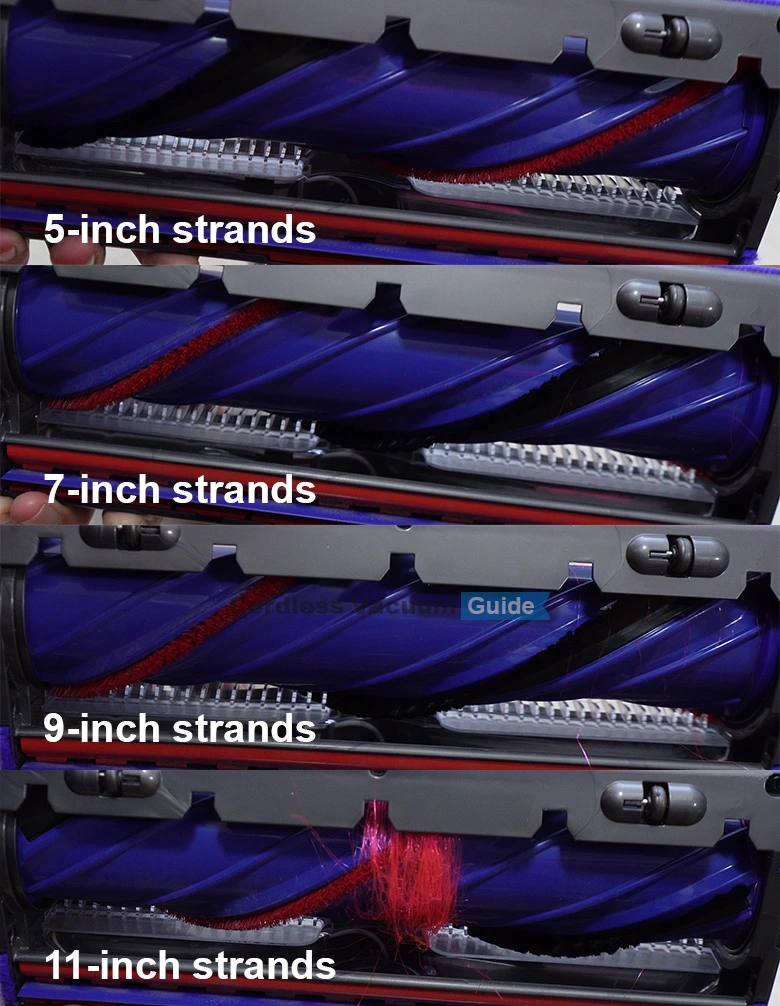
- 5-inch hair: 100%
- 7-inch hair: 100%
- 9-inch hair: 100%
- 11-inch hair: 49%
The Dyson V9 MotorBar delivered excellent results with hair lengths up to nine inches, but performance dropped with 11-inch strands, where pickup fell to 49%.
That said, this result is still reasonable, as most households won’t be dealing with hair anywhere near this length unless they have a long-haired pet that sheds heavily.
Dyson V12 Detect Results

- 5-inch strands: 96%
- 7-inch strands: 100%
- 9-inch strands: 92.5%
- 11-inch strands: 30%
The Dyson V12 Detect performed worse than the V9 in this test. Some hair wrapped around the brush during the nine-inch trial, and the wrap increased further in the 11-inch test, where pickup dropped to 30%.
Noise Comparison
Somewhat surprisingly, the Dyson V9 MotorBar was the louder vacuum across all power settings. This is likely due to the MotorBar nozzle, which tends to vibrate more than the Laser Slim Roller, resulting in higher noise levels.
Product Specifications
Where Can I Purchase These Dyson Cordless Vacuums?
The Dyson V9 Motorbar and V12 Detect are available in online stores like Amazon and Walmart. Check the links below for the latest pricing information.
Disclaimer: I will earn a commission if you click on any of the links above, but at no extra cost, so it’s a win-win for us!
Which Option Offers Better Value?
Based on both testing and day-to-day usability, the Dyson V12 Detect offers better overall value for the money—at least for my needs.
It’s a cordless vacuum that excels on hard floors, provides longer runtime, and doesn’t require frequent recharging, which makes it a better fit for my small home.
While the Dyson V9 MotorBar is the more affordable option, you get noticeably less. It includes only three above-floor tools and a single floor head that performs better on carpet than on hard floors.
If your home has more carpet than hard flooring, the V9 is still an easy recommendation. But for homes with mostly bare floors, the V12 Detect is the better choice.
4 Reasons to Choose the Dyson V9 Motorbar
- Cheaper: The Dyson V9 is the cheaper lightweight cordless option.
- Excellent at cleaning hair: The combs on the Motorbar brush helps untangle hair.
- Above-average on carpets: Despite the lack of airflow, it cleans surface dirt on carpet as well as the V12.
- Lighter: It’s more than a pound lighter than the Dyson V12 Detect.
4 Reasons to Choose the Dyson V12 Detect
- Runs longer: It will run for over 60 minutes with the laser slim nozzle.
- Better on hard floors: The laser slim roller is more efficient and helps users track dust on bare floor.
- Better technology: It offers more technology for the money you’ll spend like the Piezo sensor readout, larger motor, and laser slim roller.
- More tools: User will get more tools out of the box.
The Verdict: The V12 Detect Is The Better Option
While the Dyson V9 MotorBar is the cheaper option upfront, the V12 Detect delivers better overall value for what you’re paying.
The main issue with the V9 is the absence of a soft roller head, which is a deal breaker for me. The standard MotorBar nozzle simply isn’t as efficient on hard floors.
If Dyson included a soft roller, then it would be a no-brainer.
To be clear, the V9 can clean hard floors—but it does so less efficiently.
The added vibration from the Motorbar head and the need to use higher power settings make the experience less pleasant and shorten battery lifespan.
Over time, that increased strain can mean earlier battery replacement, which offsets much of the short-term savings.
The V12 Detect is the more versatile vacuum overall, handling both carpet and hard floors efficiently without compromise.
If budget is a concern, the best move is to wait for a sale, but between the two, the V12 Detect is the more complete and future-proof option.
