Quick Comparison: Dyson V9 vs V15 Detect
Key differences based on real-world performance testing.
Swipe on mobile or scroll horizontally to see all picks.
Update: Added a “Quick Comparison” section to highlight the key differences based on real-world testing.
The Dyson V9 and Dyson V15 Detect don’t belong in the same conversation on paper — different generations, different price tiers, different promises. But real-world cleaning doesn’t happen on spec sheets. It happens on carpet, hard floors, pet hair, fine dust, and edge cases that most reviews never test.
That’s why this comparison isn’t based on manufacturer claims or quick first impressions.
I spent hours testing the Dyson V9 and V15 Detect side by side using controlled, repeatable tests, measuring airflow, suction, runtime, noise, filtration performance, and real debris pickup across multiple surfaces. Each vacuum was pushed beyond “normal use” to reveal strengths, weaknesses, and trade-offs that only emerge after extended hands-on testing.
The result is not a generic comparison — it’s a breakdown built from real data, real messes, and real performance differences you’ll actually notice in your home.
Similarities Between the Dyson V9 and V15 Detect
While the Dyson V9 and Dyson V15 Detect target very different users, they’re built on the same foundation. Here’s what these two models have in common.
1. Trigger Switch
The Dyson V9 and Dyson V15 Detect both use Dyson’s traditional trigger-style power switch, a design found on most pre-Gen5 and pre-V12 models.
It provides power on demand, but the trade-off is fatigue during longer cleaning sessions, since the trigger must be held continuously for the vacuum to run.
2. Detachable Battery

Both models use detachable batteries, making replacements straightforward and allowing you to extend runtime if you choose to keep a spare on hand.
3. Designed for Cleaning Long Hair
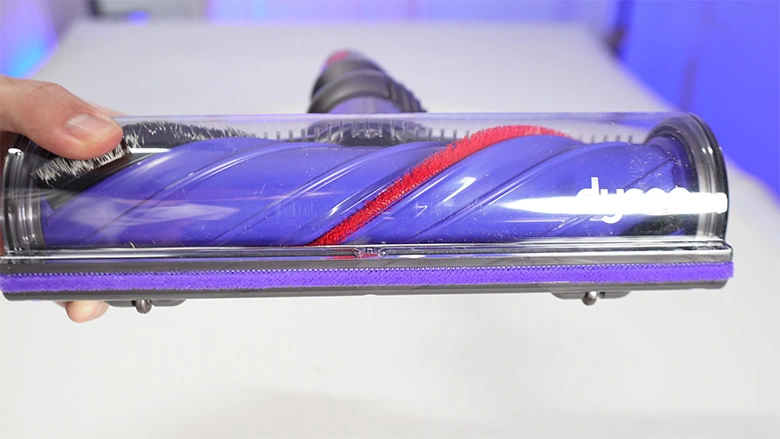
Both the Dyson V9 and Dyson V15 Detect use cleaning heads designed with long-hair management in mind, featuring built-in combs that help reduce hair wrap during use.
Each model also includes Dyson’s Hair Screw tool, which I tested extensively and found to be highly effective at removing long hair from upholstery and fabric surfaces.
4. Dustbin Design
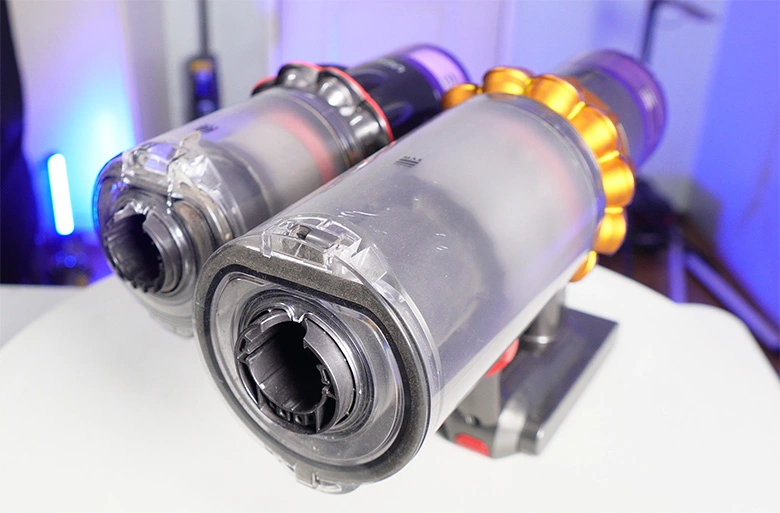
While the V15 Detect’s dustbin appears significantly larger than the V9’s, both use the same horizontally aligned bin design Dyson introduced with the V10.
Each model also features Dyson’s hygienic ejection system, which pushes debris down and out of the bin to minimize contact when emptying.
Differences Between the Dyson V9 and V15 Detect
While the Dyson V9 and Dyson V15 Detect share core design elements, their differences are substantial. Here’s where they diverge.
1. Screen Display
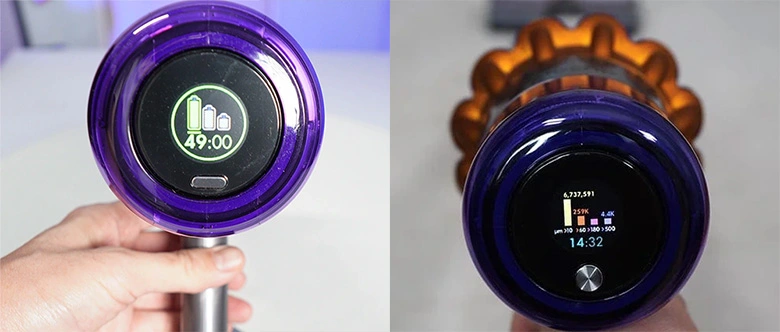
The Dyson V9 uses a basic LCD that displays remaining runtime and the selected power mode.
The V15 Detect, by contrast, features Dyson’s Piezo sensor readout, which tracks debris in real time and displays pickup across four particle-size categories using dynamic bar graphs.
2. Dustbin Size
The V15 Detect has more than double the dustbin capacity of the V9 — 0.77 liters versus 0.35 liters — allowing it to hold significantly more debris and reduce the number of trips to the trash bin during cleaning.
3. Floor Nozzles

The V15 Detect includes two dedicated cleaning heads: the Laser Slim Fluffy for hard floors and a standard motorized nozzle for carpet.

The V9, at least in the configuration I tested from Amazon, ships with a single Motorbar head — Dyson’s all-purpose brush designed to handle multiple floor types.
4. Weight
The Dyson V15 Detect body weighs about 4 pounds 8.1 ounces, making it more than two pounds heavier than the V9, which weighs just 2 pounds 11.5 ounces.
That weight difference is significant and has a noticeable impact on comfort and fatigue during extended cleaning sessions.
5. Attachments
The Dyson V15 Detect includes a wider selection of tools out of the box.

- High torque cleaning head
- Slim roller attachment
- Wall mountable dock
- Extension tube
- Crevice tool
- Hair screw tool
- Wand clip
- Flexible extension hose
- Soft dusting brush
- Combination tool
- Charger
By comparison, the Dyson V9 ships with only three attachments beyond the primary floor nozzle.
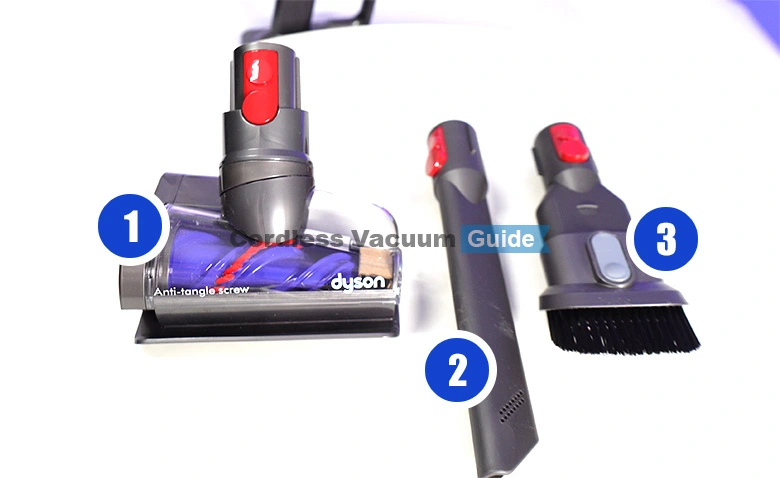
- Hair screw tool
- Crevice tool
- Combination tool
Run Time Comparison
I measured the Dyson V9’s runtime at the nozzle and with a non-powered tool, while the V15 Detect was tested using its standard laser cleaner head across hard floors and carpet. Here’s how they compare.
One of the most critical differences between the Dyson V9 and the Dyson V15 Detect — and a factor that can directly influence which model makes more sense for your home — is runtime.
In testing, the V15 Detect delivered substantially longer runtime than the V9, more than doubling it on hard floors with the Laser Slim Fluffy head, where it exceeded 84 minutes on the lowest setting.
Even on carpet, the V15 maintained a clear advantage, running for over 50 minutes in low power.
That gap narrows at higher power levels. In the middle or Auto setting on hard floors, the V15 still outperformed the V9, lasting just over 41 minutes compared to the V9’s 28 minutes.
However, when used on carpet in Auto or middle power, the V15’s runtime dropped sharply to around 17 minutes, reducing — but not eliminating — its overall lead.
The takeaway is simple: the V15 offers far more flexibility for whole-home and extended cleaning, while the V9’s shorter runtime is better suited to quicker, smaller cleaning sessions.
Airflow Comparison
The Dyson V15 Detect produces substantially more airflow than the V9 across all power settings. In testing, airflow at the extension tube ranged from 34 to 73 CFM on the V15, compared to significantly lower figures on the V9. At the nozzle, the V15 ranged from 29 to 69 CFM.
That translates to a 26–44% airflow advantage at the extension tube and a 26–58% advantage at the nozzle — differences large enough to be felt immediately during cleaning.
This airflow gap is clearly evident in performance. In the following sections, you’ll see how the V15’s higher airflow translates into stronger carpet cleaning, particularly when lifting embedded sand and long hair from carpet fibers.
Cleaning Comparison
The Dyson V15 Detect predictably earned higher overall scores, driven by its stronger carpet performance, particularly when removing embedded debris.
The V9, however, posted higher average scores on hard floors. That result comes with important context.
To achieve those numbers, I had to run the V9 in its middle or max power settings, since the Motorbar head is less efficient at lower power levels.
In contrast, the V15 achieved comparable or better results using the lowest power setting, highlighting the efficiency difference between the two designs, since the slim roller is much better at picking up dirt on hard floors.
Which Option is Better on Hard Floors?
Despite scoring slightly lower on paper, the Dyson V15 Detect is the stronger performer on hard floors. Its Laser Slim Fluffy head is simply more efficient at lifting debris with less power, which matters more in real-world use than marginal percentage differences.
The V15’s small scoring penalty comes from the behavior of its fast-spinning roller, which can push heavier debris — such as sand — forward during initial passes. That tendency affects raw pickup percentages but doesn’t reflect overall cleaning efficiency.
The V9, by comparison, achieved its high scores largely because I ran it in the middle and max power settings.
Its low-clearance Motorbar head can snowplow larger debris piles, and while the small front slots help somewhat, they aren’t large enough to fully prevent debris from being pushed ahead of the nozzle.
Both vacuums performed extremely well in the hard-floor sand test. The V15 Detect averaged 99.8% pickup, while the V9 averaged 99.9%.

Before-and-after photos showing the Dyson V15 Detect’s performance on hard floors during sand pickup testing.
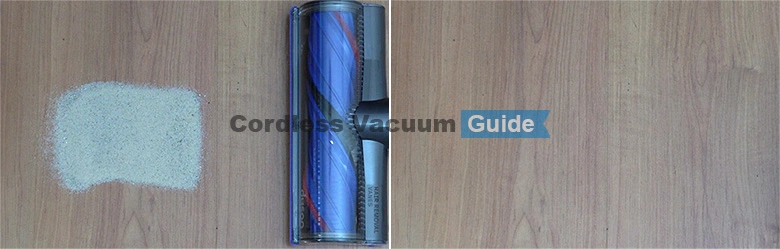
Before-and-after photos showing the Dyson V9 cleaning sand on hard floors.
In practice, however, the V15 still takes this category due to its higher efficiency and the Laser Slim Fluffy head’s green laser, which makes fine, otherwise invisible dust far easier to spot and remove.

Hair Wrap on Hard Floor
Next, we’ll examine how well these cordless vacuums handle hair — specifically their ability to resist tangles when dealing with strands measuring between five and twelve inches.
Dyson V9 Results
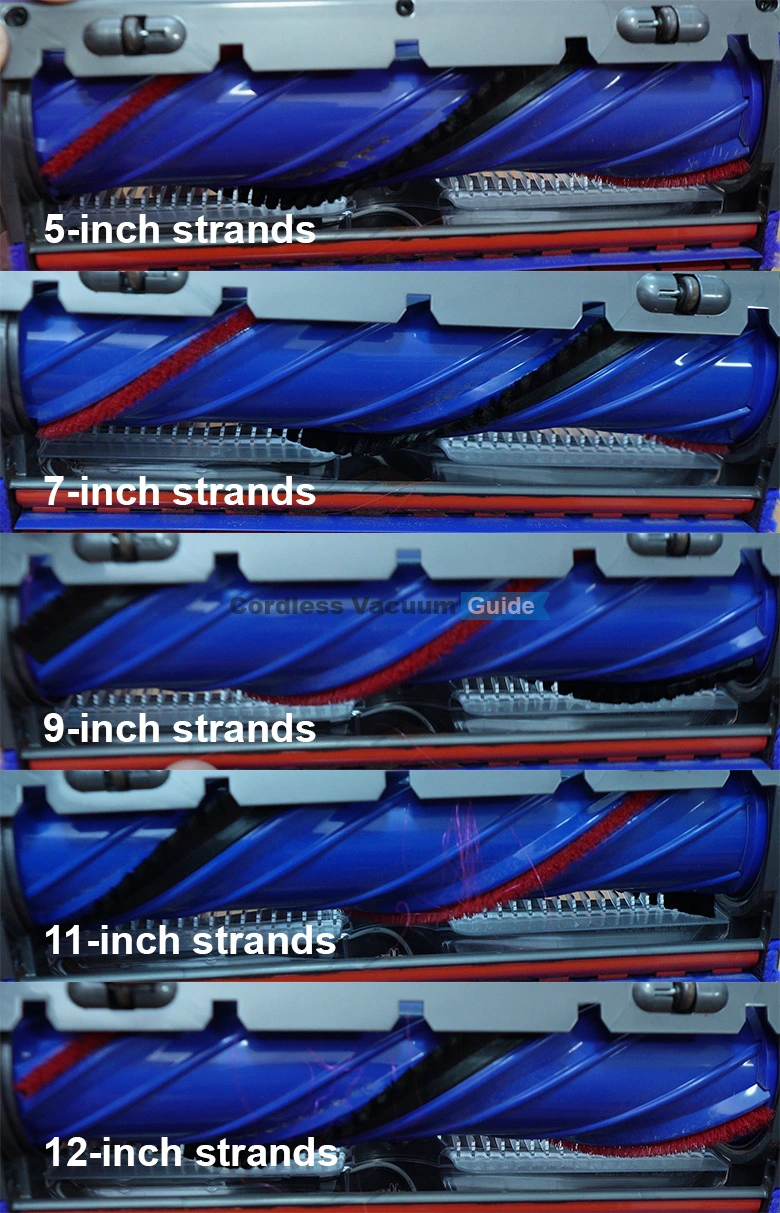
- 5-inch hair: 100%
- 7-inch hair: 100%
- 9-inch hair: 100%
- 11-inch hair: 97%
- 12-inch hair: 98%
Even with its lower airflow output, the Dyson V9 performed exceptionally well in these tests, achieving near-perfect results when averaged across all hair-length trials. While it didn’t reach 100% pickup in the 11- and 12-inch strand tests, it came very close.
Dyson V15 Results

- 5-inch strands: 100%
- 7-inch strands: 100%
- 9-inch strands: 100%
- 11-inch strands: 100%
- 12-inch strands: 80.6%
The Dyson V15 Detect performed strongly, achieving 100% pickup with hair lengths ranging from 5 to 11 inches. In the 12-inch test, however, visible hair wrap began to form on the roller.
One limitation of the Laser Slim Fluffy head is that it lacks an active anti-tangle comb system, relying primarily on suction rather than mechanical detangling to manage longer strands.
Another potential weak point for the V15 Detect is hair wrapping around the axle, where a visible gap allows longer strands to accumulate.

Edge Cleaning Comparison
Both the Dyson V9 and Dyson V15 Detect performed very well in this edge-cleaning test, where coffee grounds were scattered along the perimeter of the room.
Each vacuum required only a few passes to collect all visible debris.
The key difference was efficiency: the V15 Detect, using the Laser Slim Fluffy head, completed the task on its lowest power setting, while the V9 required the middle power setting to achieve comparable edge pickup.

Before-and-after photos showing the Dyson V15 Detect’s edge-cleaning performance.
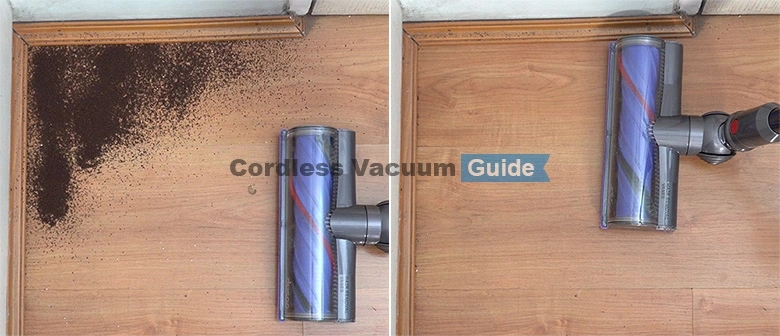
Before-and-after images showing the Dyson V9’s edge-cleaning results.
Which Option is Better on Carpet?
Based on testing, the Dyson V15 Detect outperformed the V9 in every carpet-cleaning test.
It achieved 100% pickup in both surface-level and embedded debris experiments, highlighting the advantage of its higher airflow.
This is where the V15 clearly separates itself, making it the better choice if carpet cleaning is a top priority.
The V15 Detect achieved a perfect 100% score in the deep-cleaning test, while the V9 picked up 90.15% — the lowest result among Dyson’s full-size cordless models tested.
Hair Wrap on Carpet
Next, we’ll examine how well the Dyson V9 and Dyson V15 Detect handle hair on carpet, with a focus on their ability to resist tangling.
Dyson V9 Results
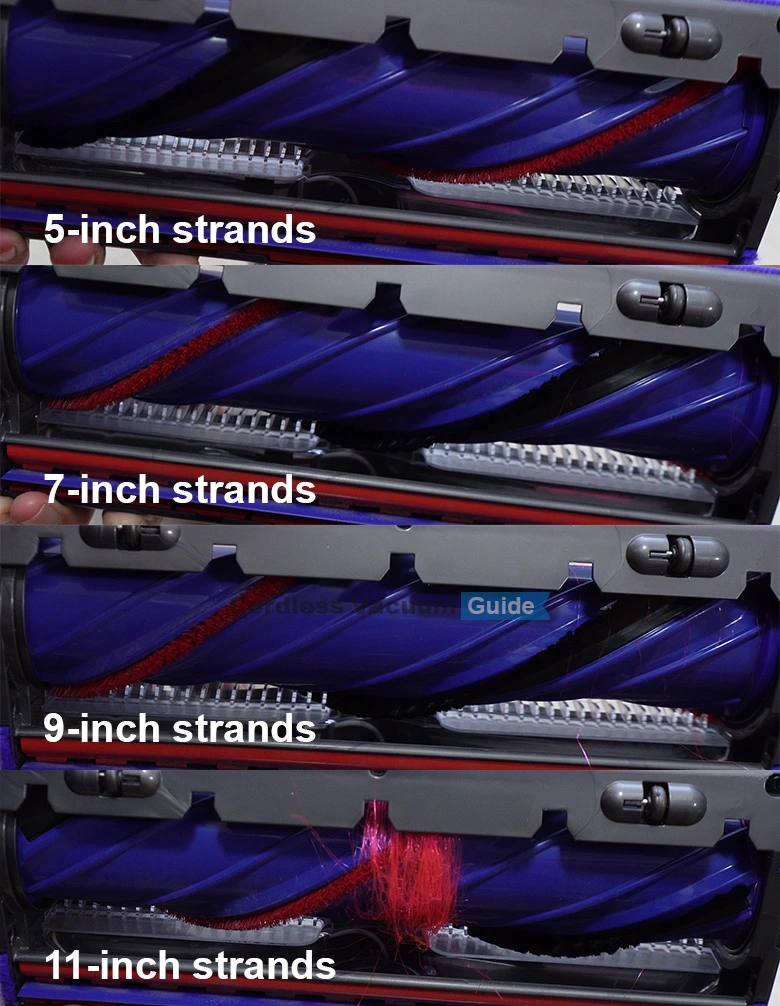
- 5-inch hair: 100%
- 7-inch hair: 100%
- 9-inch hair: 100%
- 11-inch hair: 49%
The Dyson V9 performed well when picking up hair lengths between five and nine inches, but its performance dropped sharply with longer strands.
In the eleven-inch test, pickup fell significantly, with only 49% collected, and a substantial amount of hair wrapped around the brush afterward. Because of this result, I did not proceed with the twelve-inch test.
Dyson V15 Detect Results

- 5-inch strands: 100%
- 7-inch strands: 100%
- 9-inch strands: 100%
- 11-inch strands: 99%
- 12-inch strands: 98%
The Dyson V15 Detect handled long hair on carpet far more effectively, collecting 99% and 98% in the 11- and 12-inch tests, with noticeably less hair wrapping around the brush.
That performance builds on its perfect pickup in the shorter 5- to 9-inch tests.
Noise Comparison
Despite its lower power output, the Dyson V9 is the noisier option across all power settings. The additional noise comes from vibration generated by the Motorbar head, especially on hard floors.
While the difference measures only a few decibels, it’s enough to be clearly audible during use.
Product Specifications
Where Can I Purchase These Cordless Vacuums?
The Dyson V9 and V15 Detect are available in online stores like Amazon and Walmart. Check the links below for the latest pricing information.
Disclaimer: I will earn a commission if you click on any of the links above, but at no extra cost, so it’s a win-win for us!
Which Option Offers Better Value?
While the Dyson V15 Detect costs more, it delivers substantially longer runtime, greater efficiency on hard floors, and stronger overall carpet performance.
In testing, it outperformed the Dyson V9 in nearly every category, with the V9’s main advantages limited to lower weight and a more affordable price point. The V9’s biggest limitation is the absence of a soft roller head, which reduces its efficiency on hard floors compared to the V15.
If Dyson included a soft roller attachment with the V9, it would be easier to recommend for smaller homes. As it stands, that omission significantly limits its versatility and ultimately tips the balance in favor of the V15 Detect.
4 Reasons to Choose the Dyson V9
- Lightest Dyson Full-Sized Option: The V9 is the lightest full-sized cordless vacuum in Dyson’s lineup.
- Above-average Cleaning Performance: Even with the lower airflow, the Dyson V9 delivered above-average pickup across nearly all cleaning tests.
- Better Ergonomics: Its lighter frame makes it more comfortable and easier to use in handheld mode.
- Excellent at Cleaning Long Hair: The combs built into the Motorbar head, along with the Hair Screw tool, allow the Dyson V9 to deliver above-average performance when cleaning long hair on both floors and upholstery.
4 Reasons to Choose the Dyson V15 Detect
- Runs Much Longer: The Dyson V15 Detect more than doubles the V9’s runtime on the lowest power setting and continues to run longer at higher power levels, making it the better choice for larger homes and extended cleaning sessions.
- Superior Vacuuming Performance: The V15 Detect’s higher airflow translates into stronger performance across nearly all cleaning tests, including both surface-level and embedded debris.
- Better at Tracking Dust: The Laser Slim Fluffy head’s bright green laser reveals fine, nearly invisible dust, making it easier to track debris and clean more efficiently.
- Larger Dustbin: The Dyson V15 Detect offers more than double the dustbin capacity of the V9.
The Verdict: The Dyson V9 Is Cheaper, But V15 Detect Is a Better All-Around Option
Yes, the Dyson V9 Motorbar is the more affordable option, but the V15 Detect delivers superior all-around cleaning performance and a far more advanced feature set.
In practice, the V9 feels like a compact, simplified version of the V11. Its biggest limitation is the absence of a soft roller head, which significantly reduces efficiency on hard floors. As noted earlier in the review, if Dyson included this attachment, the V9 would be much easier to recommend as a lightweight alternative — even over the V15 for smaller homes.
While the Motorbar head can be used on hard floors, it’s less efficient, and the lack of padding increases the risk of scratching delicate surfaces.
If price is a strict deal-breaker, the V9 can still make sense as a lightweight cordless option. Just be aware that its lower efficiency and limited tooling come with real trade-offs.
