Latest Updates
This comparison is regularly updated with new testing data and performance insights.
🔄
:
Added a “Quick Verdict” section to help you decide which model is the better fit.
🔄
:
Added a “Quick Comparison” section to highlight the key differences based on real-world testing. Also updated the table layout for airflow, runtime, cleaning performance, and noise to make comparisons easier.
Quick Comparison: Dyson V10 vs Gen5 Detect
Key differences based on real-world performance testing.
Swipe on mobile or scroll horizontally to see all picks.
⚡ Quick Verdict
👉 Choose the Dyson V10 if: you want a reliable, more affordable cordless vacuum that still delivers solid everyday cleaning performance.
👉 Choose the Dyson Gen5 Detect if: you want a major upgrade in power, runtime, and features—especially for carpets, pet hair, and larger homes.
Bottom line:
The Gen5 Detect is a major step up in performance, but the V10 remains a solid budget-friendly option for everyday cleaning.
If you’re torn between the Dyson V10 and the newer Dyson Gen5, you’re not alone. I’ve spent hours testing both vacuums—running airflow checks, suction measurements, runtime tests, and real-world cleaning trials—to see which one actually performs better, not just on paper but on your floors.
This comparison breaks down the results clearly: power, filtration, runtime, noise, ergonomics, and value. No marketing claims. No assumptions. Just data from hands-on testing so you can make the right choice for your home.
Similarities of the Dyson V10 and Gen5 Detect
Before diving into their differences, it’s worth noting the key features the Dyson V10 and V15 share—starting with their horizontally aligned dustbin.
1. Dustbin Alignment
The first similarity is the horizontally aligned dustbin. Dyson introduced this design with the V10 to boost airflow efficiency and increase usable capacity—and the Gen5 Detect uses the exact same layout. Despite looking larger, both models actually hold the same 0.77 liters of debris.
2. Hygienic System

Another similarity is the hygienic emptying system. Both models use the red lever at the bottom to push debris straight out of the bin—eliminating the finger-scraping hassle you’d deal with on older models like the Dyson V6.
3. Interchangeable Tools

This next point isn’t just about the similarities between V10 and Gen5 Detect—it applies across Dyson’s lineup: both models use interchangeable tools that connect directly to the motor unit or the extension wand, giving you flexibility for any cleaning task.
4. Floor Specific Nozzles

Dyson V10 Absolute floor nozzles
When the Dyson V10 launched, it came with two floor-focused nozzles—a bulky soft roller and a standard brush roll with adjustable gates to handle larger debris without snowplowing.

Dyson Gen5 Detect nozzles
The Gen5 Detect mirrors this versatility, offering a slimmer laser-equipped roller for low-clearance spaces and an upgraded standard head with combs that untangle hair more effectively than the V10’s design.
Differences Between The Dyson V10 and Gen5 Detect
While the V10 and Gen5 share several core design traits, the real story is in their differences, which we’ll look at below.
1. Interface Design

One of the most obvious differences is the interface. The Dyson V10 has no display—just the filter behind the motor, making it the simplest model in Dyson’s horizontal-dustbin lineup.
The Gen5 Detect, on the other hand, features an updated Piezo readout similar to the V15 Detect, along with a two-button setup: a red power button and a silver mode selector for switching suction levels.
2. Power Switch

The Dyson V10 relies on a trigger for power-on demand, while the Gen5 Detect uses a red push-button that keeps the vacuum running until you turn it off.
The button design reduces hand and wrist fatigue since you’re not constantly squeezing a trigger, though some users still prefer the V10’s trigger style because it helps them stretch battery life by running the motor only when needed.
3. Battery

Another key difference is the battery design. The Dyson V10 uses a built-in, non-removable pack, while the Gen5 Detect features a clip-on battery that pops off with a single red button—making replacements easier and letting users extend runtime with an extra pack.
You can still replace the V10’s battery, but it requires removing three screws.
4. Soft Roller Nozzle
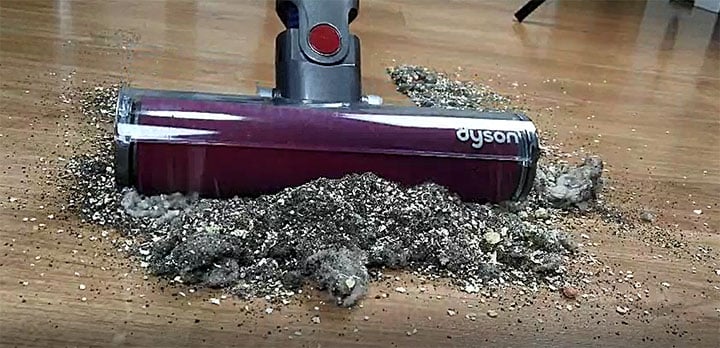
The Dyson V10—at least the original Absolute trim—included a bulky soft roller, though newer versions ship only with the standard brush roll. The Gen5 Detect upgrades this entirely with Dyson’s latest laser head, projecting a bright green beam that reveals dust far better than any LED nozzle I’ve tested.
5. Tools
Tool selection also differs between the two, as each Dyson V10 and Gen5 Detect sub-model comes with its own specific accessory set.
Here’s what you’ll get with the V10 Absolute.
- Soft roller
- Torque Drive
- Mini turbo brush
- Crevice tool
- Combination tool
- Soft dusting brush
- Extension wand
- Charging dock
Here’s what you’ll get with the Gen5 Detect.

- Fluffy Optic cleaner head
- Digital Motorbar cleaner head
- Combination tool
- Torque screw tool
- Extension tube
- Two-in-one crevice/brush tool (stored in extension tube)
- Charger
- Dyson Gen5 Detect unit
Another noticeable difference is the tool design: the Gen5 Detect integrates a crevice tool directly into the extension tube, giving you quick access without swapping attachments.

Ergonomic Comparison
Next is ergonomics—how each vacuum feels in actual use. A big part of this is a handheld weight with no attachments. The Dyson V10 has the edge here at just 3 pounds 10.5 ounces, while the Gen5 Detect comes in noticeably heavier at 4 pounds 15.7 ounces.
Interface Comparison
The Dyson V10 has the simplest interface of Dyson’s newer cordless models—no screen behind the motor, just a basic slide switch to toggle between its three power modes.

The Gen5 Detect, Dyson’s newest flagship, adds a full interactive display that shows Piezo sensor debris counts by particle size, along with remaining runtime and any active error alerts.
Run Time Comparison
The Dyson Gen5 Detect takes the clear win in runtime, delivering over 80 minutes in Eco, nearly 47 minutes in Auto, and more than 14 minutes in Max with the laser head. Impressive numbers—though I expected slightly more, given that the V15 Detect topped 84 minutes in Eco.
The Dyson V10 trails here, running about 62 minutes on its lowest setting, dropping to 46 minutes with the floor nozzle attached. And with the non-detachable battery, there’s no way to extend the runtime.
Airflow and Suction Comparison
The Dyson Gen5 Detect also wins the power category, producing over 24% more airflow at both the wand and nozzle on Max.
This doesn’t change much on hard floors—where the soft roller is already highly efficient—but it makes a noticeable difference on carpets, especially when pulling out embedded dirt.
Another test I conducted related to power is the suction test using a water lift and a Y-gauge.
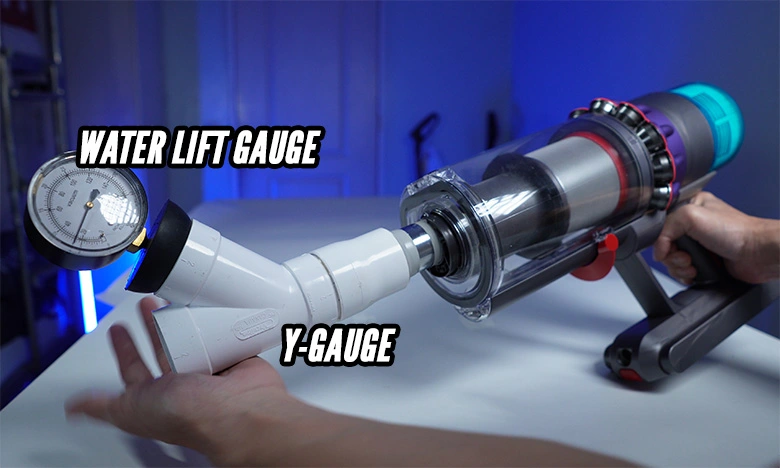
This test measures a vacuum’s suction strength in both sealed and unsealed conditions. A sealed test shows the maximum suction when the nozzle’s gates are fully closed, while the unsealed test simulates real-world airflow with the gates open.
Together, these numbers reveal how well a vacuum can pull debris from cracks, carpets, and tight spaces—not just how powerful it looks on paper.
Here are the results for the Dyson V10.
- Unsealed: 18″ water lift
- Sealed: 55″ water lift
Results for the Dyson Gen5 Detect
- Unsealed: 28″ water lift
- Sealed: 75″ water lift
Cleaning Performance
Despite the airflow gap, surface cleaning results are nearly identical—less than a 2% difference—so the V10 still performs well on bare floors. The Gen5 Detect’s real advantage shows up on carpet, where it delivers noticeably better deep-cleaning performance and nearly double the V10’s runtime.
Which is better on Hard Floors?
Overall, the Gen5 Detect comes out ahead, posting higher pickup percentages in the Quaker oats, coffee grounds, pet litter, and quinoa tests. The V10 does score a win in one area—sand on hard floors—where it achieved a perfect 100%.

Dyson V10 sand-on-hard-floor experiment. Picked up 100%.

Gen5 Detect before-and-after shots: cleaning sand on a hard floor.
Still, the gap isn’t large enough to crown the Gen5 an easy winner based on pickup alone—but its laser nozzle gives it a real edge in day-to-day use by making dust easier to spot and clean, which ultimately makes it the more efficient option.
Hair Wrap on Hard Floor Experiment
With its higher airflow, the Gen5 Detect handled hair pickup much better—capturing a higher percentage with minimal tangles, even with longer strands. The V10 struggled in this area, managing only 56% pickup on 11-inch hair.
Dyson Gen5 Detect

- 5-inch hair: 100%
- 7-inch hair: 100%
- 9-inch hair: 100%
- 11-inch hair: 97%
- 12-inch hair: 86%
Dyson V10 Absolute
- 5-inch strands: 100% inside the dustbin, 0% on the brush
- 7-inch strands: 100% inside the dustbin, 0% on the brush
- 9-inch strands: 91% inside the dustbin, 9% on the brush
- 11-inch strands: 56% inside the dustbin, 44% on the brush
Edge Cleaning Comparison
This test measures how well a vacuum cleans along edges and corners. I scatter coffee grounds into a tight corner of the room, then vacuum the area to see how effectively each model pulls debris from those hard-to-reach spots.

Dyson V10 edge cleaning experiment.

Dyson Gen5 Detect edge cleaning experiment.
Based on the results, both the Dyson V10 and Gen5 Detect handled edge cleaning well, needing only a few passes to clear all the debris in the corner.
Which Option is Better on Carpet?
Thanks to its stronger airflow and suction, the Dyson Gen5 Detect scored higher on carpet—picking up 99.9% of surface debris and 100% of embedded dirt, compared to the V10’s 98.4% and 97.03%.
It also runs longer on carpet, delivering over 20 minutes in Auto and more than 11 minutes in Max, giving it a clear advantage in range and usability.
Hair Wrap Results on Carpet
As with the hard-floor tests, I also checked how the Dyson V10 and Gen5 Detect handled hair on medium-pile carpet, using strands between 5 and 12 inches long.
Dyson Gen5 Detect results

- 5-inch hair: 100%
- 7-inch hair: 100%
- 9-inch hair: 100%
- 11-inch hair: 100%
- 12-inch hair: 100%
Dyson V10 Results

- 5-inch strands: 100%
- 7-inch strands: 95%
- 9-inch strands: 91%
- 11-inch strands: 46%
The results weren’t surprising—the Gen5 Detect’s higher airflow and built-in combs gave it a clear advantage, allowing it to pick up hair with minimal tangling.
The V10 performed reasonably well but began to struggle with longer strands around 9 inches. Overall, the Gen5 Detect is the stronger choice for hair pickup, including upholstery, when paired with its hair screw tool.
One ongoing issue with all Dyson cordless vacuums, however, is that hair tends to cling to the inner walls of the dustbin.

Noise Comparison
Like other high-airflow Dyson models, the Gen5 Detect is noticeably louder, breaking the 80-decibel mark in Auto and Max. The V10 runs quieter by comparison, staying in the low to mid-70s in its middle and highest settings.
Product Specifications
Where Can I Purchase These Cordless Vacuums?
Both the Dyson V10 and Gen5 Detect are widely available online, including on Amazon. You can check the links below for the latest pricing updates.
Disclaimer: I will earn a commission if you click on any of the links above, but at no extra cost, so it’s a win-win for us!
Which Option Offers Better Value?
Although the Dyson V10 is the older model, its price hasn’t dropped dramatically. You can find renewed versions at Walmart that include both the soft roller and standard brush roll, or buy a brand-new unit on Amazon—though those typically come without the soft roller if you only need it for carpet.
The Gen5 Detect costs more, but you get significantly better features and performance for the price. For the best deals, it’s worth waiting for major sale events like Black Friday or Prime Day.
5 Reasons To Choose The Dyson Gen5 Detect
- Newer Tech: The Dyson Gen5 Detect brings Dyson’s latest technology, including a Piezo sensor display that shows how much debris you’re picking up and a laser roller that highlights dust so you can see exactly what needs cleaning.
- Longer Run Time: The Gen5 Detect delivers over 80 minutes on a single battery—nearly double the V10’s runtime when using the floor nozzle.
- Better Hair Pickup: The Gen5 Detect handles long strands with fewer tangles thanks to its stronger airflow and built-in combs.
- Better Carpet Pickup: Its higher airflow pulls more debris from carpet, especially embedded dirt.
- Detachable Battery: You can easily extend runtime by swapping in an extra battery.
3 Reasons to Choose the Dyson V10
- Cheaper Option: The Dyson V10 is the more affordable choice, largely because it’s one of Dyson’s older models still in circulation.
- Lighter: It’s roughly a pound lighter than the Gen5 Detect, giving it noticeably better ergonomics.
- Above-Average Cleaning Performance: Despite its lower airflow, the Dyson V10 delivered strong results across multiple tests and came close to the Gen5 Detect in surface debris pickup.
The Verdict: Gen5 Offers Better Value
Despite its higher price, the Dyson Gen5 Detect delivers better overall value thanks to its newer technology, longer runtime, stronger hair pickup, and laser roller that makes cleaning dusty areas far more efficient.
The Dyson V10 is still a capable vacuum, but the Absolute version is increasingly hard to find outside of refurbished options at Walmart—and those come with the smaller dustbin.
If you prefer to buy new, you can pick up the V10 on Amazon and pair it with an inexpensive third-party soft roller head as an alternative.
