Latest Updates
This comparison is regularly updated with new testing data and performance insights.
🔄
:
Added a “Quick Verdict” section to help you decide which model is the better fit.
🔄
:
Added a “Quick Comparison” section to highlight the key differences based on real-world testing. Also updated the table layout for airflow, runtime, cleaning performance, and noise to make comparisons easier.
Quick Comparison: Dyson V8 vs V9
Key differences based on real-world testing
Swipe on mobile or scroll horizontally to see all picks.
⚡ Quick Verdict
👉 Choose the Dyson V8 if: you want a lightweight, all-around vacuum that cleans efficiently on both hard floors and carpets without sacrificing comfort—while also getting a larger dustbin capacity than the V9.
👉 Choose the Dyson V9 Motorhead if: you want a lightweight, ergonomic cordless vacuum that cleans efficiently—including hair—while offering a detachable battery for extended runtime.
Bottom line:
The Dyson V8 delivers better all-around performance thanks to its soft roller and standard brushroll, giving it an advantage on both hard floors and carpets. The Dyson V9, on the other hand, is lighter and more ergonomic in handheld mode, with improved hair pickup due to its anti-tangle comb design—but it’s less effective on hard floors since the Amazon version doesn’t include a soft roller.
Similarities Between the Dyson V8 and V9
Before diving into performance differences, it’s important to understand what the Dyson V8 and V9 have in common.
1. Lightweight Design
The V8 and V9 are two of the lightest cordless vacuums in Dyson’s lineup. However, the V8’s lighter weight wasn’t necessarily intentional — it was simply a result of Dyson’s design philosophy at the time.
Earlier Dyson cordless models, including the V8, used a vertically aligned dustbin positioned beneath the motor. This compact, in-line layout naturally created a slimmer frame and, as a result, a lighter vacuum.
That changed when Dyson introduced the V10. With the V10, James Dyson shifted to a horizontally aligned dustbin design to increase bin capacity and improve airflow efficiency. While this redesign allowed for larger dirt volume and performance gains, it also added bulk and weight to the overall unit.
The V9 was later introduced to address that gap, offering a lighter alternative for users who prioritize maneuverability and ease of handling without stepping down to a compact handheld model.
2. Trigger
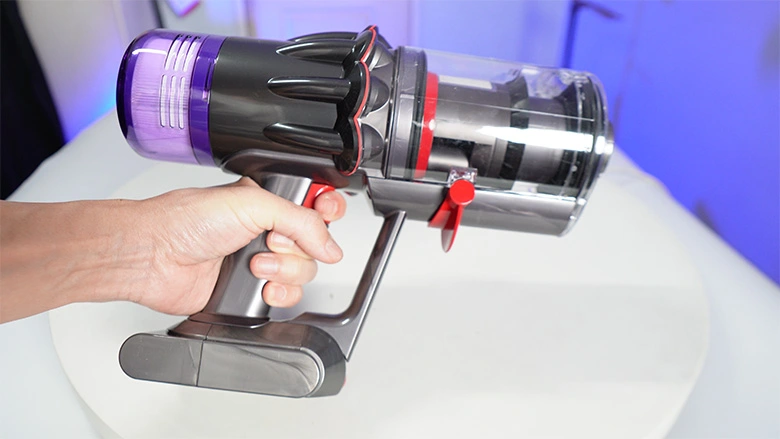
Both models use Dyson’s trigger-style power switch, which means the motor only runs while you’re actively pressing it — delivering power on demand.
Whether a trigger system is better than a traditional on/off button ultimately comes down to personal preference. Some users appreciate the improved battery efficiency and control, while others may prefer the convenience of a continuous power button.
3. Hygienic System

Both the Dyson V8 and V9 feature a hygienic bin-emptying system designed to eject dirt directly from the dustbin — minimizing the need to reach in and pull debris out by hand.
With a simple lever action, the mechanism pushes collected dust and debris downward and out of the bin, helping reduce contact with dirt during disposal.
Differences Between the Dyson V8 and V9
While the Dyson V8 and V9 share a similar overall design and target audience, the real separation shows up once you look beyond the surface.
1. Dustbin Alignment
The most noticeable difference between the two is the orientation of the dustbin. The V8 uses Dyson’s earlier vertically aligned configuration, where the dustbin sits directly beneath the motor in a straight in-line design.
The V9, in contrast, uses the newer horizontal configuration, engineered to increase bin capacity and improve airflow efficiency. This redesign allows for better space utilization inside the housing, resulting in a larger dirt volume without significantly increasing overall size.
2. Dirt Capacity
Despite its newer horizontally aligned design, the V9 has a smaller dustbin capacity — just 0.35 liters. That’s roughly 42% less than the V8’s 0.54-liter bin.
So while the horizontal configuration was originally intended to maximize internal space, in this case, the V8 still holds significantly more debris before needing to be emptied.
3. Floor Nozzles
 The Dyson V8 includes two floor-specific cleaning heads — a soft roller for hard floors and a motorized brush roll for carpet.
This dual-nozzle setup gives it an efficiency advantage, particularly on hard floors, where a dedicated soft roller is better at capturing fine dust and larger debris without scattering them.
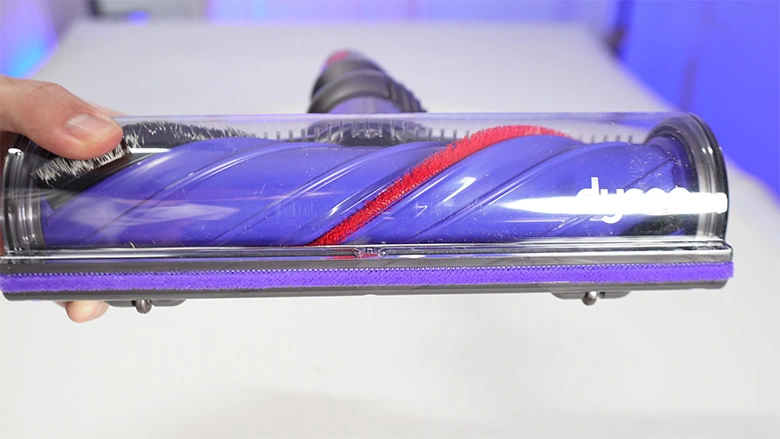
The V9, when purchased from Amazon in the Motorbar configuration, comes with a single standard brush roll.
While it performs well overall — including on hard floors — it’s primarily engineered to agitate and lift debris from carpet. As a result, it doesn’t offer the same level of surface-specific optimization as the V8’s two-tool configuration.
4. Weight
The Dyson V8 is noticeably heavier than the V9. In my measurements, the V8 weighs 3 pounds and 7.1 ounces, while the V9 comes in at just a little over 2 pounds — making it roughly a pound lighter overall.
That weight difference may not sound dramatic on paper, but in a cordless stick vacuum, it can affect maneuverability and fatigue during longer cleaning sessions.
Run Time Comparison
I tested the runtime of both the Dyson V8 and V9 at the nozzle and with a non-powered tool.
The Dyson V9 takes the advantage in overall runtime. At the lowest power setting, it ran approximately 7 minutes longer than the V8 without the nozzle, and nearly 3 minutes longer with the nozzle installed.
Its biggest edge, however, is the inclusion of a true middle power mode — something the V8 lacks. This mid setting offers a better balance between suction performance and battery efficiency, making it more practical for everyday cleaning without immediately jumping to max power.
In the highest power setting, though, the V8 actually lasted longer — both with and without the nozzle attached — giving it a slight edge for short bursts.
Airflow Comparison
One of the biggest surprises in this comparison was the airflow results. Despite being the older model, the V8 produced higher airflow readings than the V9 across all test conditions.
And that difference wasn’t just theoretical — it showed up in the real-world cleaning tests. In the deep carpet pickup trials (see results below), the V8 consistently removed more embedded debris, underscoring how airflow directly affects cleaning performance.
Cleaning Performance
The V9 Motorbar achieved a higher overall cleaning score, largely due to its stronger performance in deep-carpet cleaning tests.
While both vacuums performed well at surface-level pickup, the V9 showed a measurable advantage in extracting embedded debris, ultimately boosting its overall cleaning percentage.
Which Option is Better on Hard Floors?
On paper, the V9 posted higher pickup percentages on hard floors. However, achieving those scores required stepping up to the middle and even max power settings.
The limitation lies with the cleaning head. The V9’s standard Motorbar nozzle isn’t optimized specifically for hard floors, whereas the V8’s dedicated soft roller is engineered to capture surface debris more efficiently without relying on higher suction levels.

Before and after photos of the Dyson V8 cleaning sand.
This pattern showed up again in the sand-on-hard-floor test. While the V9 recorded a slightly higher pickup rate (99.9% vs. 99.5%), reaching that result required short bursts in max mode.
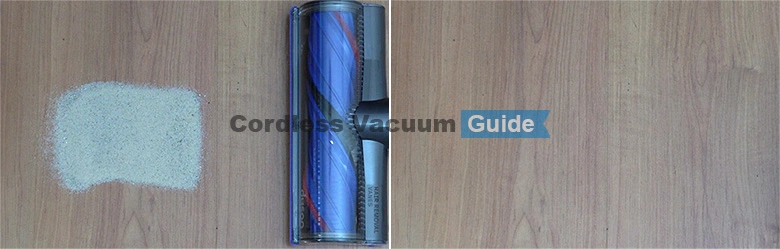
Before and after photos of the Dyson V9 cleaning sand.
The V8, equipped with its soft roller, achieved near-identical results more efficiently without requiring higher power settings.
Edge Cleaning Comparison

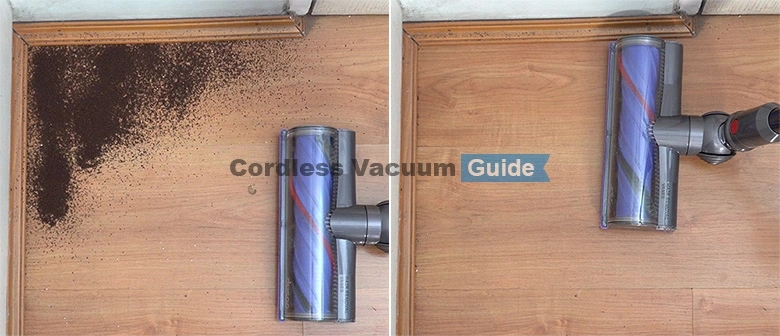
Before and after photos of the Dyson V8 cleaning pet litter on the edges.
The Dyson V8 and V9 did well at vacuuming the edges, picking up nearly every crumb of debris in just a few passes, but the V8 soft roller nozzle was much more efficient at doing so, since there was almost zero trails after the forward pass.
While the V9 picked up well, I noticed trails of coffee grounds behind the brush after the forward pass.
Hair Wrap on Hard Floors
For the hair wrap test, I evaluated both vacuums using strands of varying lengths — 5, 7, 9, 11, and 12 inches — to assess how effectively each model picked up long hair and how well it resisted tangling around the brush roll.
Dyson V8 Results

- 5-inch strands: 100%
- 7-inch strands: 100%
- 9-inch strands: 100%
- 11-inch strands: 89%
- 12-inch strands: 63%
The Dyson V8 achieved 100% pickup with 5-, 7-, and 9-inch hair strands. However, performance declined with longer lengths. In the 11-inch test, pickup dropped to 89%, and with 12-inch hair, it fell further to 64%.
A key reason for this drop-off is the absence of an active anti-tangle mechanism. As hair length increases, strands are more likely to wrap around the brush roll rather than being fully lifted into the bin.
During testing, visible hair wrap accumulated around the roller, reducing overall pickup efficiency.
Dyson V9 Results
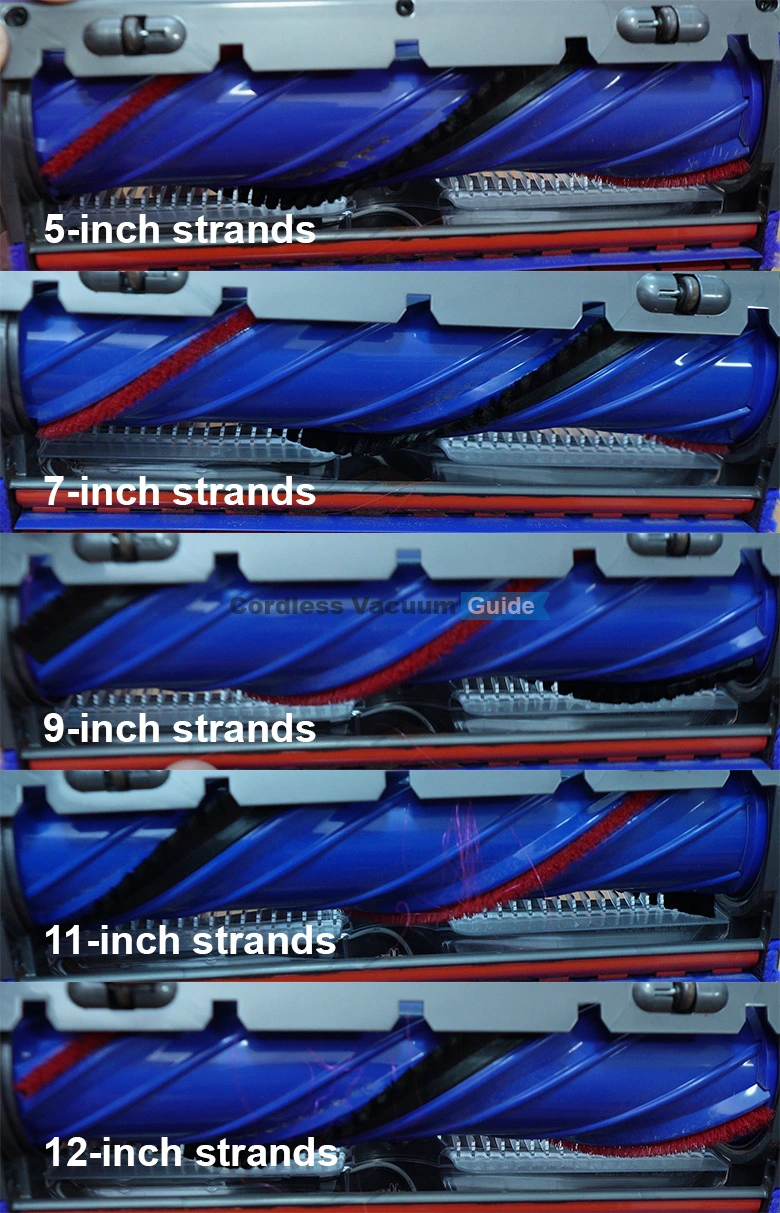
- 5-inch hair: 100%
- 7-inch hair: 100%
- 9-inch hair: 100%
- 11-inch hair: 97%
- 12-inch hair: 98%
Despite producing lower airflow overall, the Dyson V9 performed better with longer hair. It picked up 97% of 11-inch strands and 98% of 12-inch strands during testing.
The primary reason is its built-in anti-tangle design.
The comb-like structures positioned behind the brush roll help strip hair from the bristles as the brush rolls, preventing excessive wrapping and allowing longer strands to be pulled more consistently into the dustbin.
Which Option is Better On Carpet?
The Dyson V9 performed slightly better in overall carpet pickup, collecting just over 2% more debris in surface-level tests.
However, the V8 pulled ahead in the deep cleaning trials, removing nearly 7% more embedded debris. This advantage is largely attributable to its higher airflow, which helps extract particles lodged deeper within the carpet fibers.
Hair Wrap on Carpet
Dyson V8 Results

- 5-inch strands: 100%
- 7-inch strands: 100%
- 9-inch strands: 100%
- 11-inch strands: 83%
- 12-inch strands: 16%
Despite lacking built-in anti-tangle combs on its brush roll, the Dyson V8 actually removed more hair overall in certain tests. This was especially noticeable with 11-inch strands, where it achieved an 83% pickup rate.
A major factor behind this performance is its higher airflow. The stronger air movement helped pull longer strands into the suction path more effectively, even though visible hair wrap accumulated around the roller.
Dyson V9 Results
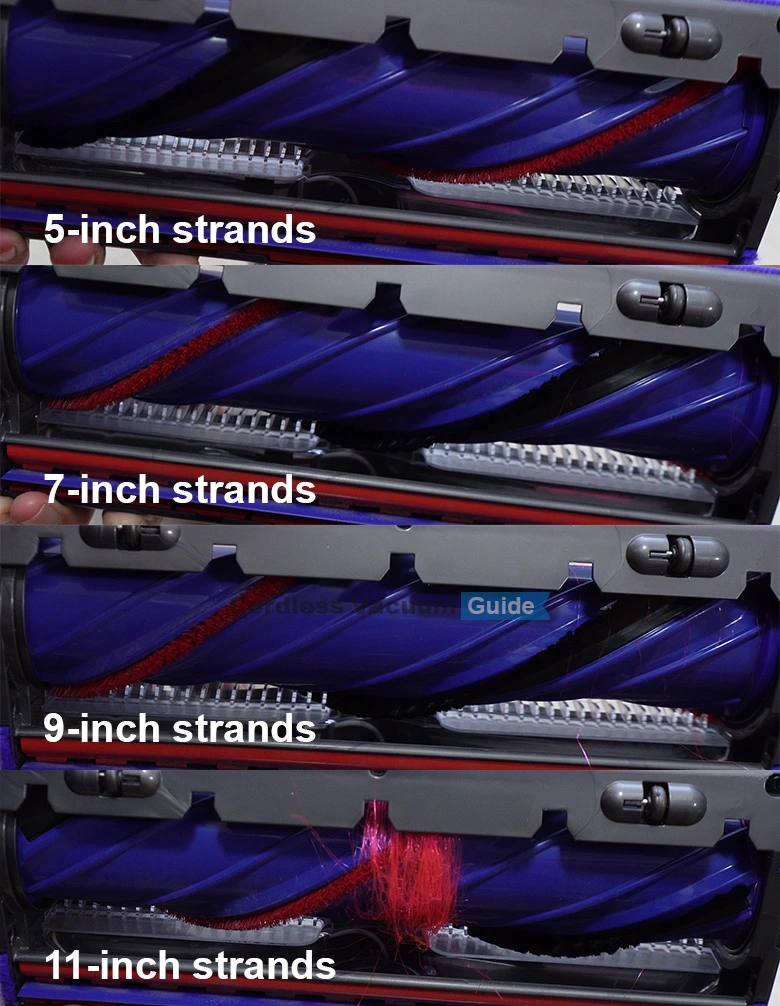
- 5-inch hair: 100%
- 7-inch hair: 100%
- 9-inch hair: 100%
- 11-inch hair: 49%
The Dyson V9 performed exceptionally well with shorter hair lengths between 5 and 9 inches. However, performance dropped significantly with longer strands. In the 11-inch hair test, pickup fell to just 49%, indicating that longer fibers were more likely to wrap or resist full extraction.
Noise Comparison
The Dyson V8 is the quieter of the two models, operating at 62-73 decibels in my tests. The V9, by comparison, registered between 72 and 80.7 decibels — nearly 10 decibels louder at peak output.
While both are within a typical range for cordless vacuums, the difference is noticeable, especially in higher power modes where the V9 produces a sharper, more pronounced sound profile.
Product Specifications
Where Can I Purchase These Cordless Vacuums?
The Dyson V9 Motorbar and Gen5 Detect are available in online stores like Amazon. Check the links below for the latest pricing information.
Disclaimer: I will earn a commission if you click on any of the links above, but at no extra cost, so it’s a win-win for us!
Which Option Offers Better Value?
Despite being the older model, the current Dyson V8 models are priced higher than the V9. Given the relatively small performance gap between the two, that pricing makes the V8 harder to recommend strictly from a value perspective.
The main limitation holding back the V9 is the lack of a dedicated soft-roller attachment. Without a floor-specific tool for hard surfaces, it has to rely on the standard Motorbar head, which isn’t as effective at removing fine dust and large debris on smooth flooring.
If the V9 included a soft roller, it would be the clear no-brainer in this comparison.
As it stands, I would still lean toward the V9 for most buyers — primarily because of its lighter weight, longer runtime, and overall value — but it’s important to be aware of its limitations, especially if your home has a lot of hard flooring.
3 Reasons to Choose the Dyson V9
- Cheaper Option: The Dyson V9 is cheaper than the V8 on Amazon.
- Comparable Cleaning Performance: Despite producing lower airflow, the V9 outperformed the V8 in surface-level pickup tests.
- Detachable Battery: This feature makes it easier to replace the battery or extend run time.
4 Reasons to Choose the Dyson V8
- Larger Dustbin: It holds approximately 42% more debris than the V9 before needing to be emptied.
- More Efficient: The soft roller nozzle is more efficient on hard surfaces.
- Quieter: Not as noisy as the V9 in all the power settings.
- Better Deep Cleaning: Picked up close to 7% more in the deep cleaning test.
