Battery life is one of the most important—and most misunderstood—factors when choosing a cordless vacuum.
Manufacturers often advertise maximum runtime under ideal conditions, which rarely reflects how these vacuums are actually used.
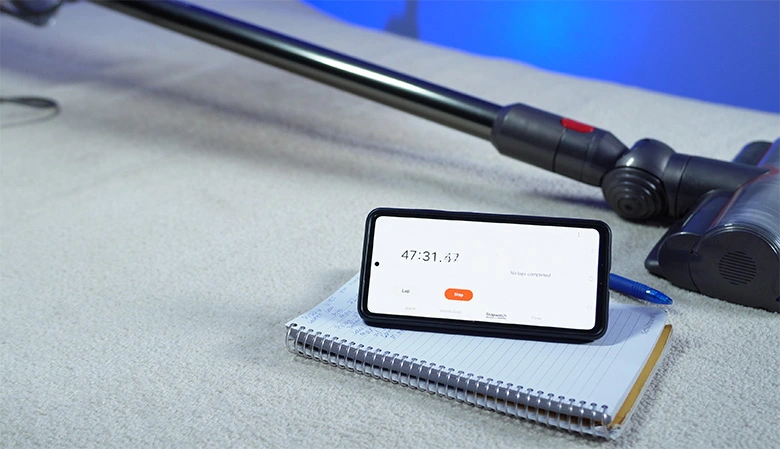
That’s why every model featured on this site undergoes real-world runtime testing designed to show how long it will actually last during normal cleaning.
🧠 What This Test Measures
Runtime testing evaluates:
- How long does a vacuum run on a full charge
- Performance across different power settings
- Real-world usability on actual surfaces
👉 The goal is simple:
Give you a realistic expectation of how long a vacuum will last in your home—not just on paper.
🔬 Testing Methodology
Each vacuum is tested using a standardized process to ensure consistent and comparable results.
Step-by-step:
- The battery is fully charged
- The main cleaning head is attached (not a non-powered tool)
- The vacuum is run continuously until it shuts off
- Time is recorded for each power setting (Eco, Medium, Boost, if available)
🧪 Real-World Testing Conditions
Unlike many published specs, testing is done using actual floor conditions, not ideal scenarios.
- Hard floor testing reflects everyday cleaning
- Carpet testing adds resistance and better represents real usage
- Motorized heads are always used when applicable
👉 This ensures results are practical—not artificially inflated.
⚠️ Why Manufacturer Claims Can Be Misleading
Most brands advertise runtime based on:
- Lowest power setting
- Non-motorized attachments
- Minimal resistance
👉 In real-world use, actual runtime is often significantly lower.
That’s why this test focuses on usable runtime rather than maximum theoretical numbers.
📊 What Affects Runtime
Several factors influence how long a cordless vacuum will run:
🔋 Power Setting
Higher power modes (Boost/Max) drain the battery significantly faster.
🧹 Surface Type
Carpet requires more power than hard floors, reducing runtime.
⚙️ Motorized Attachments
Brushrolls and motorized heads increase power consumption.
🔄 Battery Design
Some models include:
- Removable batteries
- Dual battery systems
- Smart power management
These can extend usable runtime.
🔍 How to Interpret Runtime Results
When comparing vacuums, focus on:
- Mid-power (Auto/Medium) runtime → most realistic for everyday use
- Consistency across surfaces
- Battery flexibility (replaceable or not)
👉 A vacuum with slightly lower max runtime but better mid-power consistency is often the better choice.
🧠 Key Takeaways
- Advertised runtime ≠ real-world runtime
- Mid-power performance matters more than Eco mode
- Carpet cleaning reduces battery life significantly
- Battery design plays a major role in usability
🔗 Related Testing Methods
To understand how runtime fits into overall performance:
- How We Test Cordless Vacuums (CVG Testing Lab)
- Airflow vs Suction Guide
- Carpet Cleaning Test Method
🧭 Where to Go Next
Looking for the best-performing models?