

Latest Updates
This comparison is regularly updated with new testing data and performance insights.
: Revamped the entire article with a new format—adding bar charts for test results, a detailed “How We Tested” section, a “What Matters for Carpet” guide, an FAQ, and more—to help readers better understand which models perform best on this surface.
Quick Comparison
These picks are based on real carpet testing—not specs or brand claims. Each vacuum was evaluated using controlled experiments measuring surface pickup, deep cleaning ability, and hair removal, so you can quickly find the right fit. Before choosing a model, it helps to understand what affects carpet cleaning performance. If you’re still deciding, see our cordless vacuum buying guide to choose the right model for carpet.
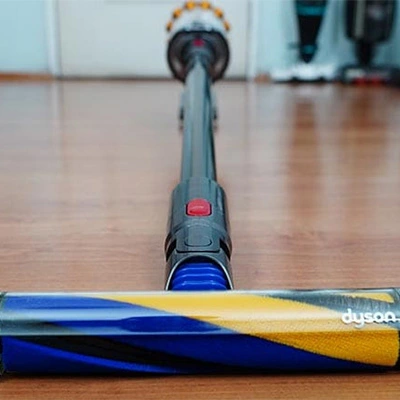
Dyson V15 Detect
Best For: Flagship-level cleaning power at a more reasonable price point
- Strong deep-cleaning performance below premium-level cost
- Automatic suction adjustment boosts power on carpeted areas
- Anti-tangle design handles long hair well across multiple lengths
- Extended run time from a single battery (over 84 minuntes)
- Not as wide as Outsize head—requires more passes for large carpeted areas
- Only comes with one battery
- Still expensive
- Airflow [Max at Nozzle]: 69.19 CFM
- Cleaning [Overall]: 99.91%
- Deep Cleaning: 100%
- Run Time: 84:19 mins
- Noise: 80.8 dB
- Weight: 6.8 lbs (w/ tube & nozzle)
- Dustbin capacity: 0.77 liters
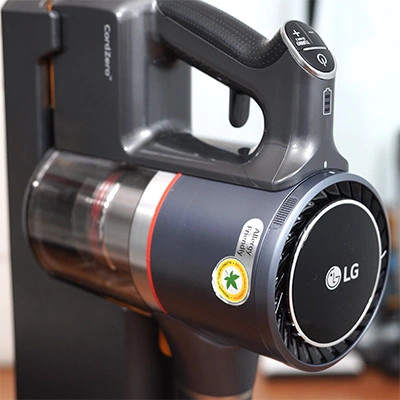
LG CordZero A9
Best For: Value-focused users who want versatility, longer total runtime, and extra batteries.
- Excellent surface-level pickup on low to mid-pile carpet
- Lightweight design makes it easier to push on carpet
- More affordable option for basic carpet maintenance
- Dual batteries allow longer carpet cleaning sessions
- Lower suction and airflow vs Dyson models
- Requires more passes to achieve similar results as V15/Gen5
- Hair pickup is less consistent, especially with longer strands
- Airflow [Max at Nozzle]: 36.32 CFM
- Cleaning [Overall]: 98.6%
- Deep Cleaning: 94.75%
- Run Time: 43:00 mins
- Noise: 79.4 dB
- Weight: 5.6 lbs (w/ tube & nozzle)
- Dustbin capacity: 0.39 liters
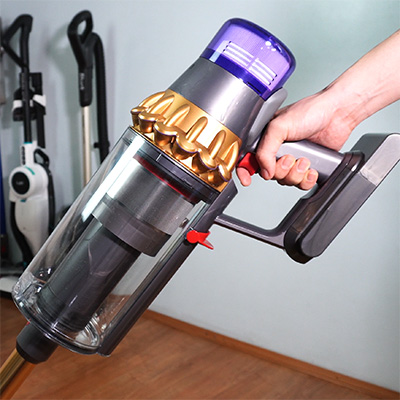
Dyson Gen5 Outsize
Best For: Large homes and heavy-duty cleaning where power, bin size, and coverage matter most.
- Best-in-class deep-cleaning performance on carpet
- Wider cleaner head covers more carpet area per pass
- Larger dustbin ideal for heavy carpet cleaning sessions
- Dual battery extends run time to over 160 minutes
- Heavier head can feel harder to push on thick carpet
- Bulkier design reduces maneuverability in tight spaces
- Overkill for light carpet cleaning needs
- Airflow [Max at Nozzle]: 59.5 CFM
- Cleaning [Overall]: 100%
- Deep Cleaning: 100%
- Run Time: 79:50 mins
- Noise: 84 dB
- Weight: 8.6 lbs (w/ tube & nozzle)
- Dustbin capacity: 1.89 liters
⚡ Quick Verdict
👉 Choose the Dyson V15 Detect if: you want near-flagship carpet cleaning performance with smart features like automatic suction adjustment and laser dust detection—without paying Gen5 prices. It’s the best balance of power, tech, and value for most homes.
👉 Choose the LG CordZero A9 if: you want a more affordable, lightweight option with longer total runtime thanks to dual batteries—ideal for lighter carpet cleaning and everyday maintenance without the premium cost.
👉 Choose the Dyson Gen5 Outsize if: you want maximum carpet cleaning performance, a larger bin, and wider coverage for big homes or heavy-duty cleaning—this is the most powerful option, built for deep cleaning at scale.
Bottom line: The V15 Detect hits the sweet spot for most users, offering near-top-tier carpet performance without the Gen5 price jump. The LG CordZero A9 is the value pick, while the Gen5 Outsize is the best choice for maximum power and large carpeted spaces.
How We Tested?
Every cordless vacuum in this guide was tested using the same controlled, repeatable methods—focused specifically on carpet performance.
Carpet is one of the most challenging surfaces to clean because debris gets embedded deep within the fibers.
To simulate real-world conditions, I tested each vacuum on low- and mid-pile carpets using materials such as sand, oats, coffee grounds, and hair.
Each model was evaluated based on:
1. Deep Cleaning Performance (or Embedded Sand Removal)

For this test, I rubbed 100 grams of sand into mid-pile carpet to simulate particles settling beneath the fibers. Each vacuum is then run over the area for several passes, each lasting a few minutes.
I weigh the dustbin before the test (empty) and after (with collected sand).
The difference is divided by 100 to calculate the pickup percentage. Each test is performed twice, and the results are averaged to determine the final score.
2. Surface Debris Pickup

I test each vacuum using different debris types—such as Quaker Oats, quinoa, pet litter, and coffee grounds—to simulate real-world cleaning conditions.
For each test, I start by weighing the vacuum (or the detachable dustbin) when empty. I then spread 50 grams of debris on the test area and ran the vacuum over it for several passes.
Afterward, I weigh the vacuum or dustbin again with the collected debris.
The weight difference is divided by 50 grams to calculate the pickup score.
3. Hair Pickup
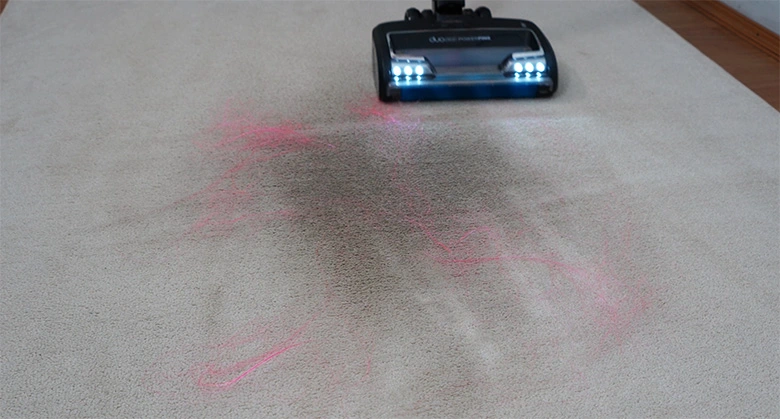
Each vacuum is tested on its ability to pick up hair from carpet.
I use five different hair lengths—5, 7, 9, 11, and 12 inches—using at least one gram per test. The hair is rubbed into mid-pile carpet to simulate real-world conditions.
I then run the vacuum over the area multiple times until all visible hair is removed.

After each test, I collect the hair from the dustbin, weigh it, and compare it to the original amount used. The result is calculated as a percentage.
Each length is tested separately to evaluate performance across different hair types.
4. Airflow at the Nozzle
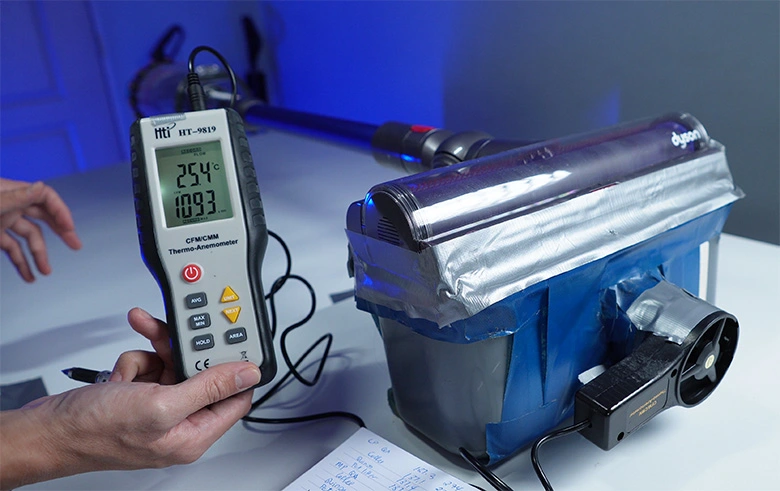
I use an anemometer to measure airflow at two key points: the extension tube and the cleaner head (nozzle). The nozzle measurement is especially important for evaluating carpet performance.
On hard floors, a soft roller can rely mostly on agitation to pick up debris. But carpet is different—dirt gets embedded beneath the surface, deep within the fibers. In this case, airflow becomes critical. It’s what lifts that hidden debris out of the carpet and carries it into the dustbin.
Agitation still matters, but without sufficient airflow, even the best brushroll can struggle to extract deeply embedded dirt.
In my testing, vacuums with higher airflow consistently perform better on carpet. That said, airflow alone isn’t enough—brushroll design and sealing also play a major role.
The best-performing models combine strong airflow with an effective brush design, allowing them to pull debris from deep within the carpet fibers and move it efficiently into the bin.
Carpet cleaning is where airflow separates good vacuums from great ones. While suction helps loosen debris, it’s airflow that carries particles out of carpet fibers and into the dustbin. The models that rank highest in my carpet tests consistently have the highest CFM ratings — I explain this pattern and the underlying science in my airflow vs. suction guide.
5. Run Time on Carpet
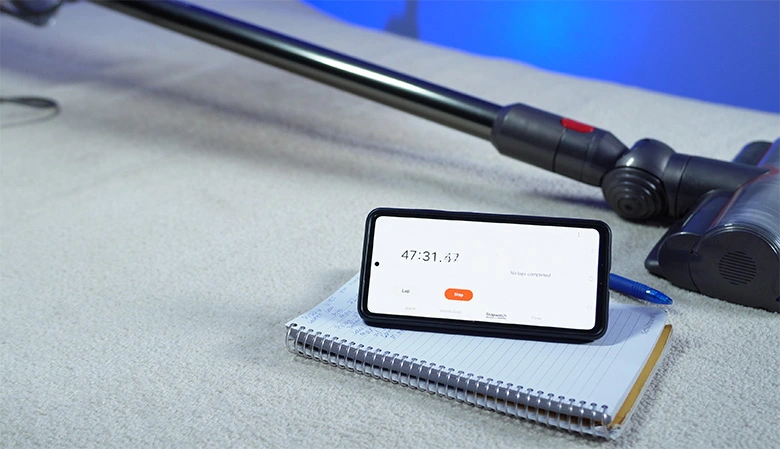
When manufacturers advertise runtime, those numbers are usually based on best-case conditions—typically using a non-powered tool with minimal resistance. In real-world use, especially on carpet, those figures rarely hold up.
Some high-end brands—like Dyson—are more accurate with their claims, and in some cases even conservative. But these ratings are still typically measured on hard floors, where there’s less resistance and lower power demand.
Carpet is a different story. Across all the cordless vacuums I’ve tested, runtime drops significantly on this surface due to increased resistance from the brush roll and the higher airflow required to pull debris from deep within the fibers.
For high-end models, I test runtime on both hard floors and carpet to show the real difference. Models with automatic suction adjustment—which increase power when detecting dirt—tend to drain even faster. In these modes, the runtime can drop by more than half.
In my testing, even the best-performing cordless vacuums typically last just over 20 minutes on carpet under realistic cleaning conditions.
What Matters For Carpet?
Carpet cleaning is completely different from hard floors. It requires more power, a better brush design, and the ability to pull debris from deep within the fibers.
Here are the key factors that actually impact performance on carpet.
1. Suction and Airflow
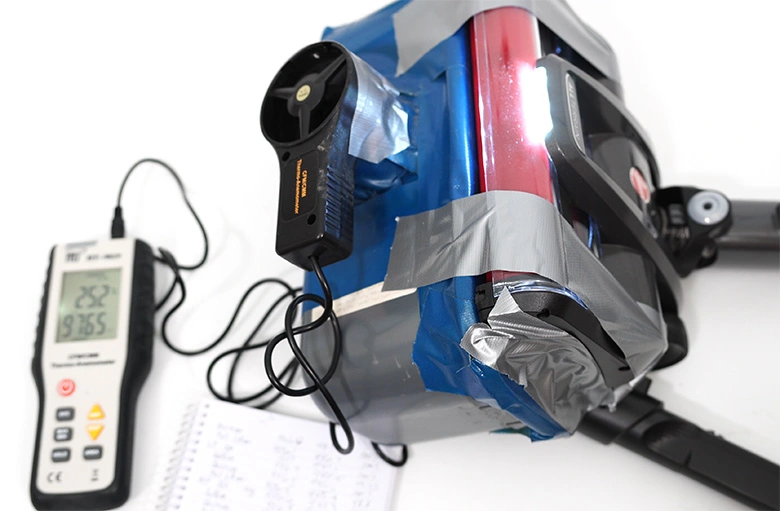
Strong suction alone isn’t enough—airflow is what actually lifts debris out of carpet fibers.
Based on testing data, high suction cordless vacuums tend to perform better on carpet, but a far more important metric is airflow, which refers to the volume of air a vacuum moves, typically measured in cubic feet per minute (CFM). It’s what carries dirt from deep within carpet fibers into the dustbin.
On carpet, debris doesn’t just sit on the surface—it gets trapped underneath the fibers. That’s where airflow becomes critical.
Airflow is what actually transports that debris out of the carpet.
Airflow is measured using an anemometer at consistent test points and calculated using a standardized method.
While these values may differ from laboratory CFM ratings, they provide reliable, real-world comparisons across all vacuums tested under identical conditions.
2. Brushroll Design & Agitation

Agitation loosens embedded dirt from carpet fibers—and brushroll design determines how effective that process is.
Even with strong airflow, a vacuum with a poorly designed brushroll will struggle to clean carpet effectively. In testing, I’ve seen lower-airflow models outperform higher-airflow ones simply because the brushroll does a better job lifting and releasing debris from the fibers.
What Makes a Good Brushroll Design?
A well-designed brushroll consistently does two critical things during carpet cleaning. First, it agitates deep into the carpet to loosen embedded dirt, sand, and hair that sit beneath the surface. Second, it helps guide the debris toward the suction path rather than pushing it away or scattering it across the surface.
What separates high-performing brushrolls from average ones comes down to a few key design details. Stiff, properly spaced bristles are essential because they can reach deeper into carpet fibers and dislodge debris more effectively.
Just as important is maintaining consistent contact with the surface—if the brushroll skips or floats, it can no longer agitate properly.
Finally, a well-sealed nozzle behind the brushroll plays a major role in performance, as it helps channel debris forward into the airflow path rather than allowing it to scatter backward.
The bottom line is that airflow pulls dirt out, and agitation makes that possible in the first place.
Hair Pickup and Anti-Tangle
What My Tests Show
In carpet tests—especially when dealing with embedded debris like sand—the brushroll design is often the biggest factor influencing real-world performance.
It directly affects how quickly a vacuum can remove debris, how many passes are needed to clean the area, and how much residue remains after each run.
When agitation is weak, performance drops noticeably. Debris tends to remain trapped beneath carpet fibers rather than being lifted out, and vacuums may leave visible trails.
This not only makes cleaning less efficient but also forces you to go over the same area multiple times just to achieve a similar result.
3. Hair Pickup & Anti-Tangle
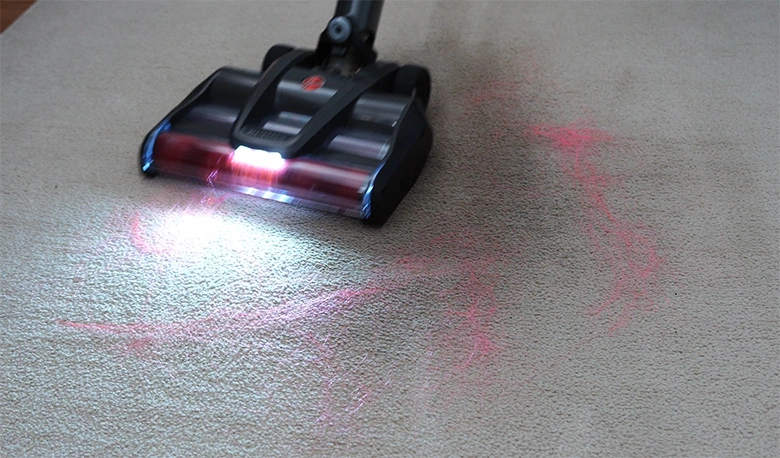
Hair wrap doesn’t just affect convenience—it directly impacts cleaning performance over time.
As hair builds up around the brushroll, it reduces agitation, restricts airflow, and makes the vacuum less effective—especially on carpet, where consistent brush contact is critical for lifting embedded debris.
Modern cordless vacuums address this with different anti-tangle designs. Premium brands like Dyson use built-in combs positioned behind the brushroll that actively strip hair off as it spins.
These are often paired with multi-surface brushrolls that combine stiff and soft bristles, helping guide tangled hair toward the combs for continuous removal.
Other brands like Shark take a different approach by adding fins or flexible vanes to the brushroll, which help reduce how tightly hair wraps in the first place.

In my testing, vacuums with effective anti-tangle systems not only require less maintenance but also maintain more consistent performance over time—especially in homes with pets or long hair.
4. Run Time on Carpet
The last crucial factor when choosing a cordless vacuum for carpet is its real-world runtime on carpet.
Since carpet cleaning requires more power, battery life drops significantly compared to advertised figures. That’s why I test how long each vacuum runs on carpet using the cleaner head attached—so you can see what to realistically expect.
In my testing, even the best-performing cordless vacuums typically last just over 20 minutes on carpet under real cleaning conditions.
Full Reviews
After testing multiple cordless vacuums on carpet, these models delivered the best overall performance in real-world conditions.
Each one stands out in a key area—whether it’s deep-cleaning ability, debris agitation, or overall value—so you can choose the best fit for your home.
Best Overall for Carpets: Dyson V15 Detect

Pros
- High-end carpet cleaning performance without the premium cost
- Got 100% score in the deep cleaning experiments, even in the auto setting
- Above-average anti-tangle system on carpet
- Capable of cleaning long hair strands on upholstery because of the hair screw tool
Cons
- Smaller dustbin than the Gen5 Outsize
- Runs for less than 20 minutes on carpet in the auto setting
- Expensive
Best for: homeowners who want strong carpet cleaning performance—both surface debris and embedded dirt—without paying full flagship prices. The Dyson V15 Detect delivers the airflow and brushroll agitation needed for deep carpet cleaning, along with enough runtime to handle small to medium-sized homes without frequent recharging. It’s also lightweight and easy to convert for handheld use, making it a versatile option for stairs, upholstery, and car interiors—without sacrificing cleaning performance.
Best Value Option: LG CordZero A9

Pros
- Above-average cleaning performance on carpet
- Comes with two batteries that double its rated run time
- A charging stand makes storage easy and saves space
- Handheld control is easy to use
- Lightest option of the three
- Cheapest option
Cons
- Worst deep cleaning performance
- Brand new units not available
- Small dustbin
Best for Large Homes: Dyson Gen5 Outsize

Why does it stand out? The Dyson Outsize stands out as the top performer on carpet thanks to its strong suction and high airflow, which translate to better deep cleaning—especially for embedded debris. It also has the largest dustbin of the three at over 1.2 liters, making it a better fit for larger homes where frequent emptying can be a hassle. The wide 12-inch cleaner head helps cover more surface area per pass, speeding up cleaning sessions. Another advantage is its dual-battery setup, which significantly extends runtime—up to 160+ minutes on hard floors and around 50 minutes on carpet—giving it a clear edge for whole-home cleaning. That said, this added size and power come with a trade-off. The Outsize is noticeably heavier than typical cordless vacuums, and that weight becomes more apparent when using it in handheld mode or for above-floor cleaning.
Pros
- Best-performing cordless vacuum on carpet, factoring in run time and raw scores
- Largest dustbin capacity
- Two batteries give it a significant runtime advantage
- Excellent option for large homes
- The wide 12-inch nozzle covers a lot of area per pass
Cons
- Top-heavy design makes it unusable in its handheld configuration
- Hard to push if the gates are closed
- Extremely pricey
Performance Comparison Table
Here’s a side-by-side comparison of how each vacuum performed on different experiments based on real-world testing. Use this table to quickly compare key metrics such as pickup performance, fine-dust handling, and overall usability.
| Test | Dyson V15 | LG CordZero A9 | Dyson Gen5 Outsize |
|---|---|---|---|
| Airflow at the Nozzle | |||
| Low (CFM) | 29.98 | 24.53 | 28.52 |
| Mid/Auto (CFM) | 36.32 | 33.40 | |
| High (CFM) | 69.19 | 36.32 | 59.50 |
| Cleaning Test Results | |||
| Overall (%) | 99.91 | 98.60 | 100.00 |
| Hard Floor (%) | 99.85 | 99.70 | 100.00 |
| Sand on Hard Floor (%) | 99.80 | 100.00 | 100.00 |
| Carpet (%) | 100.00 | 99.95 | 100.00 |
| Deep Cleaning (%) | 100.00 | 94.75 | 100.00 |
| Hair Pickup (Overall) (%) | 97.76 | 93.26 | 95.80 |
| Hair Wrap Test on Hard Floors | |||
| 5" strands (%) | 100.00 | 98.00 | 100.00 |
| 7" strands (%) | 100.00 | 81.00 | 66.00 |
| 9" strands (%) | 100.00 | 86.00 | 100.00 |
| 11" strands (%) | 100.00 | 86.00 | 100.00 |
| 12" strands (%) | 80.60 | 92.00 | |
| Run Time on Hard Floors | |||
| Low (hh:mm:ss) | 1:24:19 | 43:00 | 1:19:50 |
| Mid/Auto (hh:mm:ss) | 41:30 | 45:47 | |
| High (hh:mm:ss) | 13:44 | 15:00 | 14:28 |
Carpet Test Results Breakdown
Here’s a detailed breakdown of the carpet test results—all based on controlled, repeatable methods.
Each category highlights a key performance area, so you can quickly see how each vacuum stacks up against the competition.
First, we’ll compare how the Dyson V12, Shark Vertex Pro, and Omni-Glide perform against the broader field of cordless vacuums I’ve tested on hard floors.
The bar graphs below show the average pickup performance across multiple debris types—including Quaker Oats, coffee grounds, quinoa, and pet litter—providing a more complete view of real-world carpet-cleaning performance. You’ll notice that the gap between the top-performing models is less than one percent.
Next, we’ll examine the deep-cleaning results—one of my key benchmarks—and see how the top picks compare against the rest of the field.
Hair wrap is another key consideration—especially for pet owners. Here’s how the top picks performed compared to the rest of the field.
The scores below represent the average results from the 5-, 7-, 9-, 11-, and 12-inch hair tests. Note that not all models were tested at every length; some sub-models were excluded from longer-hair tests if they already struggled with shorter strands, as was the case with the Dyson Omni-Glide.
Cordless Vacuums To Avoid on Carpet
Not all cordless vacuums are designed for carpet, and some struggle significantly in real-world tests.
While many models can handle surface debris, fewer can remove dirt embedded deep within carpet fibers. In testing, certain designs consistently underperform due to limitations in airflow, brushroll design, or overall power.
Here are the types of cordless vacuums to avoid if carpet performance is a priority.
1. Low Airflow Models
Cordless vacuums with low airflow often struggle to remove embedded debris from carpet. While they may pick up visible dirt on the surface, they cannot pull particles from deep within the fibers.
In testing, these models leave behind a significant amount of sand and fine debris—even after multiple passes.
2. Soft Roller–Only Configuration
Soft rollers are excellent for hard floors—but they are not designed for carpet.
Models that rely only on a soft roller lack the agitation needed to loosen embedded dirt. As a result, they perform poorly in deep-cleaning tests and are better suited for bare floors.
3. Weak or Ineffective Brushroll Designs
Some cordless vacuums have brushrolls that spin but don’t provide enough agitation to lift debris from carpet fibers.
In real-world use, this leads to inconsistent pickup and reduced deep-cleaning performance, even if the vacuum has decent suction on paper.
You may find yourself going over the same area multiple times just to achieve acceptable results. In many cases, brushroll performance—not suction—is what separates average vacuums from those that truly clean carpet effectively.
4. Poorly Sealed Cleaning Heads
A vacuum can have strong suction on paper but still perform poorly on carpet if the cleaning head isn’t well sealed.
When there are gaps or air leaks, suction and airflow are no longer concentrated at the carpet surface, reducing the vacuum’s ability to pull debris from within the fibers.
This often results in fine dust and sand being left behind, especially in deeper layers of carpet.
5. Ultra-Light, Low-Power Models
Lightweight cordless vacuums are convenient and easy to handle, but many do so at the expense of motor power and overall performance.
While they work well for quick cleanups and hard floors, they often struggle with deeper carpet cleaning, heavier debris, and hair pickup. If carpet is your primary surface, these trade-offs become more noticeable over time.
6. Budget Models with Inflated Specs
Some budget cordless vacuums advertise high suction numbers but fail to deliver in real-world carpet tests. This is often due to low airflow, inefficient brushroll design, or inconsistent performance under load.
While they may look competitive on paper, these limitations become obvious during deep-cleaning tests, where embedded debris remains even after multiple passes.
This is why real-world testing is far more reliable than relying on specs alone.
Buyer’s Guide
Choosing the right cordless vacuum for carpet depends on more than just suction power. Factors like airflow, brushroll design, and carpet type all play a major role in real-world performance.
Here’s what actually matters when choosing a cordless vacuum for carpet.
1. Carpet Type (Low vs Medium vs High Pile)
Not all cordless vacuums perform the same across different carpet types. Low-pile carpet is generally easier to clean, and most cordless vacuums can handle it without issue.
Medium-pile carpet requires more airflow and stronger agitation to remove dirt effectively.
High-pile or thicker carpet is the most demanding, requiring a combination of strong suction, high airflow, and an aggressive brushroll to pull debris from deep within the fibers. If you have thicker carpet, it’s important to prioritize models that performed well in deep-cleaning tests.
2. Airflow vs Suction (What Actually Matters More)
Many brands highlight suction power, but airflow is just as critical—especially for cleaning carpet. Suction, typically measured as water lift, indicates the force the vacuum can generate and is usually tested near the motor.
In many cases, cordless vacuums with higher suction also produce higher airflow, so the two often go hand in hand. Still, suction alone is only part of the equation—it shows potential, not the full picture of real-world performance.
Airflow, measured in CFM, is what actually moves debris through the system—from the carpet, through the nozzle, and into the dustbin. Without sufficient airflow at the nozzle, even a vacuum with strong suction can struggle to transport dirt effectively.
The best-performing cordless vacuums strike a balance between both. When suction and airflow work together, you get better deep cleaning, especially on carpet.
But when a vacuum leans too heavily on one and neglects the other, it often shows up in testing—slower pickup, more passes needed, and debris left behind.
3. Brushroll Design & Agitation
Brushroll design is one of the biggest factors affecting carpet performance. A well-designed brushroll agitates carpet fibers, loosens embedded dirt, and helps guide debris into the airflow path.
Some vacuums struggle on carpet, not because of weak suction, but because their brush roll lacks the agitation needed to lift debris from beneath the surface. In many cases, brushroll performance is what separates average vacuums from top performers.
4. Pets & Hair Pickup
If you have pets, hair pickup becomes just as important as deep cleaning.
A vacuum may perform well with debris but still struggle with hair if the brushroll tangles easily or lacks the power to lift it from carpet fibers.
Features like anti-tangle brushrolls and consistent airflow can make a significant difference. In testing, some vacuums handled hair well on the surface but failed to remove dirt underneath, so it’s important to consider both factors.
5. Runtime & Battery System
Carpet cleaning requires more power than cleaning hard floors, which means runtime tends to be shorter—especially on higher-power settings. For smaller homes, a single battery may be enough.
However, for medium to large homes, a vacuum with a swappable or dual-battery system is often the better choice. This allows for longer cleaning sessions without interruption and ensures consistent performance throughout.
In the graph below, which shows runtime on the middle power setting, some models appear with a value of zero.
This doesn’t indicate poor performance—it simply means those vacuums don’t have a dedicated middle setting.
For example, the LG CordZero A9 only offers low and max modes, so it’s recorded as zero in this category for consistency in the comparison.
6. Sealing & Nozzle Design
Sealing and nozzle design play a critical role in maintaining suction and airflow at the carpet surface. A well-sealed cleaning head helps direct airflow efficiently through the carpet, improving deep-cleaning performance.
Poor sealing can lead to air leaks, reducing the vacuum’s ability to lift debris from within the fibers. This is often overlooked, but it has a direct impact on how well a vacuum performs in real-world conditions.
Some newer Dyson models include adjustable gates that let you fine-tune the seal at the cleaner head.
A tighter seal can improve suction and deep-cleaning performance, but if it’s too closed off, it creates more resistance and makes the vacuum harder to push on carpet.
Opening the gates slightly reduces that drag, making it easier to maneuver while still maintaining solid cleaning performance.
7. Weight & Ease of Use
More powerful cordless vacuums tend to be heavier, which can affect usability over longer cleaning sessions.
Lighter models are easier to maneuver and more comfortable to use, especially in handheld mode.
However, they may not always deliver the same level of deep-cleaning performance as heavier, more powerful options.
Choosing the right balance between performance and comfort depends on your priorities and how often you clean.
8. Budget vs Performance
Higher price doesn’t always guarantee better performance, but in many cases, stronger carpet performance comes at a premium due to more powerful motors and better airflow design.
Budget models can still perform well for light cleaning and low-pile carpet, but they often fall short in deep-cleaning tests. Instead of focusing on price alone, it’s more important to look at real-world test results to understand what you’re actually getting.
FAQ
Here are answers to the most common questions about cordless vacuums for hardwood floors, based on real-world testing and usage.
Are cordless vacuums good for carpet?
Yes, but not all cordless vacuums perform well on carpet. While many models can handle surface debris, fewer can deep-clean, especially on thicker carpet.
Performance depends on factors like airflow, brushroll design, and sealing. In testing, higher airflow models with effective agitation consistently perform better at removing embedded dirt.
Can cordless vacuums replace upright vacuums for carpet?
Some high-end cordless vacuums can replace upright vacuums for carpet, especially on low- to medium-pile surfaces. However, for thick or high-pile carpets, many cordless models still fall short of full-size uprights. If deep cleaning is a priority, it’s important to choose a model that performs well in embedded-dirt tests (or deep-cleaning experiments).
Which cordless vacuum is best for pet hair on carpet?
The best cordless vacuum for pet hair on carpet is one that combines strong airflow with an effective anti-tangle brushroll. Some models pick up hair well on the surface but struggle with debris underneath. In testing, vacuums with strong agitation and consistent airflow perform best for both hair and deep-cleaning.
Here’s a chart showing the top-performing cordless vacuums I’ve tested on carpet, ranked by their average pickup across all cleaning experiments.
Why do some cordless vacuums struggle on carpet?
Many cordless vacuums struggle on carpet due to low airflow, weak brushroll agitation, or poor sealing at the cleaning head.
Even if suction numbers look high on paper, these limitations can prevent the vacuum from lifting debris out of carpet fibers. Real-world performance depends on how well these factors work together.
What’s the biggest weakness of most cordless vacuums on hardwood floors?
There are two main issues. First, the lack of a properly designed nozzle, either one not optimized for this surface or with insufficient clearance.
Second, an inferior brushroll design that lacks proper sealing, causing debris to be pushed backward instead of being drawn in.
Do I need to use max power mode for carpet?
Not always. While max mode can improve deep-cleaning performance, it significantly reduces runtime and can cause the battery to overheat, shortening its service life.
Many high-performing cordless vacuums can clean carpet effectively on mid or auto settings. However, for heavily embedded dirt or thicker carpet, higher power modes may still be necessary.
How long do cordless vacuums last on carpet?
Runtime is typically shorter on carpet compared to hard floors because the vacuum works harder. Most cordless vacuums run anywhere from 10 to 40 minutes on carpet, depending on the power setting.
Models with larger batteries or swappable battery systems are better suited for longer cleaning sessions.
However, larger homes or whole-house cleaning may benefit from longer runtime or removable batteries.
Do brushrolls matter for carpet cleaning?
Yes—brushroll design is critical for carpet performance. A good brushroll agitates carpet fibers, loosens embedded dirt, and helps guide debris into the airflow. Vacuums with weak or poorly designed brushrolls often struggle to deep-clean, even if suction is strong.
Can cordless vacuums deep clean carpet?
Some can, but not all. Deep cleaning requires a combination of strong airflow, effective agitation, and good sealing.
In testing, only certain high-performance cordless vacuums can remove a significant amount of embedded debris. Many others are better suited for maintenance cleaning than deep cleaning.
Are expensive cordless vacuums better for carpet?
Not always—but there is often a correlation. Higher-end models tend to have better motors, airflow, and brushroll design, which can improve carpet performance.
That said, price alone isn’t a guarantee. Real-world testing is the best way to determine which models actually perform well.