

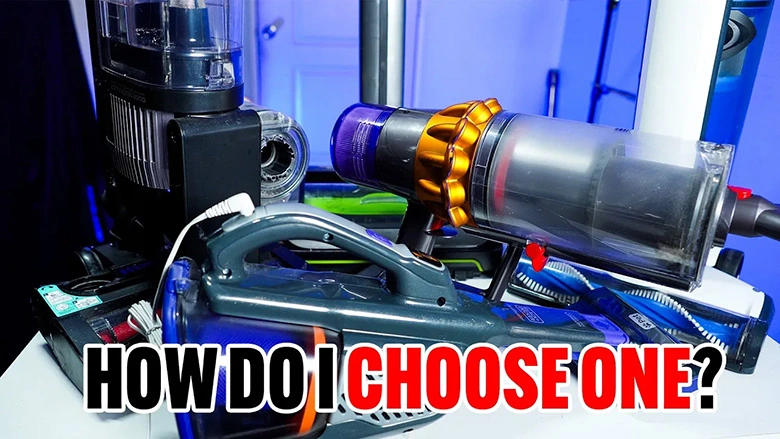
Choosing a cordless vacuum can be confusing. Specs like suction power, runtime, and features are often emphasized — but they don’t always reflect real-world performance.
After testing more than 30 cordless vacuums with repeatable, documented experiments — measuring airflow, suction, carpet deep cleaning, hard floor pickup, hair wrap, filtration, and battery runtime — I’ve learned what actually separates a good cordless vacuum from a disappointing one.
This guide breaks down each factor in the order that matters most, based on what I’ve seen in testing — not what manufacturers want you to believe.
How to Choose the Right Cordless Vacuum (Quick Decision Guide)
If you already know your situation, here’s the shortcut:
Mostly carpet? Prioritize high airflow and a motorized brushroll. In my testing, vacuums with strong airflow consistently outperform those that rely on suction alone for carpet cleaning. See what matters for carpet cleaning for the detailed breakdown.
Mostly hard floors? Choose a model with a soft roller head. Soft rollers prevent debris scatter and pick up fine dust far better than bristle brushrolls on smooth surfaces. See what matters for hardwood floors.
Mixed flooring? You’ll need either dual heads (one soft roller, one brushroll) or a hybrid head. Dual heads give better specialized performance; hybrids trade some of that for convenience. See soft roller vs brushroll for how they compare in testing.
Pet hair? Look for an anti-tangle brushroll design and strong airflow. Hair wrap is one of the most common performance killers I see in testing — some designs handle it well, others clog within minutes. See how to remove hair wrap from a brushroll.
Large home? Prioritize long real-world runtime and removable batteries. Claimed runtimes are almost always measured on the lowest power setting with no floor head attached — real carpet cleaning runtime is much shorter.
If you’re unsure about any of these, keep reading. Each section below explains what I look for, why it matters, and which vacuums I’ve tested that demonstrate these differences.
Understanding the Different Types of Cordless Vacuums
Not all cordless vacuums are built the same. Here’s how the main categories break down:
Stick Vacuums (Most Popular)

Stick vacuums are the most versatile category. They’re lightweight, convert to handheld mode for above-floor cleaning, and work well for most homes. This is the type I test most frequently, and it’s where you’ll find the widest range of performance — from budget models that struggle on carpet to flagships that rival full-size uprights.
Most of the advice in this guide focuses on stick vacuums, since they represent the majority of the cordless market and the category where testing data makes the biggest difference in choosing well.
Cordless Upright Vacuums
Cordless uprights offer larger dustbins and generally stronger carpet cleaning than stick vacuums, but they’re heavier, less versatile, and can’t convert to handheld. If your home is primarily carpeted and you don’t need above-floor cleaning flexibility, a cordless upright can be a strong choice — but for most homes, a good stick vacuum covers more ground.
Mini Stick Vacuums

Mini stick vacuums like the Shark WandVac are ultra-lightweight and designed for small spaces or quick cleanups. They’re not a replacement for a full-size vacuum — airflow and suction are significantly lower — but they fill a specific role well. In my Shark WandVac fog test, I found that even these small models vary significantly in filtration quality.
Handheld Vacuums

Handheld vacuums are best for spot cleaning — car interiors, upholstery, crumbs on counters. They’re not designed for full-home cleaning and shouldn’t be compared directly to stick vacuums. If you need a handheld, look for strong suction and a crevice tool — airflow matters less when you’re cleaning small areas at close range.
Wet/Dry Cordless Vacuums

Wet/dry models like the Dyson V15S Submarine can vacuum and mop simultaneously. They’re excellent for hard floors where you want to clean up liquid spills and dry debris in one pass. The tradeoff: they’re heavier, more complex to maintain, and typically not as strong at dry-only carpet cleaning as a dedicated dry vacuum. If your home is primarily hard floors and you want to reduce the number of cleaning tools you own, these are worth considering.
1. Airflow: The Most Important Spec for Cleaning Performance
Airflow — measured in cubic feet per minute (CFM) — determines how effectively a vacuum transports debris from the floor into the dustbin. It’s the single most important performance metric in my testing, and it’s the one most manufacturers don’t advertise.
Here’s why airflow matters more than the specs you see on the box: suction (water lift) pulls debris up from the surface, but airflow is what carries it through the hose, past the filter, and into the bin. A vacuum with strong suction but weak airflow will pick debris up and then drop it before it reaches the dustbin — or push it around on hard floors instead of collecting it.
In my carpet deep cleaning tests, I embed a measured amount of sand into carpet fibers and weigh how much each vacuum extracts. Higher-airflow models consistently remove more embedded debris, even when their suction numbers are similar to or lower than competitors.
Airflow vs. Carpet Cleaning Performance (From My Testing)
Carpet deep clean scores are from my embedded sand test. Higher is better.
| Vacuum Model | Airflow (CFM) | Carpet Deep Clean Score | Notes |
|---|---|---|---|
| Dyson V15 Detect | 69.19 CFM | 100% | Strong airflow + brushroll agitation |
| Shark Vertex Pro | 27.76 CFM | 92.75% | Hybrid head, solid all-around |
| Dyson V12 Detect Slim | 48.38 CFM | 94.1% | Lighter motor, trades some airflow |
| DreameTech T30 | 41.91 CFM | 94% | High suction but lower airflow |
| Budget Model Example | 33.3 CFM | 87% | Weak airflow limits carpet cleaning |
Scores based on my standardized embedded sand extraction test. I weigh the sand before and after to measure exactly how much each vacuum removes. See full methodology.
This is also why two vacuums with similar suction specs can perform very differently in real-world cleaning — the one with better airflow will almost always clean more effectively.
To understand the relationship between airflow and suction in more detail, see my airflow vs suction guide.
2. Floor Head Design: Soft Roller vs. Brushroll vs. Hybrid
The type of cleaning head has a major impact on real-world performance — often more than suction alone. This is one of the decisions most buyers overlook, but it determines whether a vacuum will actually clean your specific floors well.
Soft Roller Heads

Soft rollers use a plush, velvet-like material that wraps around large and fine debris without scattering it. They’re the best option for hard floors — hardwood, tile, laminate, vinyl. In my testing, soft roller heads consistently pick up fine dust and larger debris on hard surfaces with minimal scatter, which is a problem bristle brushrolls struggle with.
Dyson’s soft roller (Fluffy) heads are among the best-known examples. I’ve tested them on the V15 Detect, V12 Detect Slim, and the V8 — and the soft roller consistently outperforms standard brushrolls on smooth floors.
The downside: soft rollers are not effective on carpet. They don’t agitate carpet fibers enough to extract embedded dirt.
Brushroll Heads (Motorized Bristle)

Brushrolls use rotating bristles to agitate carpet fibers and dislodge embedded dirt. This agitation, combined with strong airflow, is what produces effective carpet cleaning. Without a brushroll, most cordless vacuums cannot deep clean carpet — they’ll only pick up surface debris.
In my testing, the combination of brushroll agitation and high airflow produces the best carpet deep cleaning results. Neither factor alone is sufficient — a strong brushroll with weak airflow won’t transport debris into the bin, and high airflow without agitation won’t dislodge what’s embedded.
The downside: bristle brushrolls scatter fine debris on hard floors and are more prone to hair wrapping.
Hybrid Heads

Hybrid heads attempt to combine soft roller and brushroll elements into one head. Shark’s DuoClean system is the most well-known example — it uses a front soft roller for hard floors and a rear brushroll for carpet.
In my testing, hybrids are a solid compromise for mixed-flooring homes. They won’t match a dedicated soft roller on hard floors or a dedicated brushroll on thick carpet, but they eliminate the need to swap heads between rooms. For most homes with a mix of hard floors and low-to-medium pile carpet, a hybrid head is a practical choice.
My recommendation: If your home has significant carpet and hard floor areas, the best performance comes from a vacuum with interchangeable heads — a soft roller for hard floors and a brushroll for carpet. If convenience matters more than maximum performance, a hybrid head is a reasonable middle ground.
3. Suction Power: Important, But Not Everything
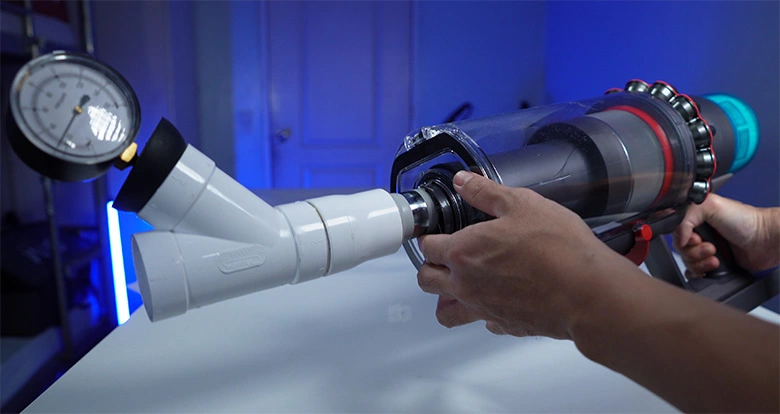
Suction — measured as water lift in inches or kilopascals (kPa) — determines how strongly a vacuum can pull debris upward from a surface. It’s the spec most manufacturers highlight because it sounds impressive, but it tells only part of the story.
Suction matters most for carpet cleaning, where the vacuum needs to pull embedded dirt upward against gravity and friction.
On hard floors, suction is less critical because debris sits on the surface — airflow and head design do most of the work.
The key insight from testing: suction and airflow must work together. I’ve tested vacuums with high suction but low airflow that struggle on carpet because they can lift debris but can’t transport it into the dustbin. And I’ve tested vacuums with moderate suction but excellent airflow that outperform them because the debris actually makes it into the bin.
For a deeper look at how I measure suction and what the numbers mean, see Suction Testing Explained.
| Vacuum Model | Suction (Water Lift) | Airflow (CFM) | Deep Clean Score | Takeaway |
|---|---|---|---|---|
| Shark Vertex Pro Powered Lift-Away | 105 in. | 21.51 | 92.25% | Highest suction I’ve tested — but low airflow holds it back |
| DreameTech T30 | 85 in. | 41.91 | 94.00% | Second-highest suction — decent score but not what you’d expect |
| Tineco Pure One S12 | 70 in. | 50.71 | 98.30% | 33% less suction than the Shark — but better airflow gets results |
| Dyson V15 Detect | 65 in. | 69.19 | 100% | 38% less suction than the Shark — but highest airflow outperforms all three |
Higher suction doesn’t always mean better cleaning. Airflow is the missing piece most specs don’t show.
Scores based on my standardized embedded sand extraction test. I weigh the sand before and after to measure exactly how much each vacuum removes. See suction testing methodology.
4. Battery Performance and Runtime
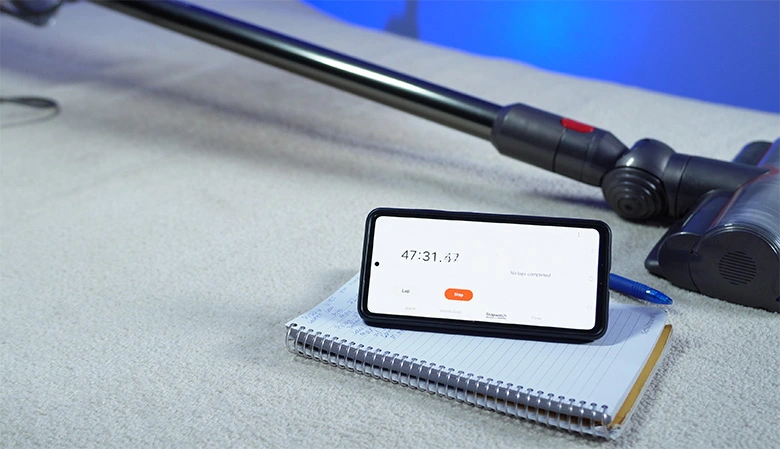
Runtime is one of the most misleading specs in the cordless vacuum market. Manufacturers measure runtime under conditions that don’t reflect real-world cleaning — typically on the lowest power setting, with no motorized floor head attached. The actual runtime you’ll get while cleaning carpet on a normal or high power setting is significantly shorter.
Here’s what to look for instead:
Real-world runtime on carpet: This is the number that matters. When I test runtime, I measure how long the vacuum runs on its standard power setting with the motorized brushroll attached and running. The difference between claimed and actual runtime can be dramatic.
Claimed vs. Actual Runtime (From My Testing)
Manufacturers measure runtime at the lowest power setting with no floor head attached. I measure with the motorized nozzle running on carpet.
| Vacuum Model | Advertised Runtime | Actual Runtime (With Nozzle) | Difference | Takeaway |
|---|---|---|---|---|
| Hoover OnePWR | 45 min | 30 min 31 sec | −32% | Lost nearly 15 minutes once the nozzle was running |
| Dyson V11 Torque Drive | 60 min | 57 min 16 sec | −5% | Nearly matched its claim — tested on carpet, lowest setting |
I test the runtime on carpet with the motorized floor head attached, which is how you’ll actually use the vacuum. Manufacturers typically measure with no floor head at the lowest setting — that’s why the numbers differ.
Removable batteries are a significant advantage. This is something I recommend for every buyer: always choose a model with a removable battery. Once a sealed battery degrades — and all lithium-ion batteries degrade over time — the vacuum it powers becomes unusable. A removable battery means you can buy a replacement for $30-80 instead of throwing away a $300-600 vacuum. You can also buy a second battery to double your runtime for large homes.
Performance consistency as the battery drains. Some vacuums maintain consistent cleaning performance throughout the battery cycle. Others lose suction and brush roll speed when the battery drops below 50%. In my testing, I’ve noticed this matters most on carpet, where reduced airflow from a dying battery can significantly cut deep-cleaning effectiveness.
5. Filtration: Important for Air Quality

Filtration determines whether your vacuum traps the fine dust it picks up or just redistributes it into the air you breathe. If you have allergies, asthma, pets, or young children, filtration quality should be high on your list.
What “HEPA” actually means: A true HEPA filter captures 99.97% of particles down to 0.3 microns. But here’s what most people don’t realize — the filter itself is only half the story. If the vacuum body has gaps or poor seals, air (and dust) escapes through those gaps and bypasses the filter entirely. This is called a “sealed system,” and it’s what separates vacuums that actually filter well from those that just have a HEPA sticker on the box.
Watch out for “HEPA-type” marketing. Some manufacturers use terms like “HEPA-type” or “HEPA-style” — these are not true HEPA filters and don’t meet the 99.97% standard. They may capture only 85-95% of particles, which sounds close but lets through significantly more fine dust.
How I test filtration: I use a fog test — I run the vacuum with a fog machine producing visible particles and look for any fog escaping from the body, seals, or exhaust. This reveals seal leaks that HEPA filter specs alone can’t tell you about. I’ve tested vacuums with HEPA filters that still leak significant amounts of fine particles because the body seals are poor.
Fog Test Results: Sealed vs. Leaking Filtration (From My Testing)
I run each vacuum with a fog machine to visually check for air leaks. A HEPA filter is only as good as the seals around it.
| Vacuum Model | Filter Type | Fog Test Result | What I Observed |
|---|---|---|---|
| Dyson V12 Detect Slim | Sealed HEPA | PASS | No visible fog escaping from the body, seals, or exhaust — air is fully filtered before exiting |
| Moosoo K17 | HEPA (not sealed) | FAIL | Heavy fog leaks from multiple points in the body — fine particles bypass the filter entirely |
For the full breakdown of how I test filtration and results across every vacuum I’ve tested, see Filtration Testing Explained.
If air quality is a priority, also consider reading about the best cordless vacuums for pet hair, where filtration is especially important because pet dander is a common allergen trigger.
6. Weight and Ergonomics
Cordless vacuums are used differently from corded uprights. You’ll hold them by a handle (not push them along the floor), use them overhead for ceilings and curtains, and carry them between floors. Weight and balance matter more than they do for a corded vacuum that stays on the floor.
What I look for in testing:
Handle weight vs. total weight. Some manufacturers quote total weight (including the floor head and wand), but what you actually feel in your hand is the weight of the motor/battery unit at the top. A vacuum that weighs 6 lbs total but has most of the weight in the motor unit will feel heavier during above-floor cleaning than one that weighs 7 lbs but distributes weight more evenly.
Balance and maneuverability. A well-balanced vacuum glides smoothly when pushing and pulling. A poorly balanced one fights you — it tips, feels front-heavy, or requires constant wrist effort to keep the floor head flat. This is hard to assess from specs alone, which is why hands-on testing matters.
Usability during above-floor cleaning. Every cordless stick vacuum doubles as a handheld. But some are much more comfortable in handheld mode than others. If you plan to clean stairs, car interiors, or furniture frequently, pay attention to how the handheld configuration feels — not just the floor-cleaning mode.
7. Dustbin Design
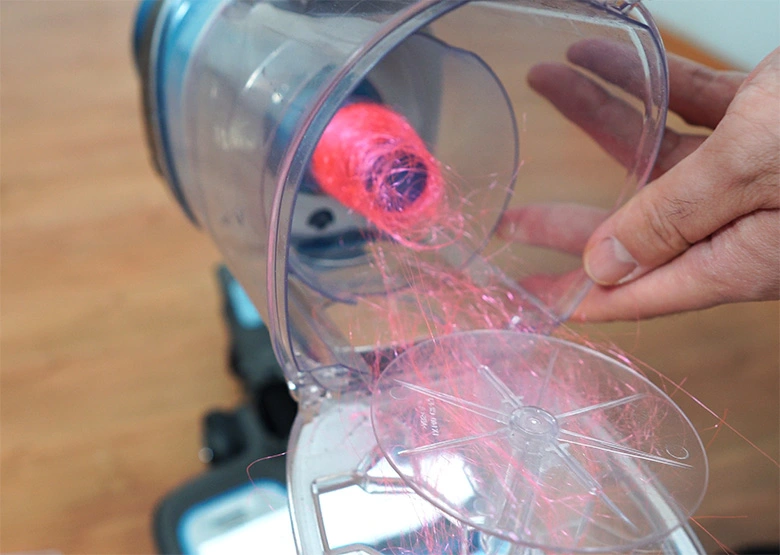
The dustbin is one of the most overlooked factors in cordless vacuum usability, and I pay close attention to it in testing because it affects every cleaning session.
What makes a good dustbin design:
Easy, clean emptying. The best designs open with one action and release debris cleanly. Poor designs require you to reach inside and pull out tangled debris — especially hair — which defeats the purpose of a vacuum that’s supposed to make cleaning easier.
Adequate capacity. A tiny dustbin means you’re emptying mid-session, which is especially frustrating in larger homes. For a home over 1,000 sq ft, I’d recommend at least a 0.5 L capacity.
Minimal clogging. Narrow dustbins with tight airflow paths clog easily, especially with pet hair and larger debris. I’ve tested vacuums where the dustbin design is the primary bottleneck — the motor and airflow are strong, but the bin geometry causes frequent blockages that kill performance.
Dustbin Design: What I’ve Found in Testing
A good dustbin empties cleanly and holds enough to finish the job. A bad one creates more mess than it cleans up.
| Vacuum Model | Dustbin Size | Emptying | The Problem |
|---|---|---|---|
| Shark WandVac Stick Vacuum | Very Small | Easy | Fills up after cleaning a small part of one room — not viable for whole-home cleaning or pet owners |
| Shark Vertex Pro Powered Lift-Away | Large | Mixed | Loose dirt empties easily, but long hair wraps around the center plastic piece inside the bin — requires manual removal |
Dustbin design is something I evaluate during every review. It affects every cleaning session and is one of the easiest things to overlook when comparing specs.
8. Hair Handling and Anti-Tangle Design
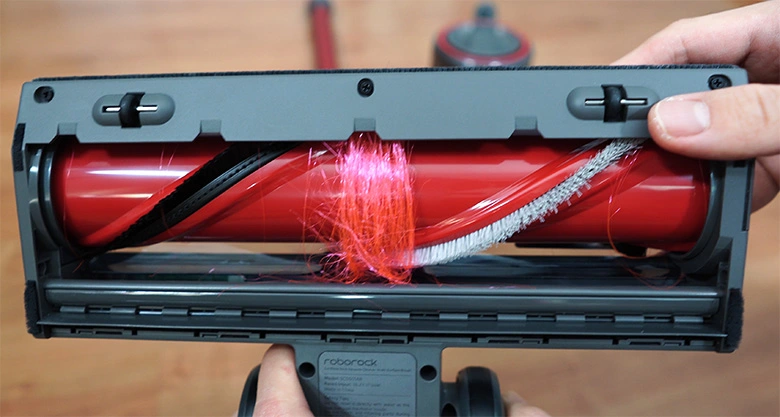 If you have pets or household members with long hair, hair wrap is one of the most common performance issues you’ll encounter. Hair tangles around the brushroll, reducing its effectiveness and eventually causing the motor to strain or the brushroll to stop spinning entirely.
In my hair wrap testing, I run a measured amount of hair through each vacuum and assess how much wraps around the brushroll. The differences between designs are dramatic — some anti-tangle brushrolls handle hair almost completely, while traditional designs require manual cleaning after every session.
What to look for:
Anti-tangle brushroll design. The most effective designs use a combination of tightly spaced bristles, comb-like features, or conical brushroll shapes that prevent hair from wrapping. Dyson’s anti-tangle Motorbar and Shark’s self-cleaning brushrolls are two examples I’ve tested that perform well.
Easy brush access. Even with anti-tangle technology, you’ll occasionally need to remove wrapped hair. Look for brushrolls that can be removed without tools and cleaned easily.
Wider airflow paths. Narrower airflow paths between the brushroll and the dustbin are more prone to hair clogs. This is a design factor that’s impossible to assess from specs — you’ll only discover it through testing or real-world use.
What to Avoid
Low-airflow models. Regardless of brand or price, a vacuum with weak airflow will struggle with both carpet cleaning and debris transport. This is the most common reason expensive vacuums underperform — they have strong suction numbers on paper but can’t move debris efficiently.
Poor brushroll design. A cheap or poorly designed brushroll leads to weak carpet cleaning and excessive hair wrap. If the manufacturer doesn’t specify the brushroll type or anti-tangle features, that’s often a sign it’s a basic design.
Sealed (non-removable) batteries. As mentioned above, this is a planned obsolescence problem. A sealed battery turns a repairable vacuum into a disposable one.
Narrow dustbins. Thin, narrow bins clog frequently and are messy to empty. Look for wide-mouth designs with at least 0.5L capacity.
Choosing Based on Your Home
Mostly Hard Floors
Prioritize a soft roller head, decent airflow, and good fine dust pickup. Filtration matters here too — hard floor cleaning tends to kick up more fine particles. My top recommendations for hard floors are in the best cordless vacuum for hardwood floors guide.
Mostly Carpet
Prioritize high airflow, a motorized brushroll with strong agitation, and good nozzle-to-carpet sealing. Suction matters more here than on hard floors. Runtime is also important — carpet cleaning drains the battery faster than hard floor cleaning because the brushroll motor is working harder. See the best cordless vacuums for carpet guide.
Mixed Flooring
If your home has a significant mix, the best approach is a vacuum with interchangeable soft roller and brushroll heads. If you prefer convenience over maximum performance, a hybrid head (like Shark’s DuoClean) handles both surfaces adequately in a single head.
Pet Owners
Prioritize an anti-tangle brushroll, strong airflow, sealed HEPA filtration, and easy dustbin emptying. Pet hair clogs, dander allergies, and frequent cleaning sessions make these factors critical. See the best cordless vacuums for pet hair guide.
Large Homes (2,000+ sq ft)
Prioritize runtime above all else. Look for removable batteries (so you can swap a charged one mid-session), real-world runtime of at least 30 minutes on standard mode, and a larger dustbin so you’re not stopping to empty constantly.
Common Mistakes to Avoid When Buying
Focusing only on suction numbers. This is the most common mistake. Suction is important, but airflow, floor head design, and filtration matter just as much — sometimes more. I’ve tested budget vacuums that outperform premium models on carpet because they have better airflow-to-suction ratios.
Ignoring floor head design for your specific floors. A vacuum optimized for carpet will scatter debris on hard floors. A vacuum optimized for hard floors won’t deep clean carpet. Match the floor head to your flooring type.
Choosing based on brand alone. Every brand has strong and weak models. I’ve tested excellent budget vacuums and disappointing premium ones. What matters is how the specific model performs in the areas that matter to you — not the logo on the handle.
Not considering your flooring type. This sounds obvious, but many buyers choose based on features or price without thinking about whether those features match their home. A high-airflow brushroll vacuum is wasted on an all-tile apartment.
Trusting claimed runtime. Always look for real-world runtime data from independent testing, not the manufacturer’s spec sheet.
What Testing Has Revealed: The Most Important Takeaway
After testing more than 30 cordless vacuums across every price range, the clearest pattern I’ve found is this: the best cordless vacuums aren’t the ones with the highest single spec — they’re the ones where airflow, floor head design, suction, and filtration all work together as a system.
Two vacuums with identical suction numbers can perform completely differently on carpet because one has better airflow and brushroll agitation. A vacuum with a “HEPA filter” sticker can leak more fine dust than one without HEPA because of poor body seals.
This is why independent testing matters, and it’s why I publish the actual test data for every vacuum I review. Specs on a box can be misleading. Test results on the same standardized tests, across dozens of models, tell the real story.
To see how I test every metric discussed in this guide, visit my testing methodology hub. And to see how every tested vacuum scores, check the full review process.
When to Buy: Getting the Best Value
If you’re considering a premium cordless vacuum, timing can save you significant money:
Sales events. Amazon Prime Day (July), Black Friday, and holiday sales consistently offer the deepest discounts on cordless vacuums. Dyson models in particular see 20-30% price drops during these events.
Previous-generation models. When a new flagship launches, the previous generation often drops in price significantly while still performing nearly identically. In my testing, the performance gap between current and previous-generation flagships is usually small — and the price gap can be $100-200.
Refurbished from the manufacturer. Dyson, Shark, and others sell refurbished units through their own stores with warranties. These can be 30-40% less than new.
What’s the Best Cordless Vacuum Right Now?
Now that you know what to look for, the next step is choosing a specific model. I’ve ranked every vacuum I’ve tested based on the factors in this guide:
See: Best Cordless Vacuums (Tested & Ranked)
Frequently Asked Questions
What is the most important feature in a cordless vacuum?
Airflow (CFM) — because it determines how effectively debris is transported from the floor into the dustbin. In my carpet deep cleaning tests, vacuums with higher airflow consistently remove more embedded dirt, regardless of their suction rating. Suction helps lift debris, but airflow is what carries it into the bin.
Is suction more important than airflow?
No. Both matter, but airflow plays a larger role in real-world cleaning. I’ve tested vacuums with strong suction but low airflow that underperform on carpet because debris gets lifted but doesn’t reach the dustbin. Ideally, you want both to be strong — but if one must be prioritized, airflow is more predictive of overall cleaning performance.
Are cordless vacuums powerful enough for carpet?
Yes — but only models with strong airflow and motorized brushroll agitation. Not all cordless vacuums clean carpet well. In my testing, some budget models with weak airflow barely remove surface debris from carpet, while the best-performing cordless vacuums extract embedded dirt at rates comparable to mid-range corded uprights.
Should I get a vacuum with a hybrid head or separate heads?
It depends on your priority. Separate heads (a soft roller for hard floors and a brushroll for carpet) will give you the best specialized performance on each surface. A hybrid head sacrifices some performance on both surfaces for the convenience of never switching heads. For most homes with mixed flooring, a hybrid head is sufficient. For homes with significant carpet area, separate heads are worth the effort.
Can a budget cordless vacuum perform well?
Yes, but you need to check the right specs. I’ve tested budget cordless vacuums under $200 that perform respectably on hard floors and light carpet cleaning. The most common weakness in budget models is low airflow and poor filtration — so if you’re on a budget, prioritize those two factors and accept trade-offs elsewhere (build quality, battery life, accessories).
How often should I clean or replace my vacuum’s filter?
Most cordless vacuum filters should be washed every 1-2 months and replaced every 6-12 months, depending on usage. A clogged filter directly reduces airflow, which means reduced cleaning performance. If your vacuum seems to be losing suction, a dirty filter is the most likely cause. For more on this, see why your cordless vacuum lost suction.
What’s the difference between a “sealed system” and a regular vacuum?
A sealed system means the vacuum body is designed so that all air passes through the filter before exiting — no air (or dust) leaks through gaps in the body. A vacuum without a sealed system may have a HEPA filter, but fine dust can escape through body gaps, making the filter less effective. I test for this with a fog test — it reveals leaks that specs alone can’t show.
Is it worth buying a Dyson over a cheaper brand?
It depends on the specific models being compared. Dyson vacuums consistently score well in my testing — particularly for airflow, filtration, and build quality — but they’re not always the best value. Some Shark and Samsung models perform comparably at lower price points. What I’d recommend: compare specific models based on test data rather than making a brand-level decision. See my individual reviews for head-to-head data.