

 Suction is the spec every vacuum brand wants you to see — but it’s also the one most likely to mislead you.
One cordless vacuum advertises “150 Air Watts of powerful suction.” Another claims “35,000 Pa.”
A third just says “extreme suction power” without any number at all. The problem is that none of these figures tell you how the vacuum actually cleans in your home.
Since 2017, I’ve tested more than 30 cordless vacuums using a water lift gauge to measure raw suction power across every power mode. In this guide, I’ll explain exactly how I run the test, what the numbers mean, and — most importantly — why suction alone doesn’t predict cleaning performance.
If you want to see how suction fits alongside my other tests, visit the Testing Methodology Hub.
What Is Suction (Water Lift)?
Suction is a vacuum’s pulling force — its ability to lift debris upward from a surface and into the airstream. The stronger the pull, the better it can extract dirt from carpet fibers, tight crevices, and other surfaces where debris tends to settle.
Think of it like drinking through a straw. The harder you draw in air, the more force you create — and the thicker the milkshake you can pull through the straw. A vacuum motor does the same thing: it spins to push air out of the machine, creating a zone of lower pressure at the inlet. The difference between that low pressure and the normal air pressure in your room is what generates suction.
The standard way to quantify this is water lift, measured in inches of H₂O. The test seals the vacuum’s inlet against a gauge filled with water, and measures how many inches the motor can pull the water upward. There’s no airflow during this measurement — it isolates the motor’s raw pulling force.
The vacuum industry has historically used the ASTM F-558 standard (“Standard Test Method for Measuring Air Performance Characteristics of Vacuum Cleaners”) as the benchmark for these measurements. My testing follows a similar principle — sealed gauge, controlled conditions, multiple readings — adapted for the consumer-level cordless vacuums I review.
Understanding the Different Suction Units
Vacuum brands use several different units to express suction power, which makes comparing models frustrating. Here’s what each one actually measures:
Inches of Water Lift (inH₂O) — The most direct measurement of sealed suction. This is what my water lift gauge reads, and it’s the unit I use throughout my testing. Most cordless vacuums fall between 20 and 120 inches of water lift.
Pascals (Pa) or Kilopascals (kPa) — Common in marketing from brands like Dreame, Roborock, and other Chinese manufacturers. This is the same concept as water lift, just expressed in metric pressure units. To roughly convert: 1 inH₂O ≈ 249 Pa. So a vacuum claiming “25,000 Pa” is roughly 100 inches of water lift. Keep in mind that many brands measure Pa differently, so these numbers aren’t always directly comparable across brands.
Air Watts (AW) — A combined measurement that factors in both suction and airflow. Dyson commonly uses this unit. Air Watts provide a fuller picture than water lift alone, but they’re still a theoretical rating — not a direct measure of cleaning ability.
Quick Reference:
| Factor | Suction (Water Lift) | Airflow (CFM) |
|---|---|---|
| What it measures | Pulling force (how hard it lifts) | Air volume (how much it moves) |
| Best for | Extracting embedded dirt, carpet cleaning | Transporting debris into the dustbin |
| Common unit | inH2O | CFM |
| Most important on | Carpet, rugs, crevices, thick pile | Hard floors, carpet, overall debris transfer |
| Key limitation | High suction alone won’t clean well without airflow | High airflow alone may not lift embedded dirt |
The important thing to understand is that none of these numbers alone predict how well a vacuum cleans. They measure potential, not performance. That’s where airflow testing and real-world debris pickup tests come in.
Why Suction Specs Alone Don’t Tell the Full Story
This is the single most important concept in this guide, and the one that most vacuum marketing deliberately obscures.
Sealed vs. Unsealed Suction
There are two ways to think about suction: sealed (at the motor, with no air flowing) and unsealed (at the cleaning head, with air moving through the system).
Sealed suction is what brands advertise. It’s the maximum theoretical pulling force the motor can generate under perfect conditions — no hose resistance, no filter drag, no air leaks.
Unsealed suction is what matters when you’re actually cleaning. Once air starts flowing through the wand, hose, and cleaning head, friction reduces the effective suction at the floor. A vacuum might measure 85 inches of water lift at the motor but deliver only a fraction of that at the brush head due to resistance in the air path.
For example, the DreameTech T30 measured 85 inches of water lift at the motor — impressive on paper. But it only delivered 41.91 CFM of airflow at the nozzle. The Dyson V15 Detect measured lower sealed suction at 65 inches of water lift, yet produced 69.19 CFM of airflow at the nozzle — nearly 50% more. In my deep-cleaning test, the V15 scored 100% while the T30 fell short, proving that suction specs alone don’t tell the full story.
This is why two vacuums with identical sealed suction numbers can perform very differently in practice. One might have a straight, wide air path that preserves suction to the floor. The other might have narrow tubes, tight bends, or a poorly sealed dustbin that bleeds pressure along the way.
The Suction-Airflow Relationship
Suction and airflow are two sides of the same coin — but they measure very different things.
Suction (water lift) measures how strongly the vacuum pulls. It determines the vacuum’s ability to lift debris from a surface — especially embedded dirt deep in carpet fibers.
Airflow (CFM — cubic feet per minute) measures how much air moves through the system. It determines how effectively debris travels from the floor, through the wand, and into the dustbin.
Here’s the simplest way I can explain it: suction is the grip strength; airflow is the arm that carries the load. A strong grip doesn’t help if you can’t move your arm, and a fast arm doesn’t help if you can’t hold onto anything.
In my testing, the vacuums that clean best — like the Dyson V15 Detect — have both strong suction and high airflow. The V15 produces 69.19 CFM at the nozzle on max power, paired with strong water lift numbers, which is why it scored 100% on my deep-cleaning test.
On the other hand, I’ve tested vacuums with impressive sealed suction numbers that still performed poorly on carpet because their airflow was restricted by narrow hose paths or clogged filters. This is exactly why I test both metrics for every vacuum I review.
| Unit | What It Measures | Common Range (Cordless) | Used By |
|---|---|---|---|
| inH2O (Water Lift) | Sealed suction force | 20–120 inches | Testing labs, independent reviewers |
| Pa / kPa | Pressure difference | 5,000–35,000 Pa | Dreame, Roborock, Xiaomi, Tineco |
| Air Watts (AW) | Suction × airflow combined | 40–250 AW | Dyson, some Samsung models |
How I Test Suction: The Water Lift Method
I use a C J Miller y-gauge and a Marshall Town water lift gauge.
Step-by-Step Procedure
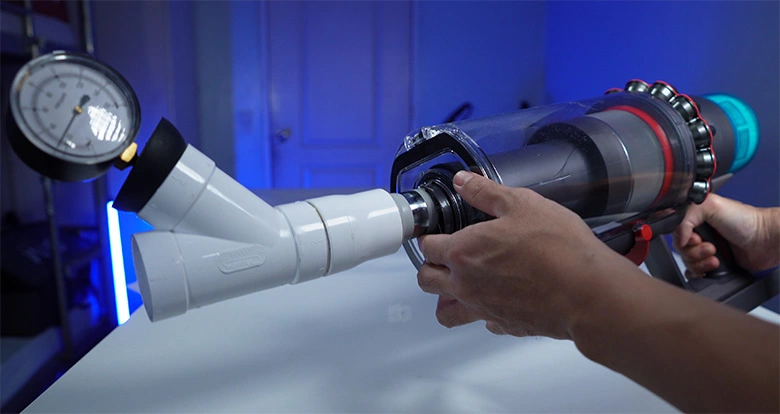
I use a Y-gauge — a Y-shaped connector that splits the vacuum’s inlet into two openings. One end is tilted (where I attach the water lift gauge) and the other end is straight (which I leave open or cover by hand to switch between test types).

My old method of testing suction without the y-gauge.
Setup. I remove the extension tube and attach the Y-gauge directly to the vacuum’s inlet, ensuring a snug fit with no air gaps. The water lift gauge goes on the tilted end of the Y-gauge. This setup stays the same for both tests — the only thing that changes is whether I cover the second opening.
Test 1: Unsealed suction. I run the vacuum on max power with the straight end of the Y-gauge left open. Air flows freely through both openings, which simulates real-world use on hard floors — where air moves under and around the cleaning head. This reading tells you how much suction the vacuum produces under normal operating conditions when the nozzle isn’t sealed against a surface.
Test 2: Sealed suction. With the vacuum still running on max, I press my palm flat over the straight end of the Y-gauge to completely block it. This simulates what happens when the cleaning head is pressed firmly against carpet, and the nozzle creates a seal against the surface. With no air escaping, the motor generates its maximum pulling force — and the gauge shows the peak water lift reading.
Both readings come from the same test run, back-to-back. I record the unsealed number first, then seal the opening and record the higher number. I repeat this at least three times and average the results.
Why I Use a Y-Gauge Instead of a Direct Connection
Early on, I tried a simpler approach — attaching the water lift gauge directly to the vacuum’s inlet using a pipe adapter, with no Y-gauge in between. The problem was that this completely sealed off the air path, meaning the motor was working against a fully blocked system. Many vacuums interpreted this as a clogged filter and shut themselves off mid-test, producing inconsistent readings.
The Y-gauge solves this by always giving the motor a second air path. Even during the sealed test (when I cover one end), some air still moves through the gauge side, so the vacuum doesn’t think it’s blocked. This produces stable, repeatable readings without triggering safety shutoffs — which is why it’s become my standard method.
Suction Test Results From My Testing
Test Results
Suction Test Results From My Testing
Water lift measurements from every cordless vacuum I’ve tested, measured at the motor using a Y-gauge on maximum power. Sorted highest to lowest. Each model name links to its full review.
Quick Reference: How to Compare Suction Units (kPa, Pa, Air Watts)
| Unit | What It Measures | Approx. Conversion | Common Brands |
|---|---|---|---|
| inH₂O (Water Lift) | Sealed suction force | Base unit (used in this table) | Testing labs, CVG, Vacuum Wars |
| Pa (Pascals) | Pressure difference | 1 inH₂O ≈ 249 Pa | Dreame, Roborock, Xiaomi, Tineco |
| kPa (Kilopascals) | Pressure difference | 1 kPa ≈ 4.01 inH₂O | Samsung, some Dreame models |
| AW (Air Watts) | Suction × airflow combined | Not directly convertible | Dyson |
Note: Brand-reported Pa and kPa numbers are measured differently across manufacturers, so direct comparison between brands can be misleading. Water lift testing under controlled conditions (as I do) provides a more consistent baseline.
| Vacuum Model | Water Lift — Max (inH₂O) | Airflow at Nozzle (CFM) | Deep Clean | Fog Test | Tier |
|---|---|---|---|---|---|
| Dyson Gen5 Outsize |
83 |
100% | No Leaks | Exceptional | |
| Dyson V15 Detect |
65 |
100% | No Leaks | Exceptional | |
| Dyson V11 Torque Drive |
60 |
100% | No Leaks | Exceptional | |
| Dyson V11 Outsize |
82 |
100% | No Leaks | Exceptional | |
| Tineco Pure One S12 | 70 | 98.3% | Slight Leaks | Strong | |
| Dyson V12 Detect Slim | 60 | 94.1% | No Leaks | Strong | |
| DreameTech T30 | 85 | 94% | Slight Leaks | Strong | |
| Tineco A11 | 65 | 96.45% | Slight Leaks | Strong | |
| Shark Vertex Pro IZ682H | 65 | 92.75% | Slight Leaks | Average | |
| Tineco A10 | 75 | 94.7% | Heavy Leaks | Average | |
| Moosoo K17 | — | 89.4% | Heavy Leaks | Below Avg | |
| Jashen V16 | — | 87.0% | No Leaks | Below Avg | |
| Dyson Omni-Glide | 50 | N/A | No Leaks | Below Avg |
What the Data Shows
After testing more than 30 cordless vacuums, a few patterns stand out.
First, suction power doesn’t always correlate with price. For example, the Tineco A11, which costs under $300, measured 65 inches of water lift — the same result as the Dyson V15 Detect at more than double the price.
Third, and more importantly, high suction does not automatically mean better cleaning. The DreameTech T30 measured 85 inches of water lift — one of the highest in my testing — but only scored 94% on the deep-cleaning test because its nozzle airflow was just 41.91 CFM. Compare that to the Dyson V15 Detect, which produced 65 inches of water lift, 69.19 CFM of airflow, and scored a perfect 100% on deep cleaning.
This is exactly why I test suction and airflow for every vacuum — and why you should never buy based on a single spec.
Suction Performance Tiers
Based on my testing data, here’s how I categorize suction performance in cordless vacuums:
Exceptional (90+ inH₂O): These vacuums generate serious pulling force. Combined with strong airflow, they handle deep-pile carpet, embedded pet hair, and heavy debris with ease. Models in this tier tend to be premium-priced. Example: Shark Vertex Pro Lift-Away
Strong (60–89 inH₂O): More than enough suction for most homes. These models handle carpet and hard floors well, especially when paired with good airflow and brush design. Examples: DreameTech T30, Dyson Gen5 Detect, Dyson Gen5 Outsize, Dyson V15 Detect, LG CordZero A9
Average (30–59 inH₂O): Adequate for hard floors and low-pile carpet. You may notice reduced deep-cleaning performance on thicker carpets. Most mid-range cordless vacuums fall here. Examples: Dyson V10 Absolute, Dyson Micro, Dyson Omni Glide, Dyson V8
Below Average (under 30 inH₂O): These vacuums struggle with embedded dirt and thick carpet. They can still work on hard floors and light surface debris, but they’re not suitable for deep cleaning. Examples: Black+Decker Furbuster
Where Suction Matters Most (and Where It Doesn’t)
Suction isn’t equally important on every surface. Understanding where it makes the biggest difference helps you decide how much suction you actually need.
Carpet — especially medium and deep pile. This is where suction matters most. Embedded dirt, sand, pet dander, and fine dust sit deep within carpet fibers, and a vacuum needs real pulling force to extract them. In my deep-cleaning tests, the vacuums with the highest suction-plus-airflow combination consistently pulled the most embedded sand from the test carpet.
Crevices and tight spaces. When you’re using a crevice tool to clean between couch cushions, along baseboards, or inside car seats, suction is what pulls debris out of narrow gaps where airflow is naturally restricted.
When the filter starts to clog. As your filter collects fine dust over time, it restricts airflow. A vacuum with strong suction can maintain its cleaning performance even with a partially clogged filter, giving you more time between filter cleanings.
Where suction matters less: hard floors. On smooth surfaces, airflow is more important than raw suction. Debris sits on top of the floor, so the vacuum doesn’t need to lift it — it just needs to move it into the dustbin. This is why some vacuums with moderate suction but strong airflow can outperform high-suction models on hardwood and tile. For more on this, see best cordless vacuums for hardwood floors.
Does Suction Decrease Over Time?
Yes — and understanding why can save you from thinking your vacuum is broken when it actually just needs maintenance.
Clogged filters are the most common cause of suction loss. The filter is the last barrier before air exits the vacuum, and when it fills with fine dust, it restricts the entire air path. In my testing, a dirty filter can reduce effective suction by 10–20%. The fix is simple: wash or replace your filter according to the manufacturer’s schedule. Most cordless vacuum filters should be washed every 2–4 weeks with regular use.
A full dustbin also reduces suction, though most people don’t realize it starts happening before the bin looks completely full. Once the bin reaches about 50–60% capacity, debris can begin to block the air path and reduce performance. I recommend emptying after every session.
Battery degradation affects suction indirectly. As the battery ages, it delivers less voltage to the motor, which means the motor spins slower and generates less pulling force. This happens gradually over 1–2 years of regular use. If your vacuum sounds noticeably weaker when fully charged, the battery may be the culprit.
For a complete troubleshooting walkthrough, see Why Your Cordless Vacuum Lost Suction (7 Common Causes + Fixes).
How Suction Fits Into My Overall Testing
Suction is one of six core metrics I measure for every cordless vacuum. Here’s how it connects to the bigger picture:
I start with power testing — both airflow (CFM) and suction (water lift) — to understand a vacuum’s raw capability. Then I run cleaning performance tests on hard floors and carpets to see whether that power translates into actual debris pickup. I test filtration using a fog test to check for seal leaks, runtime under real-world conditions, usability in terms of ergonomics and maintenance, and durability over time.
The reason I test all of these is simple: a vacuum can have exceptional suction but still perform poorly if its airflow is restricted, its filter leaks, or its brushroll can’t agitate carpet fibers. The score I assign to each vacuum on the homepage ranking reflects all six categories — not just a single number.
For the complete testing breakdown, visit the Testing Methodology Hub.
How to Check Your Own Vacuum’s Suction
You don’t need a water lift gauge to get a rough sense of whether your vacuum’s suction is holding up. Here are three simple checks you can do at home:
The tissue test. Hold a tissue or thin paper towel flat against the vacuum’s nozzle opening (with the brushroll off, if possible). Turn the vacuum on at normal power. The tissue should pull firmly against the opening and stay there without slipping. If it barely holds on or falls off, suction is significantly reduced — likely from a clogged filter or blockage.
The lift test. With the vacuum running on normal power, point the hose or crevice tool downward and see if it can pick up and hold a small, lightweight object like a ping-pong ball or a crumpled tissue. This gives you a feel for whether the pulling force is adequate.
The sound test. Turn on your vacuum and listen carefully. Then slowly move your hand to partially cover the nozzle opening. You should hear the motor strain as it works harder against the resistance. If there’s little change in sound, the motor may not be generating enough suction — or there’s an air leak somewhere in the system that’s preventing a proper seal.
If any of these tests suggest weak suction, work through the troubleshooting steps in my suction loss guide. Most of the time, the fix takes under five minutes.
For more maintenance tips and cleaning tutorials, see the Tips and How-To section.
Frequently Asked Questions
What is water lift in a vacuum cleaner?
Water lift measures a vacuum’s sealed suction strength — how hard the motor can pull against a closed system, expressed in inches of H₂O. It’s tested by sealing the vacuum’s inlet against a gauge and reading how high the motor can draw water upward. In my testing of 30+ cordless vacuums, water lift ranges from around 22 to 105 inches on maximum power, with an average of approximately 60 inches.
Is higher suction always better in a cordless vacuum?
No. Suction measures pulling force, but actual cleaning depends on the combination of suction, airflow, and brush design. I’ve tested vacuums with impressive suction numbers that still performed poorly on carpet because their airflow was restricted. The Dyson V15 Detect is a good example of the ideal balance — strong suction paired with 69.19 CFM of airflow at the nozzle, resulting in a perfect 100% deep-cleaning score.
What is a good suction level for a cordless vacuum?
Based on my testing, anything above 60 inches of water lift provides strong cleaning performance on carpet when paired with adequate airflow. Budget models typically measure between 20–40 inches, mid-range models between 40–70 inches, and premium models between 70–120+ inches. For homes with mostly hard floors, even moderate suction is sufficient — airflow matters more on smooth surfaces.
What’s the difference between suction and airflow?
Suction (water lift) measures how hard the vacuum pulls — its ability to lift debris from a surface. Airflow (CFM) measures how much air moves through the system — its ability to transport debris into the dustbin. Think of suction as grip strength and airflow as arm speed. You need both for effective cleaning. I test both metrics for every vacuum and explain the relationship in detail in my airflow vs. suction guide.
Why does my vacuum have strong suction but poor cleaning performance?
This almost always means low airflow, a clogged filter, or an air leak somewhere in the system. The vacuum’s motor might generate strong suction at the sealed inlet, but if the air path is restricted — whether by a dirty filter, full dustbin, or narrow hose — very little of that suction reaches the cleaning head. Start by washing your filter and emptying the dustbin. If the problem persists, check for blockages in the wand and hose. For a full walkthrough, see my suction loss troubleshooting guide.