

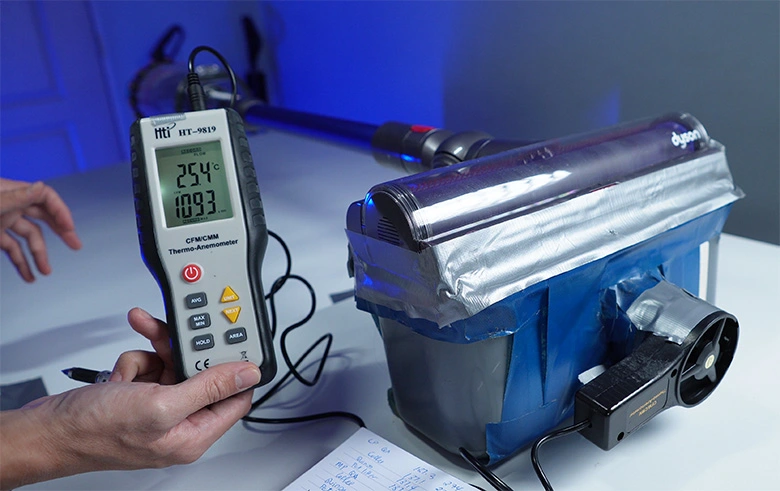
Airflow is one of the most important — and most overlooked — factors in cordless vacuum performance.
While brands love to advertise suction power in Pascals or Air Watts, airflow is what actually moves debris through the vacuum and into the dustbin. A vacuum can have impressive suction on paper and still leave dirt behind if its airflow is weak.
In this guide, I’ll explain exactly how I measure airflow using an anemometer, share the actual CFM results from every cordless vacuum I’ve tested, and show you why this number matters more than most people realize — especially on carpet.
What Is Airflow (CFM) and Why Does It Matter?
Airflow is the volume of air moving through a vacuum, measured in cubic feet per minute (CFM). Think of it this way: suction is the force that pulls debris off the floor, while airflow is the current that carries that debris through the wand, past the filter, and into the dustbin.
Without adequate airflow, debris gets stuck. It might lift off the carpet but never make it into the bin, or it gets caught somewhere in the wand or nozzle. This is why some vacuums with strong suction numbers still perform poorly in real-world cleaning tests — the motor generates force, but the system doesn’t move enough air to transport debris efficiently.
In my testing of 30+ cordless vacuums, airflow at the nozzle ranges from about 20 CFM on the low end (lightweight models like the Dyson Omni-Glide at 31.94 CFM) to over 70 CFM on high-performance models (like the Dyson V15 Detect at 73 CFM on max). That’s a massive difference — and it shows up clearly in cleaning performance.
Airflow vs. Suction: What’s the Difference?
This is the most common point of confusion I see. Here’s a simple analogy:
Imagine you’re using a garden hose. Suction is like water pressure — it determines how hard the water hits the surface. Airflow is like the volume of water — it determines how much water actually flows through the hose per minute. You need both for effective cleaning, but they measure different things.
In vacuum terms:
- Suction (water lift) is measured in inches of water. It tells you how much lifting force the motor generates. I measure this near the motor using a water lift gauge and Y-gauge setup.
- Airflow (CFM) is measured in cubic feet per minute. It tells you how much air is actually moving through the vacuum system. I measure this at both the wand and the nozzle using an anemometer.
A vacuum with high suction but low airflow can lift debris off the surface but struggle to transport it into the dustbin. In my testing, I’ve seen this exact problem — vacuums with impressive suction specs that underperform in carpet deep-cleaning tests because their airflow can’t keep up.
For a deeper comparison, see my airflow vs. suction guide.
Why Brands Advertise Suction but Rarely Mention Airflow
Suction is an easy marketing number. Brands can test it at the motor under ideal conditions (nothing attached, no restrictions) and get an impressive figure. Airflow is harder to spin because it reveals how the entire system performs — motor, wand, filter, seals, and nozzle all affect the final number.
When the Dyson Gen5 Detect launched at a premium price, my airflow tests showed it actually produced less airflow than the more affordable Dyson V15 Detect. Both delivered very similar cleaning performance despite the price difference. That’s the kind of insight airflow testing reveals.
How I Measure Airflow: Equipment and Setup
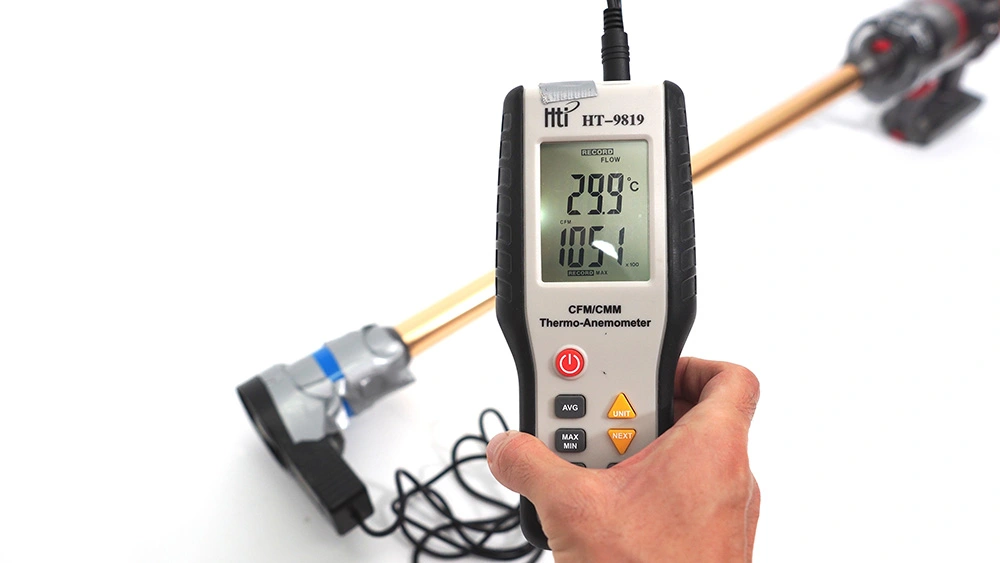
The Anemometer I Use
I use a digital anemometer to measure air velocity, which I then convert to CFM based on the cross-sectional area of the measurement point. My testing rig is custom-built to ensure consistent measurements across every vacuum I test.
Important note: My setup isn’t lab-certified, but I use the same equipment and procedure for every vacuum, which means the results are directly comparable to each other. The exact CFM number might differ slightly from what you’d get in a certified lab, but the relative differences between vacuums are accurate and consistent.
Why I Measure at Two Points (Wand and Nozzle)
I take airflow readings at two locations on every vacuum:
- The extension tube (wand) — This measures raw airflow from the motor with minimal restriction. It shows the vacuum’s maximum airflow potential before the nozzle introduces any losses.
- The floor nozzle (cleaning head) — This is the measurement that matters most. It reflects what the vacuum actually delivers at the point of contact with your floor. The nozzle’s design, seals, brushroll housing, and any gates or adjustments all restrict airflow compared to the wand reading.
The gap between wand and nozzle readings tells you how much airflow the nozzle design costs. For example, the Dyson V15 Detect produces 73 CFM at the wand but 69.19 CFM at the nozzle on max — a loss of only about 5%. Other designs with more restrictive nozzles can lose 30-50% of their airflow between the wand and the cleaning head.
My Airflow Testing Procedure
Here’s exactly how I test every cordless vacuum for airflow. This procedure is repeated identically for each model to ensure fair comparisons.
Step 1: Prepare the Vacuum
I start with a fully charged battery, an empty dustbin, and a clean filter. This gives a baseline maximum airflow reading. Testing with a partially filled bin or dirty filter would reduce airflow and make comparisons unfair.
I also make sure all components are properly attached and seated — a loose seal between the wand and body can leak air and throw off readings.
Step 2: Measure at the Wand
I attach the anemometer to the extension tube opening and run the vacuum at its maximum power setting. I take three separate readings and average them to account for any fluctuation.
For vacuums with multiple power settings, I also record CFM at each setting. For example, the Dyson V15 Detect measured:
- Eco mode: 34.55 CFM at the wand
- Auto mode: 42.38 CFM at the wand
- Max mode: 73 CFM at the wand
This shows how dramatically airflow changes across power levels — the gap between Eco and Max is more than double.
Step 4: Record and Compare
I log both wand and nozzle CFM readings into my testing database alongside the vacuum’s other performance data — suction, deep cleaning score, hair pickup, filtration results, and runtime. This lets me analyze correlations between airflow and actual cleaning performance across all tested models.
Airflow Results From My Testing
Here are the actual CFM measurements from my testing, recorded at max power. The “Deep Clean” column shows the percentage of embedded sand each vacuum extracted from medium-pile carpet — one of my most important real-world performance tests.
| Vacuum Model | Nozzle CFM (Max) | Wand CFM (Max) | Deep Clean Score | Fog Test | Review |
|---|---|---|---|---|---|
| Dyson V15 Detect | 69.19 | 73.00 | 100% | No Leaks | Full Review |
| Dyson V11 Outsize | 59.5 | 66.65 | 100% | No Leaks | Full Review |
| Dyson V11 Torque Drive | 66.13 | 53.58 | 100% | No Leaks | Full Review |
| Tineco Pure One S12 | 50.71 | 61.72 | 98.3% | Some Leaks | Full Review |
| Tineco A11 | 39.72 | 58 | 96.45% | Some Leaks | Full Review |
| Tineco A10 | 35 | 51 | 94.7% | Heavy Leaks | Full Review |
| Dyson V12 Detect Slim | 58.74 | 48.38 | 94.1 | No Leaks | Full Review |
| Moosoo K17 | 36.32 | 41.31 | 89.4% | Heavy Leaks | Full Review |
| Jashen V16 | 33.3 | 39.25 | 87.0% | No Leaks | Full Review |
| Shark Vertex Cordless | 36 | 52.53 | 94.7 | Some Leaks | Full Review |
| Dyson Omni-Glide | 26.28 | 31.94 | N/A | No Leaks | Full Review |
| All measurements taken at max power with empty dustbin and clean filter using the same anemometer and testing rig. Dash (—) indicates data not yet published for that model. Table updated as new vacuums are tested. | |||||
Table updated as new vacuums are tested. All measurements taken using the same equipment and procedure. Dash (—) indicates data not yet published for that model.
Note: I keep this table updated with every new vacuum I test. If you don’t see a model you’re curious about, contact me and I’ll prioritize it.
CFM Benchmarks for Cordless Vacuums
Based on my testing data, here’s how to interpret cordless vacuum airflow numbers at the nozzle:
- 60+ CFM: Excellent. These vacuums dominate carpet deep cleaning. The Dyson V15, V11 Torque Drive, and V11 Outsize all fall in this range, and all scored 100% in my deep clean test.
- 45-60 CFM: Good. Strong performers on carpet. The Tineco A11 (58 CFM) and Dyson V12 Detect Slim (48.38 CFM) sit here.
- 30-45 CFM: Moderate. Adequate for hard floors and light carpet use, but these models will struggle with embedded dirt. The Shark Vertex Cordless (37.87 CFM) falls here, though its aggressive brushroll helps compensate.
- Below 30 CFM: Low. Fine for hard floors with a soft roller, but not suitable for carpet deep cleaning. Some ultra-lightweight models like the Dyson Micro 1.5kg land here by design — they’re built for quick hard-floor pickups, not heavy carpet work.
You can see the pattern clearly in the results table: vacuums above 60 CFM at the nozzle consistently score 98% or higher in deep carpet cleaning. Below 45 CFM, deep clean scores start dropping noticeably.
What Affects Airflow in a Cordless Vacuum
Several factors determine how much airflow a vacuum produces at the floor — and how much it retains over time.
Filter Condition
This is the most common cause of reduced airflow. A dirty or clogged filter forces the motor to work harder while pushing less air through the system. In some vacuums, I’ve observed noticeable airflow drops when the filter hasn’t been cleaned in several weeks of regular use.
If your vacuum suddenly feels weaker, check the filter first. Wash it according to the manufacturer’s instructions and — this is critical — let it dry completely before reinstalling. A damp filter restricts airflow almost as much as a dirty one.
For more on maintaining performance, see my guide on why your cordless vacuum lost suction.
Dustbin Fill Level
As the dustbin fills, there’s less space for air to circulate, and debris can partially block the intake path. Dyson’s cyclonic separation technology helps maintain airflow as the bin fills by spinning dust out of the airstream before it reaches the filter.
Other designs without effective cyclonic systems can see more significant airflow drops as the bin fills up.
This is one reason I always test with an empty dustbin — it gives a fair baseline. But in real-world use, how well a vacuum maintains airflow as the bin fills matters too.
Nozzle and Seal Design
The nozzle is where the biggest airflow losses typically happen. Every curve, gap, seal, gate, and brushroll housing creates restriction. Well-engineered nozzles minimize these losses; cheaper designs often don’t.
The gap between wand CFM and nozzle CFM in my testing reveals this clearly. Some vacuums lose as little as 5% of their airflow from wand to nozzle (like the Dyson V15), while others lose much more. Nozzle design also explains why some vacuums with lower overall airflow can still perform well — the Shark Vertex Cordless has moderate airflow (37.87 CFM) but compensates with an aggressive dual-roller design that relies more heavily on mechanical agitation.
How Airflow Impacts Real-World Cleaning
Here’s where the numbers stop being abstract and start affecting your floors.
Carpet Deep Cleaning
This is where airflow matters most. Carpet traps dirt below the surface, embedded in the fibers where a vacuum can’t simply sweep it away. You need sufficient airflow to pull that debris up through the carpet pile and into the vacuum.
In my carpet deep cleaning test, I rub 100 grams of sand into medium-pile carpet and then measure how much each vacuum extracts. The results consistently show a strong correlation with airflow:
- Dyson V15 Detect (69.19 CFM at nozzle): 100% extraction
- Dyson V11 Torque Drive (59.5 CFM): 100% extraction
- Tineco Pure One S12 (50.71 CFM): 98.3% extraction
- Tineco A10 (35 CFM): 94.7% extraction
- Moosoo K17 (36.32 CFM): 89.4% extraction
- Jashen V16 (33.3 CFM): 87% extraction
The trend is clear: as nozzle airflow drops below 50 CFM, deep cleaning scores start falling. Airflow isn’t the only factor — brushroll agitation and nozzle sealing also play roles — but it’s the strongest single predictor in my data.
If carpet performance is a priority for you, see my best cordless vacuums for carpet picks, which are ranked using this test data.
Hard Floor Performance
On hard floors, airflow matters less because debris sits on the surface rather than being embedded in fibers. A soft roller attachment provides enough agitation to gather debris and funnel it into the nozzle’s inlet, even at lower airflow levels.
This is why models like the Dyson Omni-Glide (26.28 CFM) and Shark Vertex Cordless (36 CFM) can still score above 99% on hard floor pickup tests despite having moderate airflow. The soft roller does the heavy lifting on this surface.
Where airflow does matter on hard floors is in crevices. If your flooring has deep grooves, wide plank seams, or tile grout lines, higher airflow helps pull debris out of those gaps.
Hair Pickup and Transfer
Hair is one of the trickiest debris types for a vacuum. It’s light enough that it doesn’t need much suction to lift, but it’s long and flexible enough to get caught in the wand, nozzle, or brushroll before reaching the bin.
Higher airflow helps by creating a stronger current that pulls hair all the way through the system instead of letting it settle partway. That said, brushroll design (anti-tangle features, comb teeth, brushroll diameter) plays an equally important role in hair performance. See my best cordless vacuums for pet hair for models that handle hair well.
Limitations of the Anemometer Test
I want to be transparent about what this test can and can’t tell you.
What it does well:
- Provides consistent, comparable measurements across all vacuums I test
- Shows the airflow difference between wand and nozzle (revealing nozzle efficiency)
- Correlates strongly with carpet deep-cleaning performance in my testing
- Reveals how airflow changes across power settings
What it doesn’t capture:
- My setup isn’t lab-certified, so the absolute CFM values might differ slightly from laboratory measurements. The relative comparisons between vacuums remain valid since I use the same equipment and procedure every time.
- I test with an empty bin and clean filter, so the numbers represent peak performance. Real-world airflow will vary based on filter condition and bin fill level.
- Airflow alone doesn’t predict performance on all surfaces. Hard floor cleaning depends more on nozzle design and brushroll type than on raw CFM.
- I don’t currently measure how airflow degrades as the bin fills or the filter clogs — that’s a test I’d like to add in the future.
Airflow is one piece of a larger puzzle. That’s why I combine it with suction testing, deep cleaning tests, hair pickup tests, filtration testing (fog test), runtime measurements, and usability evaluations to give a complete picture in every review.
How Airflow Fits Into My Overall Testing
Airflow is one of six core testing categories I evaluate for every cordless vacuum. Here’s how it connects to the bigger picture:
- Airflow (CFM) — Measured at the wand and nozzle, as described in this guide
- Suction (water lift) — Measured near the motor using a water lift gauge
- Cleaning performance — Surface debris pickup and deep carpet cleaning tests
- Hair pickup — Tested with 5-, 7-, 9-, 11-, and 12-inch strands on hard floors and carpet
- Filtration — Fog test to check for seal leaks
- Runtime — Real-world runtime using the main cleaning head
Airflow and suction data help explain why a vacuum performs the way it does in cleaning tests. When a vacuum scores poorly on carpet deep cleaning, I can check whether it’s an airflow issue, a brushroll design issue, or a sealing issue.
For the full breakdown of how I test everything, see my review process and testing methodology hub.
How to Check Your Own Vacuum’s Airflow
You don’t need an anemometer to get a rough sense of whether your vacuum’s airflow is healthy. Here are two simple checks:
The hand test: Turn your vacuum on at max power and hold your hand about an inch from the nozzle opening (not the exhaust). You should feel a strong, steady pull of air. If it feels weak or inconsistent, something is restricting airflow — usually a dirty filter, a full bin, or a blockage in the wand.
The tissue test: Hold a single tissue near the nozzle opening. A vacuum with healthy airflow should pull the tissue firmly against the opening and hold it there. If the tissue flutters weakly or pulls away easily, your airflow is restricted.
If either test suggests weak airflow, start by cleaning or replacing the filter and emptying the dustbin. If the problem persists, check for blockages in the wand and nozzle — hair clogs are a common culprit.
For more troubleshooting, see my tips and how-to guides.
Frequently Asked Questions
What is a good airflow (CFM) for a cordless vacuum?
Based on my testing of 30+ cordless vacuums, nozzle airflow ranges from about 20 CFM on ultra-light models to over 69 CFM on the Dyson V15 Detect. For carpet cleaning, I recommend at least 50 CFM at the nozzle — vacuums above this threshold consistently score well in my deep cleaning tests. For hard floors only, airflow matters less since a good soft roller can compensate, and even models in the 30-40 CFM range perform well on bare surfaces.
Is airflow (CFM) more important than suction (water lift)?
Both matter, but they do different jobs. Suction is the force that pulls debris off the floor; airflow is what carries that debris through the vacuum and into the dustbin. In my testing, vacuums with high suction but low airflow often leave debris stuck in the wand or nozzle. You need adequate suction to lift debris, then sufficient airflow to transport it. For carpet specifically, airflow tends to be the stronger predictor of deep cleaning performance in my data.
Why do you measure airflow at the nozzle instead of just the motor?
Manufacturers often advertise motor-level specs because those numbers look more impressive. But the motor reading doesn’t account for restrictions from the wand, filter, nozzle design, brushroll housing, and seals. Measuring at the nozzle shows what the vacuum actually delivers where it cleans your floor. In my testing, some vacuums lose only 5% of their wand airflow by the time it reaches the nozzle, while others lose 30% or more. That difference has a real impact on cleaning performance.
Does airflow affect carpet deep cleaning?
Yes, significantly. In my carpet deep cleaning tests — where I embed 100 grams of sand into medium-pile carpet and measure extraction — vacuums with higher nozzle airflow consistently extract more embedded debris. The Dyson V15 Detect (69.19 CFM at the nozzle) extracted 100%, while the Jashen V16 (39.25 CFM) managed 87%. The correlation isn’t perfect since brushroll agitation and nozzle sealing also play roles, but airflow is the strongest single predictor of deep clean performance across all the vacuums I’ve tested.
Can a clogged filter reduce my vacuum’s airflow?
Absolutely — a dirty filter is the most common cause of reduced airflow. The filter is the main restriction point in the air path, and as it accumulates dust and debris, less air can pass through. Wash your filter regularly according to the manufacturer’s instructions, and make sure it’s completely dry before reinstalling. A damp filter restricts airflow nearly as much as a dirty one. If you notice your vacuum seems weaker than usual, the filter should be the first thing you check.
Have a vacuum you’d like me to test for airflow? Let me know — I prioritize reader requests when choosing which vacuums to test next.