

Most cordless vacuum brands push one number hard: suction power. Dyson advertises air watts. Shark highlights motor specs. Budget brands throw around “30,000Pa.”
But after measuring airflow and suction independently on over 30 cordless vacuums, the results tell a different story. Suction matters — but it’s airflow that separates vacuums that actually clean from ones that just sound powerful.
This guide explains the difference, shows real test data from my lab, and gives you a framework for cutting through misleading specs.
What Is Airflow (CFM)?
Airflow measures the volume of air moving through the vacuum system per minute. It’s measured in CFM (cubic feet per minute).
Think of airflow as the wind inside the vacuum. Once debris is pulled loose from a surface, airflow is what carries it through the hose, past the filter, and into the dustbin. Without sufficient airflow, a vacuum can grip debris but fail to transport it.
I measure airflow using an anemometer positioned at the nozzle opening. This gives the actual airflow reaching the cleaning surface — not the motor’s theoretical maximum, which is what brands typically advertise.
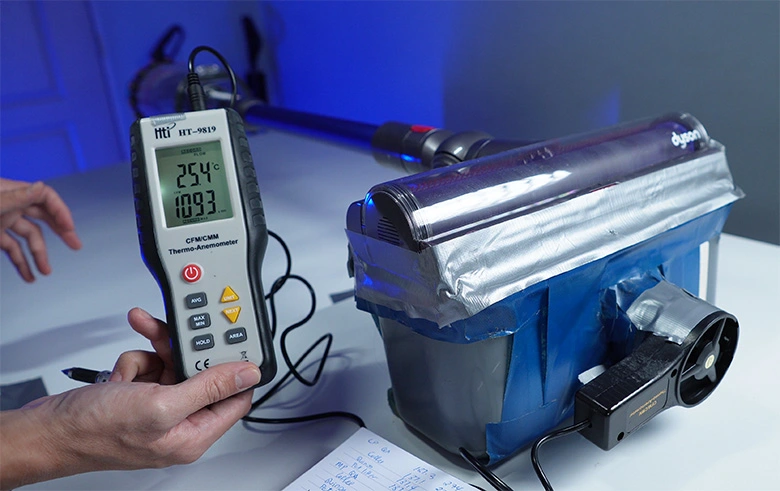
What strong airflow does:
- Transports debris efficiently from the surface to the dustbin
- Pulls fine dust and hair out of carpet fibers
- Reduces clogging by keeping particles moving
- Maintains cleaning performance as the bin fills
Typical cordless vacuum airflow ranges from my testing:
- Budget cordless vacuums: 15-29 CFM at the nozzle
- Mid-range cordless vacuums: 30-49 CFM at the nozzle
- Premium cordless vacuums (Dyson V15, Shark Stratos): 50–70 CFM at the nozzle
For context, full-size uprights typically produce 50–100+ CFM. Cordless vacuums operate with significantly less airflow, which is why motor efficiency and system design matter even more in this category.
What Is Suction (Water Lift)?
Suction measures the vacuum’s pulling force — how strongly it can draw air inward against resistance. It’s measured in inches of water lift (inches H₂O).
I measure suction using a water lift gauge connected to a sealed nozzle. This tells me the maximum pulling force the motor generates when airflow is completely blocked — the theoretical ceiling of the motor’s strength.
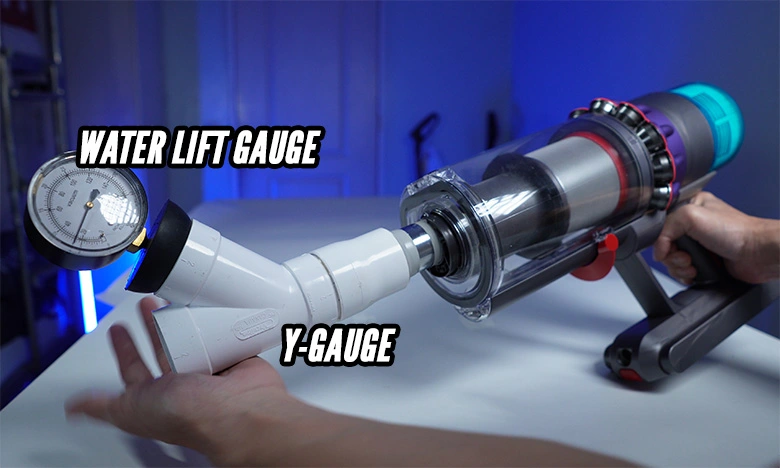
What strong suction does:
- Lifts heavier debris (cereal, gravel, cat litter)
- Maintains seal against dense carpet pile
- Helps overcome filter resistance as the filter gets dirty
- Powers effective crevice tool and attachment performance
Typical cordless vacuum suction ranges from my testing:
- Budget cordless vacuums: 20–40 inches H₂O
- Mid-range cordless vacuums: 40–60 inches H₂O
- Premium cordless vacuums: 60–80+ inches H₂O
The key distinction: suction is measured with zero airflow (in a sealed system). In real-world cleaning, the nozzle is never sealed — air is always moving. So the suction number indicates motor strength, but not how well the vacuum cleans.
How Airflow and Suction Work Together
Suction and airflow aren’t independent — they’re two ends of the same curve.
When you seal a vacuum’s nozzle completely, suction is at maximum, and airflow is zero. When the nozzle is wide open, airflow is at maximum, and suction drops to near zero. Real cleaning happens somewhere in between.
The best cordless vacuums maintain strong airflow even under resistance — meaning the motor doesn’t lose too much air volume when it encounters dense carpet or a clogged filter. This is where motor efficiency and sealed system design become critical.
The Air Watts Metric Explained
Some brands, especially Dyson, use air watts as a combined performance metric. Air watts multiply airflow (in CFM) by suction (in inches H₂O) and apply a conversion factor:
Air Watts = (Airflow in CFM × Suction in inches H₂O) ÷ 8.5
The advantage of air watts is that it captures both metrics in a single number. The disadvantage is that it can mask imbalances. A vacuum with 100 air watts from extremely high suction but poor airflow will still clean poorly on carpet compared to one with 100 air watts from a better-balanced combination.
In my testing, I report CFM and water lift separately so you can see both sides. When a vacuum has strong air watts but disappointing cleaning results, the breakdown usually explains why.
Why Airflow Matters More for Carpet Cleaning
Carpet cleaning is where airflow dominance becomes obvious.
To clean carpet effectively, three things must happen in sequence:
- Agitation — the brushroll loosens debris embedded in carpet fibers
- Suction — pulls the loosened debris away from the surface
- Airflow — carries the debris through the system and into the bin
If airflow is weak, steps 1 and 2 happen, but step 3 fails. The vacuum disturbs debris and briefly lifts it, but it falls back into the carpet because there isn’t enough airflow to carry it away.
What my testing shows
In my carpet deep-cleaning tests, I embed fine debris (baking soda, sand, and fine dust) into medium-pile carpet and measure the percentage each vacuum extracts over a fixed number of passes.
| Model | High (CFM) | Sealed (" of water lift) | Deep Cleaning (%) | Hard Floor (%) |
|---|---|---|---|---|
| Dyson V15S Detect Submarine | 56.73 | 65.00 | 100.00 | 99.75 |
| Dyson Gen5 Outsize | 59.50 | 83.00 | 100.00 | 100.00 |
| Dyson Gen5 Detect | 62.82 | 75.00 | 100.00 | 99.90 |
| Dyson V15 Detect | 69.19 | 65.00 | 100.00 | 99.85 |
| Simplicity S65 | 37.92 | 60.00 | 97.50 | 100.00 |
| Tineco A11 | 39.72 | 65.00 | 96.45 | 99.87 |
| Dyson V7 | 37.92 | 39.00 | 94.93 | 81.75 |
| LG CordZero A9 | 36.32 | 70.00 | 94.75 | 99.70 |
| DreameTech T30 | 41.91 | 85.00 | 94.00 | 98.05 |
| Miele Triflex HX1 | 45.75 | 22.00 | 93.90 | 77.75 |
| Shark IZ682H Vertex Pro | 27.76 | 65.00 | 92.75 | 99.75 |
| Dyson V9 Motorbar | 37.92 | 40.00 | 90.15 | 99.94 |
| Dyson Micro 1.5KG | 26.64 | 50.00 | 75.00 | 99.45 |
➡️ Full test methodology: How We Test Cordless Vacuums
Consistent pattern in my data: vacuums with higher nozzle CFM outperform those with higher suction but lower airflow. The Dyson V15 Detect and DreameTech T30 — both high-airflow designs — consistently score at the top of my carpet tests, even though some budget vacuums match or exceed their raw suction numbers.
What These Numbers Mean by Surface Type
Carpet
Airflow is the dominant factor. Without sufficient CFM, a vacuum agitates debris but can’t remove it. This is why some budget cordless vacuums with impressive-sounding suction specs still leave fine dust behind in carpet — the motor produces pull but not enough air volume to transport particles.
Brushroll design also plays a significant role. A vacuum with moderate airflow but an aggressive carpet brushroll (stiff bristles, tight seal against carpet) can outperform one with higher airflow but a soft roller head. The brushroll compensates by keeping debris closer to the airstream.
Hard Floors
On hard floors, the balance shifts. Suction matters more because debris sits on the surface rather than embedded in fibers. Even a vacuum with modest airflow can pick up surface debris if it has sufficient suction.
This is why soft roller heads (like the Dyson Fluffy heads) work well on hard floors despite producing less airflow than motorized carpet heads — the debris doesn’t need to be transported far; it just needs to be pulled into the intake.
That said, airflow still matters for fine dust on hard floors. A vacuum with weak airflow may push fine particles ahead of the nozzle rather than capturing them. This is evident in my hard-floor tests, where fine baking soda scatters rather than being drawn in.
Pet Hair
Pet hair pickup depends more on the combination of airflow + brush design than on raw suction.
Hair wraps around brushrolls, clogs intakes, and builds up in filters — all of which reduce airflow over time.
Vacuums that maintain airflow even as hair accumulates perform better throughout a full cleaning session.
In my hair pickup tests, the best performers share two traits: anti-tangle brushroll design and sustained airflow even with hair in the system.
➡️ See which vacuums handle pet hair best: Best Cordless Vacuums for Pet Hair
Why Vacuum Specs Can Be Misleading
Motor Wattage vs Actual Performance
Brands love advertising motor wattage (“550W motor!”), But wattage measures power consumption — not cleaning output. An inefficient motor can consume 500W and produce less airflow than an efficient 200W motor.
This is especially misleading in cordless vacuums, where motor efficiency directly affects battery life. A powerful but inefficient motor drains the battery faster without necessarily cleaning better.
The “Pa” Problem
Many budget cordless vacuums advertise suction in Pascals (Pa) — “30,000Pa suction power!” This sounds impressive, but Pa measures static pressure in a way that’s difficult to compare across brands. Different manufacturers measure at different points in the system, and Pa at the motor doesn’t translate directly to cleaning performance at the nozzle.
In my reviews, I test CFM and water lift at the nozzle using standardized equipment, which gives apples-to-apples comparisons. The Pa numbers on the box? Largely marketing.
How Filtration Affects Airflow
A factor most buyers overlook: your vacuum’s filter directly impacts airflow.
HEPA filters and fine-particle filters create more air resistance than basic filters. A well-designed vacuum compensates for this with a stronger motor and a sealed air path — but many budget vacuums don’t. The result is a vacuum that advertises “HEPA filtration” but loses significant airflow because the motor can’t push air through the filter effectively.
Dirty filters make this worse. A filter that hasn’t been cleaned in months can cut airflow by 30–50%, turning a capable vacuum into a weak one.
➡️ Learn more about how I test filtration: How We Test Vacuum Filtration (Fog Test Method)
➡️ Related: Why Your Cordless Vacuum Lost Suction — filter maintenance is often the cause.
Limitations of These Measurements
No single metric tells the full story. My airflow and suction measurements are taken at maximum power mode with a clean filter and empty bin.
Real-world performance varies because:
- Bin fill level reduces airflow progressively
- Filter condition degrades airflow over time
- Surface type creates varying resistance
- Brushroll effectiveness determines how much debris reaches the airstream
- Seal quality — leaks in the airpath reduce effective airflow even if the motor is strong
This is why I test actual cleaning performance (debris-removal percentage) in addition to raw CFM and water-lift numbers. The raw numbers explain why a vacuum performs well or poorly, but the cleaning tests show what actually happens on the floor.
A Simple Framework for Choosing a Cordless Vacuum
When evaluating a cordless vacuum, here’s what matters in order of importance:
- Actual cleaning test results — does it pick up debris effectively on the surfaces you care about?
- Airflow (CFM) — look for 25+ CFM at the nozzle for carpet cleaning; 18+ CFM for primarily hard floors.
- Suction (water lift) — anything above 40 inches H₂O is adequate for most home use. Higher helps with heavy debris and attachment tools.
- Sealed filtration system — ensures all air passes through the filter and nothing leaks. A vacuum with great airflow but a leaking seal pushes dust back into your room.
- Brushroll design — anti-tangle for pet hair, stiff bristles for carpet, soft roller for hard floors.
- Battery runtime at usable power — the runtime in “eco” mode is misleading if “eco” mode doesn’t clean effectively. Look for the runtime in the power mode you’ll actually use.
➡️ See my current top picks: Best Cordless Vacuums
How I Measure Airflow and Suction
All measurements on this site follow a consistent protocol:
Airflow test:
- Tool: Digital anemometer
- Position: At the nozzle opening (no attachment, motor head only)
- Conditions: Clean filter, empty bin, maximum power mode
- I test each power mode and report all readings
Suction test:
- Tool: Water lift gauge with Y-connector
- Position: Sealed at the nozzle
- Conditions: Clean filter, empty bin, maximum power mode
These measurements are taken on every vacuum I review and are reported on each individual review page. This allows direct comparison across models — something you can’t do with manufacturer specs, since they measure at different points and under different conditions.
➡️ Full details on all my testing methods: How We Test Cordless Vacuums
➡️ See how this fits into my overall framework: Testing Methodology Hub
Frequently Asked Questions
Does higher suction always mean better cleaning?
No. Suction (water lift) measures pulling force with a sealed nozzle — a condition that never exists during actual cleaning. A vacuum with 80 inches of water lift but poor airflow will underperform one with 50 inches of water lift and strong airflow on carpet. Suction helps with heavy debris and attachments, but airflow is what carries dirt through the system. My test results consistently show that airflow correlates more strongly with carpet cleaning scores than suction alone.
What’s a good CFM for a cordless vacuum?
From my testing, cordless vacuums in the 25–35 CFM range at the nozzle perform well on carpet. Below 18 CFM, carpet cleaning drops off significantly. For hard floors only, 15+ CFM is usually sufficient. Keep in mind these are nozzle measurements — the number at the motor will be higher since air resistance from the hose and filter reduces flow before it reaches the cleaning surface.
What are air watts, and should I trust them?
Air watts combine airflow and suction into one number (CFM × water lift ÷ 8.5). They’re useful as a general indicator — higher air watts usually means better overall performance. But air watts can hide imbalances. Two vacuums with identical air watts can clean very differently if one achieves that number through extreme suction with poor airflow versus a balanced combination. I report CFM and water lift separately so you can see both sides.
Can I improve my vacuum’s airflow?
Yes, and it’s usually free. The most common airflow killer is a dirty filter. Cleaning or replacing your filter can restore 30–50% of lost airflow. Also check for clogs in the hose, wand, and nozzle — even partial blockages reduce airflow significantly. If your vacuum has a removable dustbin, make sure the seal is intact and the bin isn’t overfull.
Why do budget vacuums advertise high Pa but clean poorly?
Pascals (Pa) measure static pressure, which is related to suction but measured differently across brands. A vacuum advertising “30,000Pa” may be measuring at the motor rather than the nozzle, and the number tells you nothing about airflow. In my testing, several budget vacuums with impressive Pa claims produced below-average CFM at the nozzle and scored poorly on carpet cleaning tests. Always look for independently tested airflow and cleaning performance data rather than relying on manufacturer Pa claims.
Have a vacuum you want me to test? Contact me, and I’ll add it to the testing queue.
All test data, photos, and measurements on this page are from my independent testing. No brands have paid for placement or influenced results. See my editorial guidelines for more.