

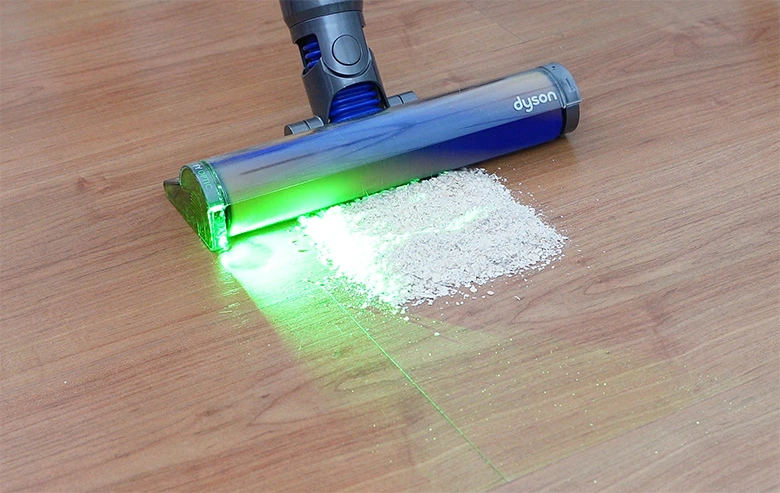
Hardwood floors may look easy to clean, but they expose weaknesses that carpet hides. On bare floors, there’s nothing for debris to cling to — so if a vacuum’s nozzle isn’t designed properly, particles get pushed forward, flung backward, or left behind entirely.
After testing over 30 cordless vacuums on real hardwood floors — measuring pickup percentages, documenting debris scatter, and comparing nozzle designs — I’ve identified the factors that genuinely separate good hard floor performance from bad. This guide covers what to look for, what to avoid, and what I’ve actually measured in testing.
Why Hardwood Floors Are Different to Clean
Carpet cleaning is mostly about power and agitation — the vacuum needs to dig into fibers and pull out embedded dirt. Hardwood floors are the opposite. Debris sits on the surface, exposed and loose, which means the vacuum needs precision and control rather than brute force.
This creates three challenges that don’t exist on carpet. First, fine dust (sand, powder, micro-particles) is highly visible on hardwood and requires a floor head that maintains consistent contact with the surface. Second, lightweight debris like oats, rice, and crumbs can easily be scattered by a poorly designed nozzle or a high-speed brushroll. Third, hard floors offer no “grip” for debris, so if airflow isn’t strong enough to transport particles into the dustbin, they end up partially picked up but never fully collected.
Understanding these differences is the foundation for choosing the right vacuum — and it’s why suction power alone is a poor predictor of hard floor performance.
The Factors That Matter Most (Based on Testing)
1. Floor Head Type: Soft Roller vs Brushroll
This is the single biggest factor in hard floor performance, and it’s not even close.

A soft roller (sometimes called a “fluffy head”) uses a woven fabric cylinder that maintains gentle, continuous contact with the floor. It picks up fine dust and large debris simultaneously without pushing particles around. In my testing, vacuums equipped with soft rollers consistently deliver pickup rates above 95% on hardwood for both standard debris and sand.
A brushroll, by contrast, uses stiff bristles designed to agitate carpet fibers. On hard floors, those spinning bristles can fling lightweight debris backward or push it out of the suction path. Models like the Dyson V9 and Moosoo K17 — both brushroll-only designs — showed noticeably higher debris scatter and lower fine dust pickup on hardwood compared to their soft roller counterparts.

Hybrid (dual-function) heads split the difference. They combine soft elements with some bristles, making them more versatile across surfaces but less effective than a dedicated soft roller on bare floors. If your home is mostly hardwood, a soft roller head will outperform a hybrid in most real-world scenarios.
For a detailed comparison with test results, see my full soft roller vs brushroll guide.
2. Standard Surface Pickup Performance

Hard floors require a vacuum that handles two types of debris effectively: fine particles (dust, sand, powder) and larger items (rice, oats, crumbs, coffee grounds). I test every vacuum using four standardized debris types — Quaker Oats, quinoa, pet litter, and coffee grounds — measuring the exact weight of collected debris against the starting amount to calculate a pickup percentage.
A good vacuum should handle both fine and large debris without pushing particles forward or leaving trails behind. In my testing, vacuums with soft roller heads consistently achieve above 95% pickup on standard hard floor debris, while brushroll-only models often fall into the 75–90% range — with the gap widening significantly on fine particles.
3. Sand Pickup (The Ultimate Hard Floor Differentiator)

Sand is dense, heavy, and unforgiving. It’s the debris type that most clearly separates strong hard floor performers from weak ones. I use 100 grams of sand, run the test twice, and average the results.
Through this test, I’ve found that bristled brush designs — common in older-generation cordless vacuums — tend to leave sand trails behind during forward passes. The bristles are engineered to agitate carpet fibers, not to sweep heavy particles off a flat surface. Soft rollers, with their continuous floor contact and fabric-wrapped design, handle sand dramatically better.
The Dyson V12 Detect, for example, picked up 99.9% of sand on hardwood in my testing. The Shark Vertex Pro IZ682H achieved 99.4%. Both use nozzle designs optimized for bare floor contact. Budget models with standard brushrolls typically land in the 80–92% range on this same test.
4. Debris Scatter Control

Debris scatter is one of the most frustrating performance issues on hardwood floors — and one of the most common in cordless vacuums that rely solely on brushrolls.
Scatter occurs when the nozzle pushes debris rather than picking it up. Three things cause it: poor nozzle sealing (gaps where particles escape), high-speed brushrolls that fling lightweight debris, and insufficient airflow to capture particles before they’re displaced.
I document scatter visually during every test. Soft roller models like the Dyson V15 Detect and Dyson V12 Detect show virtually zero scatter on standard test debris. Brushroll-only models — particularly budget options — frequently leave visible trails of scattered particles, especially with lighter debris like oats and coffee grounds.
If you’ve ever noticed your vacuum leaving more mess behind than it picks up, debris scatter from a mismatched floor head is likely the reason. Understanding why your cordless vacuum might be losing suction can also help diagnose this issue.
5. Airflow and Suction Balance
Even on hard floors, airflow matters. Suction creates the pulling force, but airflow is what actually transports debris from the nozzle into the dustbin. Low airflow can cause particles to get partially lifted but then dropped before reaching the collection chamber — a problem that shows up as inconsistent pickup or debris left in the vacuum’s path.
In my testing, I measure airflow at the nozzle (in CFM) using an anemometer. Models with higher CFM readings at the nozzle tend to perform more consistently across multiple debris types on hard floors. The Dyson V12 Detect, for instance, measured 48.38 CFM at max — significantly higher than the Shark Vertex Pro’s 27.76 CFM — which helps explain its more consistent fine particle collection.
That said, airflow alone doesn’t guarantee good hard floor performance. A vacuum with strong airflow but a poorly designed brushroll can still scatter debris. The combination of a soft roller nozzle and strong airflow is what produces the best results.
6. Edge Cleaning Reach
Dust and debris naturally accumulate along baseboards and wall edges — areas where many cordless vacuums struggle. Edge cleaning performance depends on how close the nozzle’s suction path extends to its outer edge and whether the design allows the vacuum to reach tight spots along walls.
Some models, like the Dyson Gen5 Detect and Shark Detect Pro, handle edge cleaning well regardless of approach angle. Others leave a visible gap between the cleaned floor and the baseboard. When choosing a vacuum for hardwood floors, pay attention to edge cleaning if your home has lots of baseboards and wall-to-wall flooring.
Hard Floor Test Results (30+ Vacuums Tested)
How I Test Hard Floor Performance
Every vacuum goes through the same controlled testing process on real hardwood floors in my testing area. I use three core measurements. For a complete breakdown of every test I run, see my full testing methodology.
Standard debris pickup: I scatter 50 grams each of Quaker Oats, quinoa, pet litter, and coffee grounds. I weigh the dustbin before and after vacuuming, then divide collected weight by starting weight to calculate pickup percentage.
Sand pickup: I use 100 grams of sand, run the test twice, and average the results. This test specifically targets fine particle performance on bare floors.
Scatter observation: I visually document whether the vacuum pushes debris forward or backward during each pass, noting the severity and taking photos for reference.
The table below shows results from vacuums I’ve tested on hardwood floors. I’ll continue adding results as I test new models — if you’d like me to test a specific vacuum, feel free to reach out.
Results Table
| Vacuum Model | Floor Head | Standard Surface Pickup | Sand Pickup | Debris Scatter | Hard Floor Score |
|---|---|---|---|---|---|
| Dyson V12 Detect | Soft Roller | 99.8% | 99.9% | None | 9.7 / 10 |
| Dyson V15 Detect | Soft Roller | 99.85% | 99.8% | None | 9.7 / 10 |
| Dyson Omni-Glide | Dual Soft Roller | 99.35% | 99.5% | None | 8.7 / 10 |
| Shark Vertex Pro IZ682H | DuoClean (Hybrid) | 99.75% | 99.4% | Minor | 9.5 / 10 |
| Dyson Gen5 Detect | Soft Roller | 99.9% | 99.56% | None | 9.6 / 10 |
| Dyson V8 | Soft Roller | 99.66% | 99.5% | Minimal | 9.5 / 10 |
| Shark Wandvac Stick | Brushroll | 97.8% | 98.46% | Minor | 7.1 / 10 |
| Miele Triflex HX1 | Brushroll | 77.75% | 100% | Moderate | 6.8 / 10 |
| Moosoo K17 | Brushroll | 99.58% | 99.8% | Minor | 5.9 / 10 |
This table is updated as I test new vacuums. All percentages are measured using controlled, repeatable testing methods. Want me to test a specific model? Let me know.
What this data shows: The pattern is clear — vacuums with soft roller heads dominate hard floor performance. Every model scoring above 9.0 uses a soft roller or hybrid design with a soft element. Brushroll-only models consistently underperform, particularly in the sand pickup test where the gap is most pronounced.
For my full ranked recommendations, see the Best Cordless Vacuums for Hardwood Floors (Tested & Ranked).
Protecting Your Hardwood Floors While Vacuuming
Performance matters, but so does protecting the floor itself. A powerful vacuum that scratches your hardwood is worse than a weaker one that cleans safely.
Wheel Type and Scratch Risk
Pay attention to what’s touching your floor beyond the nozzle. Rubber or felt-padded wheels glide safely across hardwood and won’t leave marks. Hard plastic wheels — common on budget models — can scuff softer wood finishes over time, especially when combined with a heavier vacuum.
The National Wood Flooring Association (NWFA) recommends using vacuums specifically designed for hard surfaces and avoiding models with exposed metal nozzle plates or unpadded wheels. Their guidance is worth following — hardwood floor damage from vacuuming is cumulative and often only becomes visible after months of
Brush Bar Safety
If you’re using a vacuum with a brushroll on hardwood, make sure you can turn the brush bar off. Fast-spinning stiff bristles can scratch delicate finishes and also reduce pickup efficiency on bare floors (by scattering debris instead of collecting it). Many newer vacuums include a brush on/off switch or automatically adjust when switching surfaces — look for this feature if you have mixed flooring.
Soft rollers don’t carry this risk. Their woven fabric construction is gentle on all hard floor types, including hardwood, tile, and laminate.
Battery Life on Hard Floor Settings
Here’s something many buyers overlook: hardwood floors typically require less power than carpet. Since debris sits on the surface rather than being embedded in fibers, you can usually clean effectively on a vacuum’s lower power setting. This means longer runtime per charge.
This is another area where soft roller heads offer an advantage. Because they’re already optimized for bare floor pickup, you don’t need to boost to a higher power mode to get good results. With a brushroll, you might find yourself switching to a higher setting to compensate for scattered debris — which drains the battery faster and defeats the purpose.
For reference, the Dyson V12 Detect runs for about 63 minutes on its lower setting — more than enough for most hardwood-floor homes. The Shark Vertex Pro gets about 50 minutes. The compact Dyson Omni-Glide trades runtime (about 23 minutes) for extreme maneuverability, which works well for small apartments with mostly hard floors.
Which Vacuums Performed Best on Hardwood
Based on my testing, here are the top performers on hardwood floors. For the full ranked list with detailed reviews, visit Best Cordless Vacuums for Hardwood Floors.
Best Overall: Dyson V12 Detect
The V12 delivers the best balance of fine dust pickup, zero debris scatter, and lightweight handling. Its Laser Slim Fluffy soft roller head exposes fine dust that’s invisible to the naked eye, making it especially effective on hardwood where dust is highly visible. At 5.2 lbs with tube and nozzle, it’s comfortable for daily use. Read my full Dyson V12 Detect review.
Best Value: Shark Vertex Pro IZ682H
If you want strong hard floor performance without the Dyson price tag, the Vertex Pro is the pick. Its DuoClean head combines a soft roller with a brushroll, giving it solid results on both hard floors and carpet. It’s heavier at 8.82 lbs and slightly noisier, but the 1.28-liter dustbin means less frequent emptying. Read my full Shark Vertex Pro review.
Best for Quick Cleanups: Dyson Omni-Glide
The Omni-Glide is a purpose-built hard floor specialist. Its dual soft roller design allows it to pick up debris in both forward and backward passes, and the four caster wheels give it true 360-degree steering. The trade-off is a tiny dustbin (0.18 liters), short runtime, and no carpet capability — but for small spaces and daily quick cleans on hardwood, nothing is more effortless. Read my full Dyson Omni-Glide review.
Filtration and Hard Floors
Fine dust is far more visible on hardwood than on carpet. If your vacuum has poor filtration or leaky seals, you might notice a thin film of dust settling back onto the floor after vacuuming — essentially redistributing the problem rather than solving it.
Good filtration means the vacuum captures fine particles and keeps them contained inside the dustbin. A sealed system prevents air from leaking through gaps in the body, ensuring that all exhaust passes through the filter. This matters more on hard floors because there’s nothing to mask the escaped dust — every particle that leaks out is visible.
If you or your family members deal with allergies, this is especially important. Pets compound the issue by introducing dander and fine hair that easily becomes airborne. For more on this, see my guide on the best cordless vacuums for pet hair.
Common Mistakes to Avoid
Choosing based only on suction power. High suction doesn’t prevent debris scatter — and on hardwood floors, scatter is often a bigger problem than insufficient suction. A 150 AW vacuum with a poorly designed brushroll will leave more mess than a 100 AW vacuum with a soft roller.
Using a brushroll for fine-dust-heavy homes. If your floors accumulate a lot of fine dust, sand, or powder (common in homes near beaches, construction areas, or with heavy foot traffic), a soft roller will dramatically outperform a brushroll. The data in my test results table makes this clear.
Assuming hybrid heads perform the same as dedicated soft rollers. Hybrid heads are a good compromise for mixed-flooring homes, but they’re still a step below a dedicated soft roller on pure hard floor performance. If your home is 80%+ hardwood, the dedicated soft roller is worth it.
Ignoring weight and maneuverability. Hard floors highlight usability issues that carpet hides. A heavy vacuum that’s hard to push or turn reduces cleaning efficiency and discourages frequent use — which is the opposite of what hardwood floors need.
How Filtration Fits Into Overall Testing
Hard floor performance is one piece of how I evaluate every cordless vacuum. My complete review process also covers carpet cleaning, hair wrap resistance, noise levels, battery runtime, filtration, and build quality. Each factor is measured using standardized, repeatable tests so you can compare vacuums objectively.
If you’re weighing performance across multiple surfaces (not just hardwood), my testing methodology hub explains every test I run and why.
Frequently Asked Questions
Does a soft roller scratch hardwood floors?
No. Soft rollers are made of woven nylon or microfiber material that maintains gentle, continuous contact with the floor. Unlike stiff-bristle brushrolls, soft rollers don’t scratch hardwood, tile, or laminate surfaces. They’re specifically designed for bare floor use.
Can I use a brushroll vacuum on hardwood floors?
Yes, but with trade-offs. Brushroll vacuums tend to scatter fine debris on hard floors rather than picking it up cleanly. In my testing, soft roller heads consistently outperform brushrolls by 15–25% in fine dust pickup on hardwood. If your vacuum has a brush on/off switch, turning the brushroll off on hard floors can help reduce scatter.
Why does my vacuum push debris on hardwood floors?
This is usually caused by one of three things: a nozzle with poor sealing (gaps where particles escape), a high-speed brushroll that flings debris backward, or insufficient airflow to capture particles before they’re displaced. Vacuums with soft roller heads and proper nozzle design minimize this problem.
Do I need a separate vacuum head for hardwood floors?
A dedicated soft roller head will give you the best results on hardwood. Hybrid or multi-surface heads work on both carpet and hard floors but don’t match the performance of a purpose-built soft roller on bare surfaces. If your vacuum came with both heads (like many Dyson models), use the soft roller for hardwood and the brushroll for carpet.
How often should I vacuum hardwood floors?
For most homes, vacuuming hardwood floors once or twice a week is sufficient to prevent grit buildup that can scratch the finish over time. Homes with pets, children, or heavy foot traffic benefit from vacuuming every other day. Since hardwood requires less power than carpet, most cordless vacuums can handle frequent sessions without running out of battery. Check out more maintenance tips for keeping your vacuum and floors in good shape.