

Carpet cleaning is where most cordless vacuums fail — and where the differences between models become impossible to ignore.
While most brands lead with suction specs, real-world testing tells a different story. After running controlled carpet experiments on more than 30 cordless vacuums, I’ve found that carpet performance depends on a combination of airflow, brushroll agitation, and nozzle sealing — not just raw suction numbers.
This guide breaks down what actually matters, backed by data from my testing lab. If you just want to see which vacuums perform best, skip straight to my carpet vacuum rankings.
Why Carpet Is the Hardest Test for a Cordless Vacuum
Hard floors are forgiving. Debris sits on the surface, and even a low-powered vacuum can push it into the dustbin with a couple of passes.
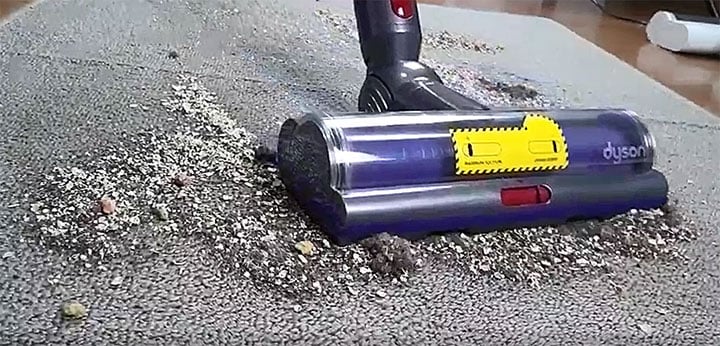
Carpet is completely different. Dirt, sand, pet hair, and allergens don’t sit on top — they get embedded deep within the fibers. Pulling that debris out requires a vacuum to do three things at once: agitate the fibers to loosen trapped particles, create enough airflow to lift them upward, and seal tightly enough to direct that airflow through the carpet rather than letting it leak around the edges.
Most cordless vacuums can handle visible crumbs on the carpet surface. Far fewer can deep-clean — and that’s where the real separation happens. In my deep-cleaning experiments, I embed 100 grams of sand into mid-pile carpet and measure how much each vacuum extracts. The results range from nearly perfect (the Dyson V15 Detect and Dyson Gen5 Outsize both hit 100%) to mediocre (the LG CordZero A9, despite strong surface pickup, managed 94.75%).
That 5% gap doesn’t sound like much on paper, but it represents a significant amount of sand left in your carpet — the kind of fine grit that wears down fibers over time and circulates allergens with every footstep.
Airflow Is the Single Biggest Factor
If I had to pick one metric that predicts carpet cleaning performance, it’s airflow — measured in cubic feet per minute (CFM).
Suction (water lift) creates the pulling force. But airflow is what physically transports debris from inside the carpet fibers, through the nozzle, and into the dustbin. Think of suction as the strength of a river’s current, and airflow as the volume of water actually moving. A narrow stream with intense current won’t carry much; a wide, powerful flow will.
What My Testing Shows
In my carpet experiments, vacuums with higher CFM at the nozzle consistently remove more embedded debris. The pattern holds across every model I’ve tested:
| Vacuum Model | Airflow at Nozzle (Max, CFM) |
Deep Clean (Embedded Sand) |
Overall Cleaning (All Debris) |
Hair Pickup (Average) |
|---|---|---|---|---|
| Dyson V15 Detect
BEST OVERALL |
69.19 | 100% | 99.91% | 97.76% |
| Dyson Gen5 Outsize
BEST FOR LARGE HOMES |
59.50 | 100% | 100% | 95.80% |
| LG CordZero A9
BEST VALUE |
36.32 | 94.75% | 98.60% | 93.26% |
| How to read this table: Airflow (CFM) is measured at the nozzle using an anemometer. Deep Clean score = percentage of 100g embedded sand recovered. Overall Cleaning = average pickup across multiple debris types. Hair Pickup = average across 5 hair lengths (5–12 inches). All tests use the same mid-pile carpet sample. See full testing methodology → | ||||
The Dyson V15 Detect and Gen5 Outsize, which have the highest airflow readings in my database, both achieved perfect deep-clean scores. The LG CordZero A9 — a solid vacuum that performs well on surface debris — has nearly half the airflow and leaves measurably more sand behind in the carpet.
This doesn’t mean suction is irrelevant. High suction helps create the pressure differential that keeps the nozzle sealed against the carpet and prevents air from leaking around the edges. But without sufficient airflow to carry particles through the system, even strong suction won’t get embedded dirt into the dustbin.
I break down the relationship between these two metrics in more detail in my airflow vs. suction guide.
How I Measure Airflow
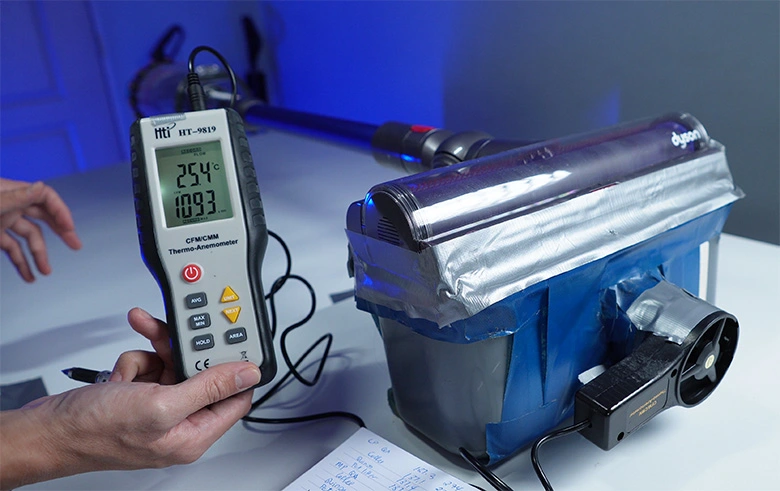
I use an anemometer to measure airflow at two points: the extension tube and the cleaner head (nozzle). The nozzle reading is the one that matters for carpet, because it reflects how much air is actually moving at the cleaning surface.
These measurements are taken the same way on every vacuum, so they’re directly comparable — even though they may differ from manufacturer-claimed CFM values, which are often measured under ideal conditions without a cleaning head attached.
Brushroll Agitation — The Second Most Important Factor
Airflow can’t do its job alone. Before air can lift debris out of carpet, something has to loosen it from the fibers first. That’s the brushroll’s job.
A well-designed carpet brushroll does two things: it agitates deep into the carpet pile to dislodge embedded dirt, and it guides the loosened debris toward the suction path so airflow can carry it away. When either function breaks down, carpet cleaning suffers — sometimes dramatically.
What Makes a Good Carpet Brushroll
In testing, the brushroll designs that perform best on carpet share a few traits:
Stiff, properly spaced bristles. Soft roller heads — like those Dyson includes for hard floors — are essentially useless on carpet. They don’t dig into the fibers and can’t dislodge embedded particles. Every time I test a vacuum in soft-roller-only configuration on carpet, the results drop significantly. Stiff nylon or polycarbonate bristles reach deeper and shake particles loose.
Consistent contact under load. A brushroll might spin fast when held in the air, but what matters is how it performs under the resistance of carpet. On a thicker pile, weaker brushrolls slow down or bounce, creating gaps in agitation. The Dyson Motorbar design maintains consistent speed across different surfaces because it uses a direct-drive motor rather than depending on airflow to spin.
Tight sealing behind the brush. This is the detail most people overlook. A gap between the rear of the brushroll and the nozzle housing allows debris to scatter backward rather than be channeled into the airflow path. Vacuums with tight rear seals — like the Dyson V15 Detect — transfer debris more efficiently.
I’ve seen lower-airflow models outperform higher-airflow ones on carpet simply because the brushroll did a better job loosening and directing debris. The brushroll and airflow work as a system — weakness in one undermines the other.

How Hair Wrap Kills Carpet Performance Over Time
Hair buildup doesn’t just make your vacuum harder to maintain — it actively degrades carpet cleaning performance. As hair wraps around the brushroll, it reduces bristle contact, which creates agitation, restricts airflow, and forces the motor to work harder, draining the battery faster.
In my hair wrap experiments, I test five different hair lengths (5, 7, 9, 11, and 12 inches) on each vacuum. The results reveal significant differences in anti-tangle design:
The Dyson V15 Detect uses built-in combs positioned behind the brushroll that strip hair off as it spins, paired with a Motorbar that combines stiff and soft bristle rows. It scored 100% on most hair lengths.
Shark takes a different approach with fins and flexible vanes that reduce wrapping in the first place. The results are decent, though not quite as consistent as Dyson’s comb system across all hair lengths.
Budget vacuums with standard bristle rolls tend to accumulate hair rapidly, and their carpet performance declines noticeably over just a few cleaning sessions if the brushroll isn’t manually cleaned.
If you have pets or anyone with long hair in the household, anti-tangle design matters just as much as raw cleaning power. For specific recommendations, see my best cordless vacuums for pet hair.
Nozzle Seal and Adjustable Gates
This is one of the most overlooked factors in carpet cleaning — and one of the biggest differentiators I see in testing.
A vacuum’s nozzle seal determines how much of the suction and airflow is actually directed through the carpet versus leaking out around the edges. A poor seal means the vacuum is working hard but not delivering that work where it counts.
Why Sealing Matters More Than You’d Think
Imagine holding a garden hose with no nozzle — water flows out, but without much force or direction. Now squeeze the end partially closed. The same volume of water now hits a smaller area with much more pressure.
A well-sealed nozzle does the same thing for airflow. It forces air through the carpet fibers instead of allowing it to escape around the sides, concentrating the cleaning power exactly where it’s needed.
In my testing, vacuums with poor nozzle sealing leave fine sand and dust behind even when their suction and airflow specs look adequate on paper. The air is there — it’s just not going through the carpet.
Adjustable Gates Change Everything
Some newer Dyson models include adjustable gates on the cleaner head that let you control the seal manually:
Closing the gates creates a tighter seal against the carpet. This concentrates suction and airflow, improving deep-cleaning performance — but it also makes the vacuum noticeably harder to push. The head grips the carpet surface more aggressively, which can feel like pushing through mud on thicker pile.
Opening the gates lets more air in from outside, reducing the seal. This makes the vacuum much easier to maneuver, but the trade-off is slightly reduced deep-cleaning intensity.
In practice, I find that a partially closed gate position offers the best compromise — strong enough sealing for effective deep cleaning, but not so tight that you fatigue your arm pushing across a whole room.
Not all vacuums have adjustable gates. Among the models I’ve tested, this is primarily a feature on Dyson’s higher-end cordless models. But even on vacuums without adjustable gates, the factory seal design matters. Check whether the cleaning head sits flat and flush against the carpet with no visible gaps around the edges — that’s a quick indicator of how well it will seal.
Suction Power — Important but Overrated
Suction, typically measured as water lift (in inches of H₂O), indicates how strong the vacuum’s pulling force is. It’s the number most brands advertise, and it’s the spec most buyers focus on. But after testing dozens of vacuums, I can say definitively: suction alone does not predict carpet cleaning performance.
Why High Suction Doesn’t Always Mean Better Carpet Cleaning
Suction matters for a few specific things on carpet. It helps pull heavier debris (like sand and grit) upward from the carpet base. It contributes to the nozzle seal by holding the cleaning head tight against the surface. And it creates the initial pressure differential that gets airflow moving.
But here’s what I’ve observed repeatedly in testing: vacuums with strong suction and low airflow produce mediocre carpet results. The vacuum can generate pulling force, but without sufficient air volume moving through the system, debris doesn’t travel from the carpet into the dustbin efficiently. It gets pulled loose but then settles back into the fibers.
The opposite combination — moderate suction with high airflow — tends to produce better real-world carpet cleaning. The debris gets moved, not just disturbed.
What My Testing Shows
In my data, the correlation between suction alone and carpet performance is weaker than most people expect. The correlation between airflow and carpet performance is much stronger. And the best-performing vacuums — like the Dyson V15 Detect — excel because they balance both, not because they max out one at the expense of the other.
For a deeper dive into how these two metrics interact, including test data across multiple models, see my full airflow vs. suction guide.
Consistent Power Delivery Across the Battery Cycle
Some cordless vacuums deliver strong performance when the battery is full but fade noticeably as charge drops. On carpet, where cleaning demands sustained power, this matters more than on hard floors.
In my runtime testing, I measure how long each vacuum runs on carpet with the main cleaner head attached — not the optimistic numbers manufacturers quote using a non-powered tool on eco mode. The reality is sobering: even the best-performing cordless vacuums typically last just over 20 minutes on carpet under realistic conditions.
Models with automatic suction adjustment (like the Dyson V15 Detect’s Auto mode) adjust power dynamically based on detected debris, which can drain the battery faster but ensures consistent cleaning intensity. In my tests, the V15 ran for about 41 minutes on Auto and just under 14 minutes on Max on carpet.
If you have a large home with lots of carpet, consider models that include swappable batteries. The LG CordZero A9 comes with two batteries that effectively double its usable runtime, and the Dyson Gen5 Outsize’s dual-battery system provides over 50 minutes of carpet cleaning time — enough for most whole-home sessions.
A declining battery doesn’t just mean shorter runtime. If a vacuum’s motor slows down as charge drops, airflow decreases, which means your last few minutes of cleaning may not be doing much actual work. This is harder to measure but worth paying attention to — if the vacuum sounds noticeably weaker toward the end of a session, it’s likely not cleaning carpet effectively at that point.
How I Test Carpet Cleaning Performance
Every carpet claim on this site is backed by controlled, repeatable testing. Here’s exactly what I do.

Test Setup
I use a consistent mid-pile carpet sample for all tests. The carpet is cleaned between models to prevent cross-contamination.
For deep-cleaning tests, I measure out 100 grams of fine sand and rub it into the carpet fibers by hand, simulating the embedded dirt that accumulates in a home over days and weeks. This isn’t debris sitting on the surface — it’s pushed down into the pile where a vacuum has to work to extract it.
What I Measure
Deep cleaning (embedded sand removal): I weigh the empty dustbin before running the vacuum over the sand-loaded carpet. After a set number of passes, I weigh the dustbin again with the collected sand. The difference, divided by 100 grams, gives the pickup percentage. Each test is run twice and averaged.
Surface debris pickup: I spread 50 grams of different debris types — Quaker Oats, quinoa, coffee grounds, and pet litter — on the test carpet and measure how much each vacuum collects in a set number of passes.
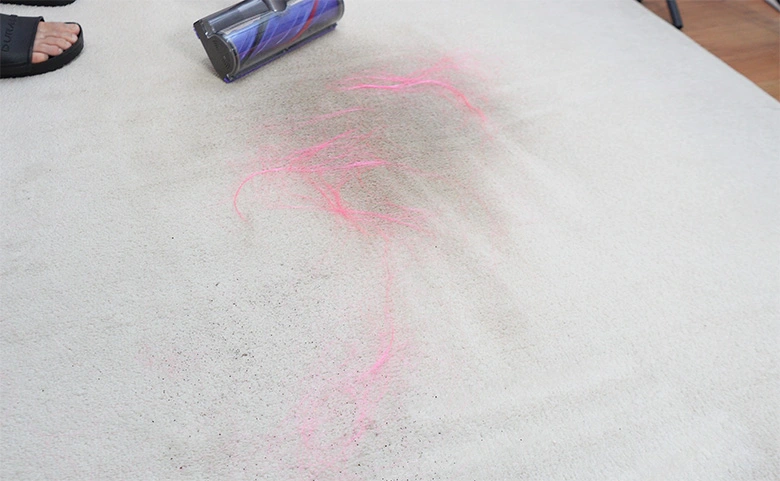
Hair pickup: I test with five hair lengths (5, 7, 9, 11, and 12 inches), rubbing at least one gram of each into mid-pile carpet. The vacuum runs until all visible hair is removed, and the collected hair is weighed against the original amount.
Airflow at the nozzle: Using an anemometer, I measure CFM at the cleaner head to quantify how much air is actually moving at the carpet surface.
Limitations
This is not a laboratory setting with ASTM-certified equipment. My anemometer readings provide reliable relative comparisons between vacuums tested the same way, but they may not match laboratory CFM values. The carpet sample is consistent, but represents one pile type — performance on your specific carpet may vary. And I’m one person testing in one environment, not a team in a controlled lab.
That said, I test every vacuum identically, so the comparisons are fair and the relative rankings are meaningful. For the full methodology across all test categories, see my review process.
Carpet Performance Results by Vacuum Model
Here’s how the cordless vacuums I’ve tested actually performed on carpet. These numbers come from controlled experiments, not manufacturer claims.
| Vacuum Model | Airflow Max CFM at nozzle |
Deep Clean Embedded sand |
Overall Cleaning All debris |
Hair Pickup Average |
Runtime Hard floor (low) |
Weight w/ tube + nozzle |
|---|---|---|---|---|---|---|
| Premium models | ||||||
| Dyson V15 Detect
BEST OVERALL · 9.6/10 |
69.19 | 100% | 99.91% | 97.76% | 84:19 | 6.8 lbs |
| Dyson Gen5 Outsize
LARGE HOMES · 9.1/10 |
59.50 | 100% | 100% | 95.80% | 79:50 | 8.6 lbs |
| Dyson Gen5 Detect
9.4/10 |
~62 | 100% | 99.5% | 98.3% | 80:13 | ~7.72 lbs |
| Mid-range & value models | ||||||
| Dyson V12 Detect Slim
LIGHTWEIGHT · 8.8/10 |
48.38 | 94.1% | 98.31% | 89.44% | 63:00 | 5.2 lbs |
| LG CordZero A9
BEST VALUE · 9.4/10 |
36.32 | 94.75% | 98.60% | 93.26% | 43:00 | 5.6 lbs |
| Tineco Pure One S12
9.4/10 |
~50 | 98.3% | 99.17% | 92.37% | 51:21 | 6.6 lbs |
| Shark Vertex Pro
8.2/10 |
21 | ~92% | ~99% | ~98% | ~40:00 | ~7.2 lbs |
| Budget models | ||||||
| Shark Vertex (IZ462H)
9.4/10 |
36 | 94.7% | ~98.4% | ~95.36% | ~69:50 | ~8.93 lbs |
| Tineco A11 Master
BUDGET PICK · 9.4/10 |
~39 | 96.45% | 98.6% | 80.85% | 26:44 | 5.5 lbs |
| Moosoo K17
9.0/10 |
~36 | 89.4% | ~96% | 87.75% | ~30:00 | ~2.79 lbs |
| Shark WS632 WandVac
8.8/10 |
~22 | 88.05% | 95.81% | 100% | ~12:00 | ~2.1 lbs |
| How to read this table: Airflow (CFM) measured at the nozzle on max setting using an anemometer. Deep Clean = percentage of 100g embedded sand recovered from mid-pile carpet. Overall Cleaning = average pickup across Quaker Oats, quinoa, coffee grounds, pet litter, and sand on hard floors and carpet. Hair Pickup = average across 5 hair lengths (5–12 inches). Runtime measured on hard floor with cleaner head on low setting. Values marked with ~ are approximate; see individual reviews for exact figures. | ||||||
This table is updated each time I test a new vacuum. Want me to test a specific model on carpet? Let me know.
A few patterns stand out from this data. The two Dyson models with the highest airflow both achieved perfect deep-clean scores. The LG CordZero A9, which has almost half the airflow, still performs respectably on surface debris (98.60% overall cleaning) but falls behind on embedded sand extraction. And hair pickup correlates more closely with brushroll design than with raw airflow or suction — the V15’s comb-based anti-tangle system gives it an edge here.
How Carpet Type Changes Everything
Not all carpet is equal, and a vacuum that performs well on one type may struggle on another.
Low-Pile Carpet
Low-pile (or loop) carpet is the easiest to clean. Debris sits closer to the surface, fibers are shorter and denser, and most cordless vacuums can deliver adequate results here. Even models with moderate airflow can handle low-pile effectively, because there’s less depth for debris to embed into.
That said, low-pile carpet can expose weaknesses in brushroll sealing. Because the fibers are short, the nozzle needs to ride close to the surface to maintain contact and suction — vacuums with poor height adjustment may leave a gap that reduces performance.
Medium-Pile Carpet
Medium-pile carpet is where the separation begins. It’s thick enough to trap sand and fine grit below the visible surface, but not so thick that all vacuums struggle. This is the carpet type I use for my standard deep-cleaning tests, because it represents the most common residential carpet.
Performance differences become apparent here. Vacuums with strong airflow and effective brushrolls handle medium-pile well, while lower-powered models start leaving debris behind — especially fine particles like sand that settle to the carpet backing.
High-Pile and Plush Carpet
High-pile and plush carpet is the most demanding surface for any cordless vacuum. The long fibers create more resistance for the brushroll, require more airflow to penetrate, and can cause weaker motors to bog down.
On thick carpet, adjustable gates (if available) can help — closing them increases the vacuum’s ability to pull through the deep pile. But it also makes the vacuum harder to push, so there’s a practical trade-off in endurance.
If you have predominantly high-pile carpet, prioritize the highest-airflow models in my testing data and expect shorter runtimes, since the vacuum works harder on this surface. The Dyson V15 Detect and Gen5 Outsize are the strongest performers I’ve tested on thick carpet.
What I Recommend Based on Testing
Based on my carpet experiments across 30+ models, three vacuums consistently outperform the rest:
Dyson V15 Detect — The best overall for carpet. It combines the highest airflow in my database (69.19 CFM) with a highly effective Motorbar brushroll and tight nozzle sealing. It achieved a perfect 100% deep-clean score and 97.76% hair pickup. The price has dropped since the Gen5 and V16 launched, making it the best value in the premium tier.
Dyson Gen5 Outsize — The best for large homes with heavy carpet. Its wider cleaning head covers more area per pass, the 1.89-liter dustbin handles big jobs, and dual batteries provide over 50 minutes of carpet runtime. It matched the V15’s perfect deep-clean score. The trade-off: it’s noticeably heavier and harder to push when the gates are closed.
LG CordZero A9 — The best value option. It doesn’t match the Dysons on deep cleaning (94.75%), but at a significantly lower price point with dual batteries included, it’s the most capable budget-friendly option I’ve tested for carpet maintenance.
For the full breakdown with detailed test data and additional models, see my best cordless vacuums for carpet.
Frequently Asked Questions
What is more important for carpet cleaning, suction or airflow?
Both matter, but airflow (CFM) has a bigger impact on real-world carpet cleaning. Suction creates the initial pulling force, but airflow is what physically moves debris from inside carpet fibers into the dustbin. In my testing, vacuums with high suction but low airflow consistently underperform on carpet compared to balanced models. I wrote a detailed breakdown of how airflow and suction work together.
Can cordless vacuums deep-clean carpet effectively?
Yes — but only certain models. In my deep-cleaning experiments, the Dyson V15 Detect and Gen5 Outsize both extracted 100% of embedded sand from mid-pile carpet. However, many budget and mid-range cordless vacuums struggle with embedded debris, even if they handle surface cleanup well. Deep cleaning requires the combination of high airflow, effective brushroll agitation, and tight nozzle sealing that only certain models deliver.
Why does my cordless vacuum leave dirt in the carpet?
The most common causes are low airflow (the vacuum can’t lift embedded particles), a weak or clogged brushroll (no agitation to loosen debris), or poor nozzle sealing (suction leaks around the edges instead of pulling through the carpet). A dirty or clogged filter can also reduce airflow significantly — see my guide on why cordless vacuums lose suction for troubleshooting steps.
Are soft roller heads good for carpet?
No. Soft roller heads are designed for hard floors and completely lack the stiff bristle agitation needed to loosen embedded dirt from carpet fibers. If your vacuum only includes a soft roller head, it will pick up visible surface debris from carpet but leave most of the embedded dirt behind. For carpet cleaning, you need a motorized brushroll with firm bristles.
How do I know if my vacuum is actually deep-cleaning my carpet?
Run the vacuum over a carpet section, then make a second pass and check the dustbin. If you’re still collecting significant debris after the first pass, that’s expected. If you’re still collecting a lot after three or four passes, the vacuum may lack the airflow or brushroll agitation for effective deep cleaning. Models like the Dyson V15 Detect include a real-time particle counter that shows exactly how much dust it’s picking up — when the count drops near zero, the carpet is genuinely clean.
Does brushroll speed matter for carpet cleaning?
Consistency matters more than raw speed. A brushroll that maintains its rotation speed under the resistance of carpet is more effective than one that spins fast when unloaded but slows down on thick pile. Motorized brushrolls with direct-drive motors (like Dyson’s Motorbar) maintain speed better than air-turbine designs, which depend on suction airflow and lose agitation as the dustbin fills or filters clog.
Have a specific vacuum you want me to test on carpet? Let me know — I’m always expanding my database.