


Hair wrap is one of the most common problems with cordless vacuums — and one of the biggest performance killers I see in testing.
As hair builds up around the brushroll, it reduces agitation, blocks airflow, and makes your vacuum less effective — especially on carpet. Left unchecked, it can even cause permanent motor damage.
The good news? It takes about five minutes to fix. Below, I’ll walk you through exactly how to remove hair wrap safely, show you which vacuums are worst (and best) for tangling based on my testing, and explain when hair wrap crosses the line from nuisance to motor killer.
Why Hair Wraps Around Your Brushroll
Hair wrap occurs when strands get caught around the brushroll as it spins. The spinning motion pulls hair inward, where it winds tightly around the bristles and — more critically — the axle.
It’s more likely in households with:
- Long hair (7–12 inches and above)
- Shedding pets (especially long-haired breeds)
- Brushrolls without anti-tangle designs
- Vacuums with exposed axle gaps near the brushroll ends
The problem compounds quickly. A few strands become a mat within a handful of uses, and once hair reaches the axle bearings, it creates friction that the motor has to fight against with every pass.
Which Brushroll Types Are Worst for Hair Tangles
In my hair pickup tests, I use standardized strand lengths of 5″, 7″, 9″, 11″, and 12″ to replicate real household conditions — from short pet hair to long human hair. Here’s what I’ve found across 30+ cordless vacuums I’ve tested.
Cylindrical Brushrolls (Worst)
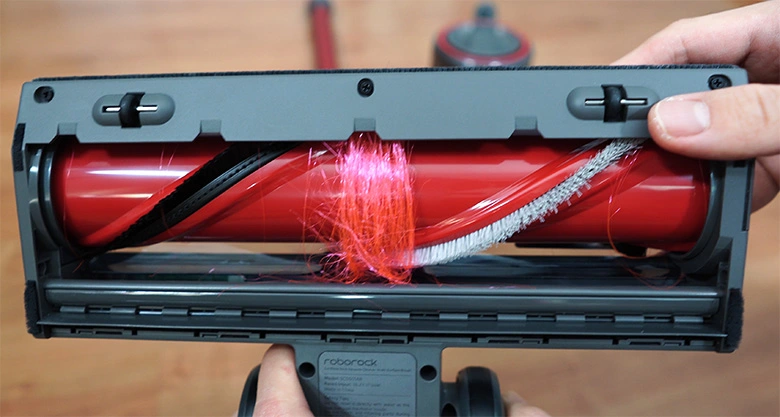
Traditional spinning cylinders wrap hair the fastest. Strands catch on bristle rows and spiral toward the axle with almost no resistance. In my 12″ strand test, tangles formed in 2–4 passes. Most budget cordless vacuums use this design.
Tapered/Conical Brushrolls (Best for Hair)

Dyson’s conical anti-tangle technology uses a tapered brush bar that funnels hair toward the outer edge and into a cutter, rather than letting it spiral around the axle. On the V15 Detect, V12 Detect Slim, and Gen5 Detect, this design is available as the Hair Screw Tool — a handheld attachment meant for upholstery, stairs, pet beds, and car seats. It’s not built into the main floor head on those models (their primary floor heads use the Digital Motorbar, which is cylindrical with anti-tangle combs — see below).
The Dyson V16 Piston Animal is the first model to bring conical anti-tangle technology into the main floor head itself. Its All Floor Cones Sense cleaner head uses two conical brush bars designed to eject hair directly into the bin as you clean — no cutting or pulling required.
In my testing of the Hair Screw Tool attachment, the conical design reduced visible axle wrap dramatically compared to standard cylindrical brushrolls — though some buildup still accumulated at the edge after extended use.
Cylindrical Brushrolls with Anti-Tangle Combs (Dyson Digital Motorbar)

This is the design Dyson uses as the main floor head on the V15 Detect and Gen5 Detect — and it’s important not to confuse it with the conical Hair Screw Tool attachment that ships with those same vacuums.
The Digital Motorbar is still a cylindrical brushroll, but Dyson added 43 polycarbonate de-tangling vanes built into the cleaner head housing. As the brushroll spins, these vanes act like a comb — they intercept hair that wraps around the brush bar and actively strip it off, directing it into the bin.
In my testing, the Digital Motorbar handled strands up to about 12 inches on carpet without significant tangling — a major improvement over older cylindrical designs like the V7 and V8 that would wrap within 2–3 passes. The combs don’t prevent all buildup (hair still migrates to the axle ends over time), but they dramatically slow it down and reduce the frequency of manual cleaning.
The key difference between this and the conical Hair Screw Tool: the Digital Motorbar relies on combs to strip hair off a standard-shaped roll after it wraps, while the conical design uses the tapered shape to prevent hair from wrapping in the first place by funneling it toward the edge. Both work well, but for different use cases — the Motorbar handles full floor cleaning, while the Hair Screw Tool is a handheld attachment for upholstery and tight spaces.
Models that use this design: Dyson V15 Detect, Dyson Gen5 Detect, Dyson Gen5 Outsize (Digital Motorbar XL — 25% wider, same comb system).
Flat/Paddle Brushrolls (Mixed)
Common in Shark models. These pick up hair effectively, but the hair tends to fold and bunch at the center shaft rather than wrap the full length. Easier to remove but still needs frequent cleaning.
The Axle: The Real Problem Area
In every vacuum I’ve tested, the brushroll axle — not the bristles — accumulated the most damaging buildup. Hair that reaches the axle is harder to cut and can stress the motor. This is why surface-level cleaning isn’t enough — you need to get into the axle area every time.
Hair Wrap Test Results by Vacuum Model
I test every cordless vacuum for hair wrap resistance using the same protocol: 5″–12″ hair strands, identical carpet surface, same number of passes. Here’s how the models I’ve tested compare.
How to read this table: “Wrap Severity” is based on how much hair accumulated on the brushroll and axle after a standardized test run. “Passes to Tangle” indicates how quickly significant wrap formed with 12″ strands.
Low Minimal wrap
Low–Mod
Moderate
High Heavy wrap
How I test: Each vacuum is tested with standardized 5″–12″ hair strands on the same carpet surface with the same number of passes. “Passes” indicates how quickly significant wrap formed with 12″ strands. Results reflect main floor head performance. Models that also include the conical Hair Screw Tool attachment are noted. I update this table as I test new vacuums — request a model if yours isn’t listed.
How to Remove Hair Wrap Step by Step
Tools You’ll Need
- Seam ripper — best control, ideal for fine or tightly wrapped hair
- Small embroidery scissors (sharp tip) — better for thick or matted hair
- Included cleaning tool (Dyson/Shark models) — only useful if it has a blade edge, not just a hook
- Trash bag or bin nearby
Avoid kitchen scissors with thick blades — they drag instead of cutting cleanly.
Step 1: Power Off and Detach
Always power off your vacuum and remove the battery before cleaning. Detach the floor head from the main body for easier access.
Step 2: Cut the Hair — Where to Cut (and Where Not To)
Most brushrolls have a narrow channel or groove running the length of the roll — this is your cutting guide. It’s usually a slight indent in the plastic or rubber between bristle rows.
Where to cut:
- Insert your seam ripper or scissors into the groove channel, not through the bristle rows
- Angle the blade parallel to the brushroll axis, not perpendicular
- Make one continuous cut from end to end — don’t stab repeatedly
What to avoid:
- Don’t cut through bristle tufts — this permanently reduces cleaning performance
- Don’t insert the blade deeper than the groove — axle damage is possible on thin brushrolls
- Don’t use excessive force — if the hair is too matted to cut easily, remove the brushroll entirely (see below)
If your model doesn’t have a groove: Some budget cordless vacuums lack a dedicated cutting groove. Look for the natural gap between bristle rows and cut along that line instead. Go slowly and keep blade angle shallow.
Step 3: Pull Out the Hair
Gently remove all strands. Be thorough — leftover hair seeds the next tangle.
Step 4: Clean the Axle and Edges
This is the step most people skip, and it’s the most important one. Hair wraps around the brushroll ends, axle caps, and side gaps where it’s hard to see. This is where the worst buildup hides and where motor damage starts.
Remove everything you can see and feel. Use tweezers for strands buried deep around the axle.
Step 5: Reassemble and Test
Reattach the floor head. Spin the brushroll by hand — it should rotate freely with no resistance or grinding. If it catches or squeals, recheck the axle area.
Removing the Brushroll for Deep Cleaning (Model-Specific)
For severe hair buildup — especially around the axle — it’s worth fully removing the brushroll rather than cleaning around it. Here’s how it works on the most common models I’ve tested:
Dyson V-Series and Gen5
Hair Screw Tool (Anti-Tangle Conical Brush): Press the red release tab on the side of the floor head, then slide the brushroll out. The axle end caps pull off with a firm tug. Clean axle caps separately — this is where the worst accumulation hides.
Laser Slim Roller: Locate the release tab on the left side of the nozzle. Pull the tab upward, then slide the roller out toward you. This gives you full access to both axles on either end.
Standard Brush: Find a coin that fits the release lever slot. Insert the coin into the slot and twist clockwise until the brush assembly pops out. Clean or replace the brush as needed.
Shark Models (IZ/IW Series)
Soft Roller Removal (Quick-Release):
- Locate the quick-release lever on the left side of the nozzle head
- Pull the lever firmly in the direction indicated by the arrow printed on the nozzle
- The roller disengages automatically and drops free from the axle
Standard Brush Roll Removal (Non-Detachable Design):
- Flip the nozzle to access the bottom panel
- Unfasten the coin-slot screws along the bottom edge (typically 1–3 screws depending on model). Be gentle — these are small and can strip easily
- Carefully lift the bottom panel to expose the brush roll chamber
- Remove visible hair wrapping by hand or with tweezers. Do not attempt to pull the roller from its axle — it will not release
- Reassemble the panel and tighten screws in a crisscross pattern (not in a line) to ensure even pressure
General rule: If you haven’t done a full brushroll removal in 3+ months of regular use, you’ll almost certainly find hidden hair buildup on the axle even after surface cleaning.
Do Anti-Tangle Brushrolls Actually Work?
Marketing claims are everywhere. Here’s what my testing actually showed.
How Anti-Tangle Systems Work
There are three main approaches:
- Cylindrical brushroll with de-tangling combs (Dyson Digital Motorbar) — The main floor head on the V15 Detect and Gen5 Detect uses a standard cylindrical brushroll, but with 43 polycarbonate de-tangling vanes built into the cleaner head. As the brush spins, the vanes actively comb hair off the brush bar and direct it into the bin. This is the most common anti-tangle system in Dyson’s current lineup and handles full floor cleaning.
- Conical/tapered design with cutter (Dyson Hair Screw Tool) — Instead of a cylindrical roll, these use a tapered shape that funnels hair toward the narrow end and into a cutting mechanism. On the V15, V12, and Gen5, this is a handheld attachment for upholstery, stairs, and pet beds — not the main floor head. The Dyson V16 Piston Animal is the first model to use this conical design in the primary floor head, with two conical brush bars in its All Floor Cones Sense cleaner head.
- Paddle/fin brushroll with comb system — Shark’s PowerFins and similar designs use a flatter paddle-style brush with combs behind the brush to catch and separate hair. Hair tends to bunch at the center shaft rather than wrap the full length, making it easier to remove.
What I Found in Testing
I ran 5″–12″ strand tests on anti-tangle vs. standard brushrolls under identical conditions — same carpet, same hair density, same number of passes.
Vacuums with true anti-tangle designs — the Digital Motorbar’s comb system on the Dyson V15 and Gen5, the conical Hair Screw Tool attachment, and Shark’s PowerFins — all significantly outperformed standard cylindrical brushrolls. Of these, the Digital Motorbar’s combs performed best for full floor cleaning with long hair, handling 12″ strands on carpet without significant wrapping.
The conical Hair Screw Tool excelled on upholstery and tight spaces. Models without any anti-tangle features struggled, especially with strands longer than 9″ and on carpet.
That said, even the best anti-tangle brushrolls need cleaning every 1–2 months. “Anti-tangle” means less maintenance, not zero maintenance.
If hair wrap is a constant problem in your household, upgrading to a vacuum with a genuine anti-tangle system is one of the most impactful changes you can make. Check my list of the best cordless vacuums for pet hair — I test every model on that list for hair wrap resistance.
When Hair Wrap Actually Damages Your Motor
Leaving hair wrap untreated isn’t just a performance issue — it can permanently damage your vacuum.
The Failure Sequence
- Hair wraps the brushroll and reaches the axle bearings
- The motor works harder to spin the now-restricted brushroll
- Heat builds up in the motor and bearing housing
- Over time, bearings wear prematurely — this is often irreversible
A clogged filter makes this worse. If the filter is restricting airflow while hair is loading the motor, you’re accelerating wear from two directions. If you haven’t cleaned your filter recently, here’s how to do it properly.
Warning Signs to Watch For
- A burning smell during use (hair friction against the hot motor housing)
- Grinding or high-pitched squealing from the floor head
- Noticeably reduced suction combined with unusual brushroll heat
- The brushroll stopping mid-use despite the motor still running
If you’re experiencing suction loss alongside these symptoms, the problem may be compounding — here’s how to diagnose whether hair wrap, a blockage, or a filter issue is the root cause.
When Does Damage Actually Occur?
In my long-term testing, light buildup causes no lasting harm if addressed within a few uses. The danger zone is sustained use over weeks with heavy accumulation — particularly when hair reaches and locks around the axle end caps.
Bottom line: Clean hair wrap every 1–3 uses if you have long hair or pets. Don’t wait until you notice performance loss — by then, wear may already have started.
How Often Should You Remove Hair Wrap?
The right frequency depends on your household:
- Pet owners (especially long-haired breeds): Every 1–2 uses
- Long hair households: Weekly
- Short hair / light use: Every 2–3 weeks
These aren’t arbitrary numbers — they’re based on how quickly I’ve seen significant axle accumulation form across different hair types in my testing.
How to Prevent Hair Wrap

1. Clean the Brushroll Regularly
Don’t let buildup accumulate. A 2-minute check after each use is faster than a 15-minute deep clean later.
2. Choose a Vacuum With Anti-Tangle Technology
If hair wrap is a recurring frustration, a vacuum with a genuine anti-tangle system will make the biggest difference. Based on my testing, the Dyson Gen5 Detect and V15 Detect — with their Digital Motorbar comb system and included Hair Screw Tool — offer the best hair wrap resistance among cordless vacuums currently available. Shark models with PowerFins and comb systems are a more affordable option with good (though not quite as effective) tangle reduction.
For a detailed breakdown of which models perform best, see how each vacuum handles hair in my brushroll vs. soft roller comparison.
3. Vacuum High-Shedding Areas More Frequently
Bedrooms and areas where pets sleep accumulate hair fastest. Vacuuming these zones more often — rather than waiting for visible hair clumps — prevents the kind of heavy loads that overwhelm any brushroll.
Frequently Asked Questions
Can hair wrap damage a vacuum permanently?
Yes. In my long-term testing, sustained hair wrap around the axle bearings caused premature motor wear that was irreversible. The warning signs are grinding noises, burning smells, and the brushroll slowing down or stopping mid-use. Light buildup cleaned within a few uses causes no lasting damage — the risk comes from weeks of heavy accumulation left unchecked.
What’s the best tool for removing hair from a brushroll?
A seam ripper gives you the most control and is ideal for fine or tightly wrapped hair. Small embroidery scissors with a sharp tip work better for thick, matted buildup. The cleaning tools included with some Dyson and Shark models are adequate for light maintenance but not great for heavy tangles — they lack a real cutting edge.
Why does hair keep wrapping around my brushroll even after I clean it?
Three common reasons: your brushroll design doesn’t have anti-tangle features (most cylindrical brushrolls will always wrap hair), you’re cleaning the bristles but not the axle and end caps (where hair migrates and causes the real problems), or you’re waiting too long between cleanings. If you have long hair or pets, cleaning every 1–2 uses prevents the compounding tangle effect.
Are anti-tangle brushrolls worth the extra cost?
Based on my testing across 30+ vacuums — yes, if hair wrap is a recurring problem for you. Models with true anti-tangle systems (Dyson’s Digital Motorbar with de-tangling combs, Shark’s PowerFins designs) reduced hair wrap significantly compared to standard brushrolls. They don’t eliminate maintenance entirely, but they extend the interval from “every use” to “every month or two.” The improvement is most dramatic with hair longer than 9 inches.
Can I upgrade my current vacuum’s brushroll to an anti-tangle version?
In most cases, no. Anti-tangle systems are engineered into the floor head design — the brushroll shape, the comb placement, and the airflow path all work together. You can’t just swap in a different brushroll and get the same results. If hair wrap is a serious issue, upgrading the vacuum itself is the more reliable solution. Check my recommended models for pet hair households — each one has been tested specifically for hair wrap resistance.