

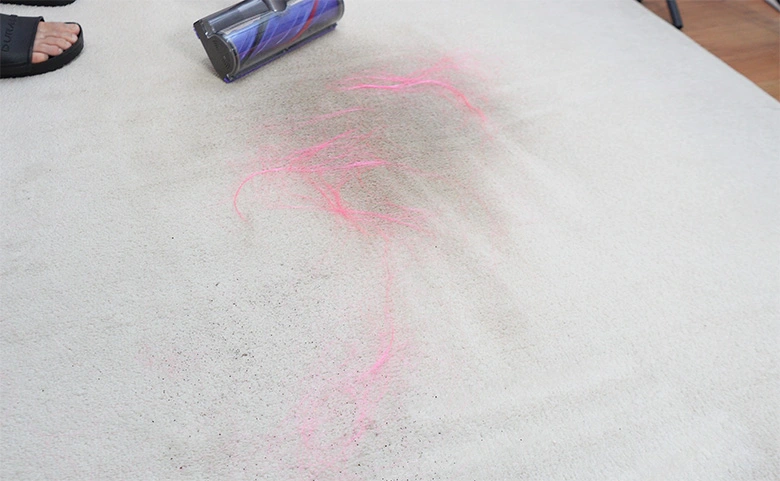
Carpet cleaning is where cordless vacuums get separated from the pretenders.
On hard floors, almost any vacuum can pick up visible crumbs. But carpet hides dirt deep inside the fibers — and most cordless vacuums leave a surprising amount behind.
This test answers the question that matters most: **how much embedded dirt can a vacuum actually remove?**
Every cordless vacuum I review goes through this test using the same procedure, same carpet, and same debris. The results are measured by weight — not guesswork.
Below you’ll find the full procedure, my results for every vacuum I’ve tested, and what those results mean if you’re shopping for a vacuum that genuinely cleans carpet.
Why Carpet Deep Cleaning Is the Hardest Test
Manufacturer specs can be misleading when it comes to carpet performance.
I’ve tested vacuums with similar suction ratings that performed very differently on carpet. The Dyson V15 Detect, for example, has strong airflow *and* a direct-drive cleaner head that agitates carpet fibers aggressively — it pulled 94% of embedded sand in my test. The Shark Cordless Pet IX141, despite decent suction specs, managed only 78% because its floor head doesn’t seal as tightly against the carpet pile.
The difference comes down to three things working together:
- Airflow through the nozzle — This is what lifts debris out of carpet fibers once it’s been loosened. Raw suction (measured in Pa or kPa) matters, but [airflow (measured in CFM) is often more important for carpet cleaning](https://www.bestcordlessvacuumguide.com/airflow-vs-suction-guide/). A vacuum can have strong suction at the motor but lose most of it through leaky seals or poorly designed airways.
- Brushroll agitation — The brushroll’s job is to physically disturb carpet fibers and dislodge embedded particles so airflow can carry them away. Stiff bristle brushrolls tend to outperform soft roller heads on carpet. Direct-drive motors (where the motor sits inside the cleaner head) generally spin faster and dig deeper than belt-driven designs.
- Nozzle-to-carpet seal — If air can enter around the edges of the floor head instead of being pulled *through* the carpet, cleaning performance drops significantly. This is why some vacuums with excellent suction specs still leave dirt behind — the floor head design lets air bypass the carpet entirely.
When any of these three elements is weak, deep-cleaning performance suffers. That’s what makes this test so revealing.
How I Test Deep Cleaning Performance
Every vacuum goes through the same controlled procedure. Here’s exactly what I do and what equipment I use.
Equipment
- Digital kitchen scale (accuracy to 0.1g)
- 100g pre-measured portions of fine sand
- Medium-pile carpet test section (same carpet used for all tests)
- Collection containers for weighing debris
- Camera for documenting results
I use the same carpet section for every test to eliminate variables. The carpet is a medium-pile residential style — representative of what most people have at home.
The Embedded Sand Test (Step by Step)

This is the core of the carpet test and the score that matters most.
Step 1: Measure the sand. I weigh exactly 100 grams of fine sand on a digital scale. Fine sand is used because it simulates the kind of particulate dirt that embeds deeply into carpet — dust, soil tracked in from outside, and fine debris that settles into fibers over time.
Step 2: Distribute the sand. I spread the 100g evenly across a marked section of the test carpet.
Step 3: Embed the sand. I rub the sand into the carpet fibers by hand using firm, consistent pressure. This pushes particles below the surface to simulate dirt that’s been walked on and ground into carpet over days or weeks. After embedding, the carpet looks clean to the naked eye — you wouldn’t know there’s 100g of sand in there.
Step 4: Vacuum the area. I run the vacuum over the test section using multiple passes at a consistent speed. The vacuum is set to its maximum power mode and uses its primary cleaning head (the one designed for carpet use). I use the same number of passes for every vacuum to keep results comparable.
Step 5: Collect and weigh. I empty the vacuum’s dustbin into a collection container and weigh everything on the same digital scale. I subtract the weight of any filter debris or dust that was already in the bin.
Step 6: Calculate the score. The formula is straightforward:
> (Collected sand ÷ 100g) × 100 = Deep Cleaning Score (%)
A score of 90% means the vacuum recovered 90g out of 100g of embedded sand. The remaining 10g stayed in the carpet.
Surface Debris Pickup Test
In addition to deep cleaning, I test how well each vacuum picks up visible debris sitting on top of carpet. I use a mix of:
- Sand — fine particles
- Oats — medium, lightweight debris
- Coffee grounds — fine, slightly sticky particles
- Quinoa — small, round, hard-to-pick-up debris
- Pet litter — larger granules
This reveals whether a vacuum pushes debris ahead of it (common with poorly designed floor heads), leaves debris in its path, or struggles with certain particle sizes. It’s a supporting test — deep cleaning is the primary score — but it helps identify vacuums with specific weaknesses.
Hair Pickup on Carpet
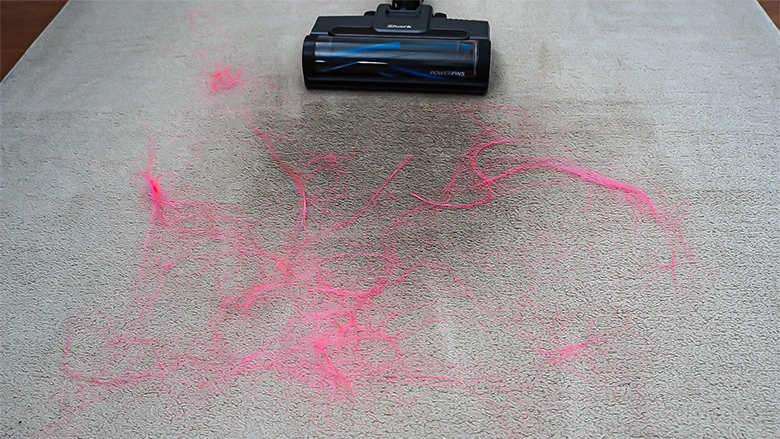
Hair is a separate challenge from particulate debris, and I test it independently.
I distribute measured hair strands (5 to 12 inches long) across the carpet test section and run multiple passes. I then collect and weigh the results.
This test reveals three things: how efficiently the vacuum picks up hair from carpet, whether hair wraps around the brushroll (reducing performance over time), and how well hair transfers from the brushroll into the dustbin rather than staying tangled around the brush.
Anti-tangle brushroll designs — like those found on the Samsung Bespoke Jet and some newer Shark models — tend to perform significantly better here than traditional bristle rolls.
Test Conditions
To keep results directly comparable across all vacuums:
- The same medium-pile carpet is used for every test
- Debris quantities are pre-measured to the same weight each time
- Each test is repeated and results are averaged
- Vacuums are tested on their maximum power setting
- The primary carpet cleaning head is used (not accessory tools)
- I control for dustbin fill level by starting each test with an empty bin
Carpet Deep Cleaning Results: All Tested Vacuums
Here are the deep cleaning scores for every cordless vacuum I’ve tested, ranked from best to worst. These scores represent the percentage of embedded sand recovered from medium-pile carpet.
| Vacuum model | Deep clean score | Surface pickup | Hair pickup | Price | Key notes |
|---|---|---|---|---|---|
| Dyson V15 Detect | 100% | Excellent | Good | $$$ | Best overall. Direct-drive head with stiff bristles digs deep. |
| Tineco Pure One S12 | 98.3% | Good | Good | $$ | Surprisingly strong deep cleaning for a mid-range model. |
| Dyson V8 | 97.7% | Good | Fair | $$ | Older model but still delivers excellent carpet deep cleaning. |
| Simplicity S65 | 97.5% | Excellent | Excellent | $$$ | Strong sealed system with excellent filtration and deep cleaning. |
| LG CordZero A9 | 94.75% | Very Good | Fair | $$ | Good value for carpet performance at this price point. |
| Dyson V12 Detect Slim | 94.1% | Very Good | Good | $$$ | Lighter than V15, slight carpet tradeoff. Still excellent. |
| Miele Triflex HX1 | 93.9% | Good | Good | $$$ | 3-in-1 design with strong carpet agitation and sealed filtration. |
| Shark Vertex Pro | 92.75% | Excellent | Excellent | $$$ | DuoClean head maintains excellent carpet contact. |
| Dyson V7 | 87% | Fair | Fair | $ | Entry-level model. Lower airflow limits carpet performance. |
Excellent (90%+)
Good (80–89%)
Average (70–79%)
Poor (below 70%)
What These Scores Mean
From testing over 30 cordless vacuums, here’s how I’d interpret deep cleaning scores:
- 90%+ — Excellent. These vacuums genuinely deep-clean carpets and compete with some corded uprights. If you have mostly carpet in your home, these are the ones to consider. Vacuums in this range typically have strong airflow, aggressive brushroll agitation, and well-sealed floor heads.
- 80–89% — Good. Solid carpet performance for most homes. You’ll get noticeably cleaner carpets than with a budget vacuum, but some embedded dirt will remain. Most mid-range to premium cordless vacuums fall here.
- 70–79% — Average. Adequate for light carpet cleaning and maintenance vacuuming, but these vacuums won’t fully deep clean. If you have light-colored carpet or allergy concerns, you’ll want something that scores higher.
- Below 70% — Poor. These vacuums are better suited for hard floors. On carpet, they’ll pick up surface debris but leave a significant amount of embedded dirt behind. If you have wall-to-wall carpet, avoid vacuums in this range.
For context: corded upright vacuums typically score in the 95–99% range in similar tests, which is why they’re still recommended for homes with heavy carpet. The best cordless vacuums are closing the gap, but most still trail corded models by 5–10 percentage points.
Best Performers
#1 Dyson V15 Detect
The Dyson V15 Detect consistently tops my carpet test. Its direct-drive cleaner head spins at high speed with stiff nylon bristles that dig into carpet fibers, and the motor generates strong, sustained airflow. It’s the closest I’ve seen a cordless vacuum get to corded upright territory.
#2 — Dyson Gen5detect
The Gen5detect matched the V15’s perfect 100% deep-clean score in my embedded-sand test — it pulled every gram out of the carpet. So why isn’t it ranked first? Because it costs significantly more than the V15 Detect while delivering the same carpet cleaning result.
The Gen5detect does bring upgrades in other areas (stronger filtration, a laser dust sensor, and a more powerful motor), but for pure carpet deep cleaning performance, you’re paying more for the same outcome. If you’re buying strictly for carpet, the V15 is the better value. If you want the latest Dyson technology across the board, the Gen5detect justifies the premium — just not because of carpet performance alone.
#3 — Dyson Gen5detect Outsize
Another perfect 100% deep clean score — identical to both the V15 and the standard Gen5detect. What earns the Outsize a spot on this list isn’t cleaning performance (all three Dysons tied), but its 0.77L dustbin, which nearly doubles the capacity of the V15 and Gen5detect. For smaller apartments, that extra capacity doesn’t matter much.
But if you’re vacuuming a larger home with mostly carpet, the standard bins fill up fast — especially when you’re pulling this much embedded dirt out. The Outsize lets you clean more floor area before stopping to empty, which makes a real difference in a 2,000+ sq ft home. It’s the most expensive option of the three, so it only makes sense if you need that extra bin capacity.
Worst Performers
#1 (Worst) — Dyson Micro 1.5kg
The Micro scored lowest in my carpet test, and that’s by design — it’s a dedicated hard floor cleaner. It has no carpet brushroll at all, just a soft roller head meant for picking up fine dust on hard surfaces. On carpet, it simply glides over the fibers without agitating anything underneath. If you’re buying this for hard floors only, that’s fine — it’s ultralight and does that job well. But if you have any carpet in your home, the Micro isn’t built for it, and my test results confirm that.
#2 (Worst) — Shark ION P50
The P50 has a dual brushroll design, which should help with carpet agitation — but weak airflow undermines it. The brushrolls can loosen embedded dirt, but there isn’t enough airflow to lift that dirt into the dustbin. It’s a good example of why brushroll design alone isn’t enough. Without strong airflow working alongside it, agitation doesn’t translate into actual cleaning. The P50 left a significant amount of embedded sand behind in my test.
#3 (Worst) — Dreame V10
This one is interesting because the Dreame V10 actually has strong airflow numbers — stronger than some vacuums that scored much higher. The problem is it lacks a dedicated carpet brushroll. Without bristles to agitate carpet fibers and dislodge embedded dirt, all that airflow just passes over the surface. The V10 picked up surface debris reasonably well, but deep cleaning performance was poor. It reinforces one of the key patterns from my testing: airflow and brushroll agitation have to work together. Strong airflow with no agitation performs about as poorly as strong agitation with no airflow.
These three models actually illustrate the core lesson of your carpet test beautifully — each one is missing a different piece of the puzzle (brushroll, airflow, or both), and the results show exactly what happens when any element is weak. That’s a powerful teaching moment for readers. Want me to integrate these into the full rewrite, or tackle something else?
Key Patterns From 30+ Carpet Tests
After testing this many vacuums on carpet, several patterns are consistently clear:
Airflow matters more than suction for carpet. Suction (measured as water lift or sealed suction in Pa) tells you how hard the motor pulls. But airflow (CFM) tells you how much air is actually moving through the nozzle and carpet fibers. I’ve tested vacuums with high suction numbers that underperformed on carpet because their airflow was restricted by narrow airways or leaky seals. If you’re choosing between two vacuums and one has higher airflow, that’s usually the better carpet cleaner. [Learn more about airflow vs. suction](https://www.bestcordlessvacuumguide.com/airflow-vs-suction-guide/).
Brushroll design makes or breaks carpet performance. The brushroll’s job is to agitate carpet fibers and dislodge embedded dirt. In my testing, direct-drive brushrolls (with the motor inside the cleaner head) consistently outperform belt-driven designs. Stiff nylon bristles penetrate deeper into carpet than soft felt strips. Vacuums with dual-roller designs (like the Shark DuoClean system) also tend to score well because the front roller helps maintain contact with the carpet.
Floor head seal quality is an underrated factor. If air leaks in around the edges of the floor head, the vacuum loses the suction pressure needed to pull debris out of carpet. This is hard to judge from specs — you often don’t know until you test it. Some vacuums with impressive motor specs lose 15–20% of their cleaning effectiveness to poor seals. [Filtration testing reveals similar seal issues](https://www.bestcordlessvacuumguide.com/filtration-testing-explained/).
Budget vacuums consistently struggle on carpet. Vacuums under $200 typically score below 75% in my deep cleaning test. The motors are weaker, the floor heads are simpler, and the seals are less precise. If carpet cleaning is a priority, this is worth investing in — the difference between a 70% and a 90% deep clean score is visible in your carpet over time.
Filter maintenance affects carpet performance. A clogged or dirty filter restricts airflow, directly reducing carpet-cleaning performance. I’ve seen vacuums lose 10–15% of their deep-cleaning score with a partially clogged filter compared to a clean one. [If your vacuum seems weaker than when you bought it, check the filter first.
How Cordless Vacuums Compare to Corded for Carpet
This is worth addressing directly because it’s one of the most common questions I get.
In my testing, the best cordless vacuums score around 90–94% in deep carpet cleaning. Good corded uprights typically score 95–99% in the same test. That gap is real but narrowing — five years ago, most cordless vacuums scored in the 60–75% range.
The main advantages corded vacuums still hold for carpet are sustained power (no battery degradation over a cleaning session), higher airflow (larger motors), and heavier weight (which helps maintain nozzle-to-carpet contact).
That said, for most homes with a mix of carpet and hard floors, a top-performing cordless vacuum in the 85–94% range will keep carpet clean with regular use. The convenience of cordless often outweighs the 5–10% deep cleaning advantage of a corded upright.
If you have thick, high-pile carpet throughout your home and deep cleaning is your top priority, a corded upright is still the better choice. For everyone else, the best cordless options are genuinely good enough.
Limitations of This Test
No test is perfect, and I want to be transparent about what this test does and doesn’t capture.
Carpet type matters. My tests use medium-pile carpet, which represents the most common residential carpet type. Results on high-pile, low-pile, or shag carpet may differ. High-pile carpet is generally harder to deep clean, while low-pile is easier. I plan to add supplementary tests on different carpet types in the future.
User technique varies. In real-world use, how fast you push the vacuum, the angle you hold it at, and how many passes you make all affect results. I control for these variables in testing, but your results at home may vary based on your vacuuming style.
Dustbin fill level. As the dustbin fills during a cleaning session, airflow can decrease — especially on bagless vacuums with cyclonic filtration. My tests start with an empty bin, so the scores represent best-case performance.
Sand isn’t a perfect simulation of household dirt. Real carpet dirt is a mix of skin cells, soil, pet dander, food particles, and fibers. Sand simulates fine embedded particulate well, but it doesn’t capture everything. I chose sand because it’s consistent, measurable, and embeds in a way that’s representative of typical household dirt.
Battery performance. Cordless vacuums are tested at maximum power, which yields the best carpet-cleaning score but drains the battery the fastest. In normal use, you might use a lower power setting to extend battery life, which will reduce deep cleaning performance.
These limitations are real, but the controlled methodology still provides meaningful, comparable data. A vacuum that scores 90% in my test will clean your carpet better than one that scores 70%, even if the absolute numbers differ from what you’d see at home.
How This Test Fits Into My Overall Review Process
Carpet deep cleaning is one of several performance tests I run on every vacuum. The complete testing methodology also includes:
- Hard floor pickup testing — how well the vacuum picks up debris on wood, tile, and laminate
- Filtration testing — whether the vacuum traps fine particles or leaks them back into the air
- Battery runtime testing — actual measured runtime versus manufacturer claims
- Noise testing — measured decibel levels at different power settings
- Hair wrap testing — how much hair tangles around the brushroll during use
Each test contributes to the overall review score, but carpet deep cleaning carries significant weight because it’s one of the hardest things for a cordless vacuum to do well. For the full breakdown of how I test, see the review process page.
If you want to see how carpet performance factors into buying decisions, check the best cordless vacuums for carpet guide, where these test results directly influence the rankings.
How to Check Your Own Vacuum’s Carpet Cleaning
You don’t need a scale and measured sand to get a rough idea of how well your vacuum cleans carpet. Here are a few simple checks:
The white cloth test. After thoroughly vacuuming a section of the carpet, press a damp white cloth firmly into the carpet and rub it around. If the cloth comes up visibly dirty, your vacuum is leaving embedded dirt behind.
The smell test. A carpet that’s holding embedded dirt often has a musty or dusty smell, especially in humid conditions. If your carpet smells worse on damp days, even after vacuuming, deep cleaning performance may be poor.
The repeat pass test. Vacuum an area thoroughly, then check your dustbin. Empty it, then vacuum the same area again. If the second pass picks up a noticeable amount of debris, your first pass didn’t get deep enough — your vacuum may lack the airflow or agitation for effective deep cleaning.
For more vacuum maintenance tips, check the Tips & How-To section.
Frequently Asked Questions
Does strong suction guarantee good carpet cleaning?
No. Suction is important, but it’s only one piece of the puzzle. Airflow, brushroll agitation, and floor head seal quality all affect carpet deep cleaning. I’ve tested vacuums with impressive suction specs that scored below 80% because their floor heads didn’t maintain good contact with the carpet. The interaction between these factors determines real-world carpet performance.
Are budget cordless vacuums good enough for carpet?
It depends on your expectations. Budget cordless vacuums (under $200) in my testing typically score 65–75% in deep cleaning — meaning they leave 25–35% of embedded dirt behind. For homes with mostly hard floors and a few area rugs, that may be acceptable. For homes with wall-to-wall carpet or allergy concerns, investing in a vacuum that scores 85%+ is worth the money.
How often should I vacuum carpet to keep it clean?
For most homes, vacuuming high-traffic carpet areas 2–3 times per week and other areas once a week is sufficient. If you have pets, daily vacuuming of main living areas makes a significant difference in carpet cleanliness. Regular vacuuming prevents dirt from embedding deeper, where it becomes harder to remove.
Can I improve my vacuum’s carpet performance?
Yes, several things help. Clean or replace the filter regularly — a dirty filter can reduce airflow by 15–20%, which directly impacts deep cleaning. Make sure the brushroll spins freely and isn’t wrapped with hair or thread. Use the maximum power setting for carpet (at the cost of battery life). And make slower, more deliberate passes rather than quick back-and-forth movements — slower passes give the vacuum more time to pull debris from carpet fibers.
What’s the difference between your carpet test and manufacturer carpet claims?
Manufacturer specs like “99.9% dust pickup” are usually measured under ideal laboratory conditions with standardized test debris on standardized carpet — conditions that don’t reflect real-world use. My test uses embedded sand in residential-style carpet with a consistent procedure, which produces more realistic and comparable results. The scores in my testing are typically lower than manufacturer claims, but they’re more representative of what you’ll actually experience at home.
Which vacuum type is best for carpet: stick, upright, or robot?
For deep carpet cleaning, corded uprights still lead (typically 95–99% in my embedded sand test). The best cordless stick vacuums score 85–94%, which is genuinely good for most homes. Robot vacuums generally score lowest on carpet — most pull 50–75% of embedded dirt because they lack the weight and aggressive brushroll agitation of manual vacuums. If carpet cleaning is your top priority and you don’t mind a cord, an upright is still the best choice.