

Performance Breakdown
| Evaluation Criteria | Bissell PowerGlide Pet Slim | Cordless Stick Vacuums Avg |
|---|---|---|
| Ergonomics | 8.7 | 9.2 |
| Surface Cleaning | 9.5 | 9.5 |
| Deep Cleaning | 7.5 | 8.7 |
| Mopping | — | 5.0 |
| Quality | 7.8 | 8.9 |
| Design | 7.8 | 9.0 |
| Value | 8.0 | 8.9 |
| Overall Average | 8.2 | 8.5 |
Specification Sheet
| LED Headlights | Yes |
|---|---|
| Adaptive Suction | No |
| Soft Roller? | None |
| Battery | 21-volt Lithium Ion |
| Recharge (hrs) | 5 hrs |
| Dustbin Capacity | 0.5 liters |
| Weight | 9.25 lbs |
| Warranty | 2 yrs |
Pros & Cons
Pros
- Surprisingly above average pickup with surface dirt
- Excellent with hair up to 9 inches
- Easy to empty dustbin
- Much cheaper than a premium Dyson cordless
Cons
- Bulky nozzle
- Leaked heavily during fog test
- Battery not detachable
- Short runtime
Check Availability
At $270, the Bissell PowerGlide Pet Slim is not a budget vacuum. That price puts it directly against the Dyson V8, the Shark IZ series, and other mid-tier cordless vacuums that have been proven through years of testing. At that price point, you have the right to expect solid cleaning performance, reliable filtration, and hardware that lasts.
After running it through my full test suite — airflow, hard floors, carpet, deep cleaning, hair wrap, edge cleaning, crevice pickup, filtration, and noise — here’s what the numbers actually say.
The surface cleaning is genuinely good. Overall pickup landed at 95.37%, and hard floor results are near-perfect. Hair performance up to 9 inches on hard floors is excellent.
But several things don’t hold up at $270. The fog test was a disaster — this vacuum leaks badly, which is inexcusable at this price. The battery isn’t removable. Runtime on high is only 17 minutes. And the nozzle is bulkier than the “slim” name suggests.
When you’re spending $270 on a cordless vacuum, those aren’t minor inconveniences. They’re reasons to look at the competition.
Here’s the full breakdown.
Features
The PowerGlide Pet Slim is a lightweight cordless stick with two power settings, a brushroll designed for pet hair, and a bottom-release dustbin. It converts to handheld mode for above-floor cleaning, giving it more versatility than a floor-only unit like the Bissell Air Ram.
Nozzle
The nozzle is where the “slim” branding starts to feel like a stretch. It’s wider than you’d expect from a vacuum marketed around tight spaces and furniture edges. Getting into narrow gaps between furniture legs is awkward.
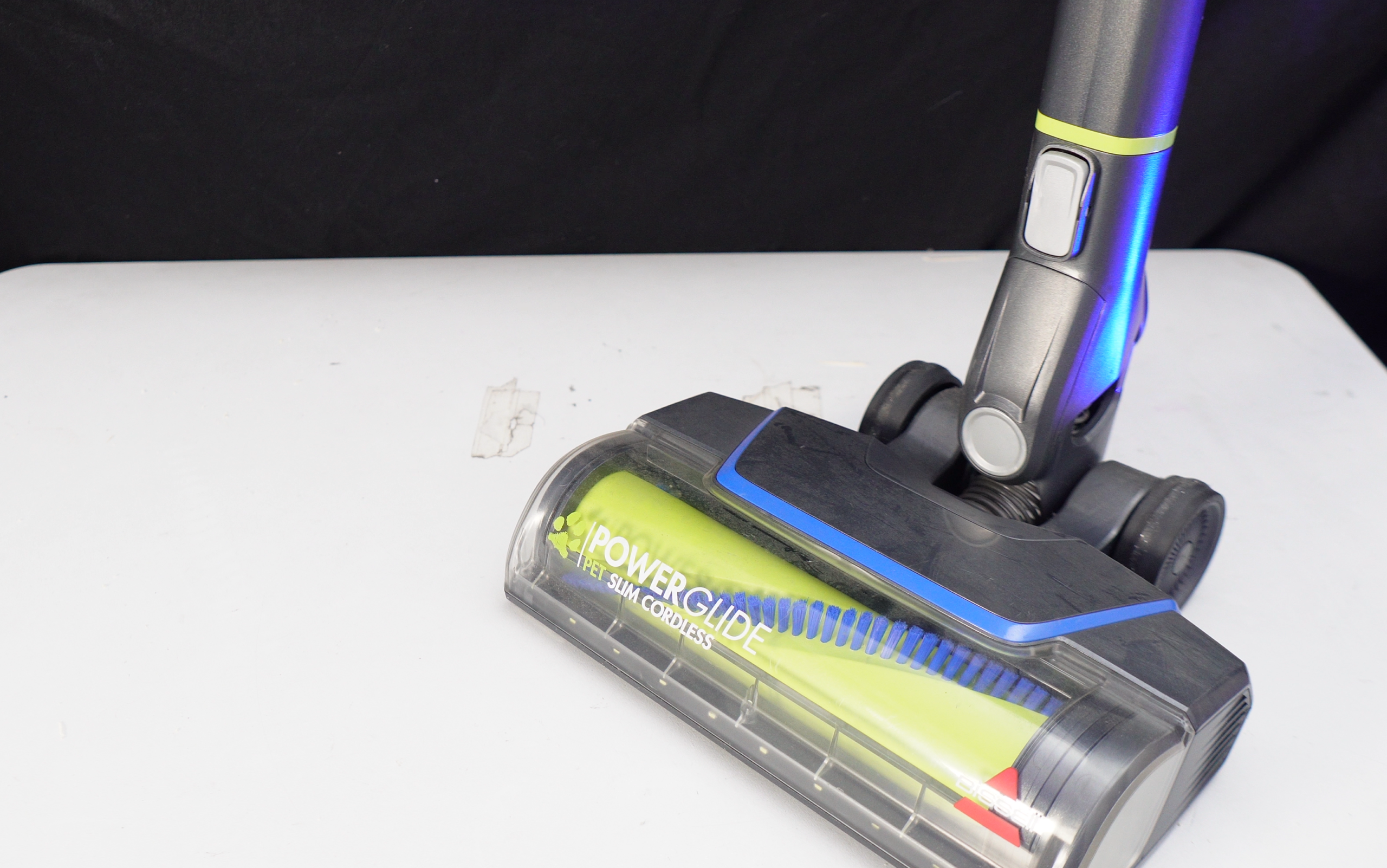
While this vacuum is advertised for pets, it doesn’t have an active anti-tangle system. It relies on a thick brush with stiff bristles that works to some extent, but larger amounts of long hair will wrap around it.
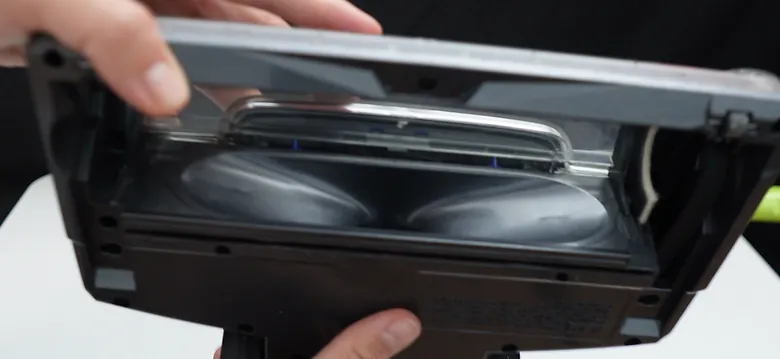
Dustbin
The dustbin doesn’t have any quick-release mechanism like a Dyson. To empty, you detach the dustbin container from the frame, pull out the filter assembly, then pour out the contents.
Battery
The battery is built-in and non-removable. That’s a long-term durability concern. When the battery degrades — and it will — you can’t swap in a fresh one. You’re either buying a new vacuum or hunting for a third-party repair solution.
Filtration
There are no HEPA filtration claims here, which is fine, but the fog test result (covered below) shows the filtration system has serious real-world problems regardless of what filter is installed.
Handle Control
The Bissell PowerGlide has a simple handle-mounted control interface that lets users turn the vacuum on and adjust power. Unlike other cordless vacuums, this model defaults at the max setting because it’s the most usable, ensuring that you pick up the most debris possible.
Airflow
Measured at the nozzle and wand using my calibrated airflow meter:
Nozzle
- Low: 22.58 CFM
- High: 29.64 CFM
Wand
- Low: 27.43 CFM
- High: 36.32 CFM
The wand readings are higher than the nozzle — that’s expected, since the nozzle adds restriction at the cleaning head. What matters for performance is the nozzle figure, since that’s where suction meets the floor.
29.64 CFM on high is low. For reference, the Dyson V8 sits around 37 CFM, and higher-tier cordless vacuums like the V15 measure over 70 CFM. The Air Ram, which only has one power setting, registers 28.52 CFM — and the PowerGlide Pet Slim on high barely clears that.
That low airflow ceiling is why the surface cleaning numbers look decent, but the deep-cleaning score drops off, and it’s exactly why the crevice pickup test failed (more on that below).
Run Time
Nozzle on Hard Floor
- Low: 32:00 minutes
- High: 17:31 minutes
Nozzle on Carpet
- Low: 29:11 minutes
- High: 16:57 minutes
Runtime on low is acceptable — about half an hour on hard floors and just under 30 minutes on carpet. On high, you’re looking at roughly 17 minutes before the battery gives out, which is tight if you’re cleaning a larger home in one session.
The carpet runtime being shorter than hard floor is expected — more motor load on carpet, faster battery drain. Nothing unusual there.
What is a problem: the battery is not removable. You can’t swap in a second pack to extend cleaning time. If you need to do more than 17 minutes of high-power cleaning, you have to wait until it’s fully recharged.
Another issue is usable power. The default power setting is max, which is its most usable. I tried using the lowest setting on sand, and this happened.
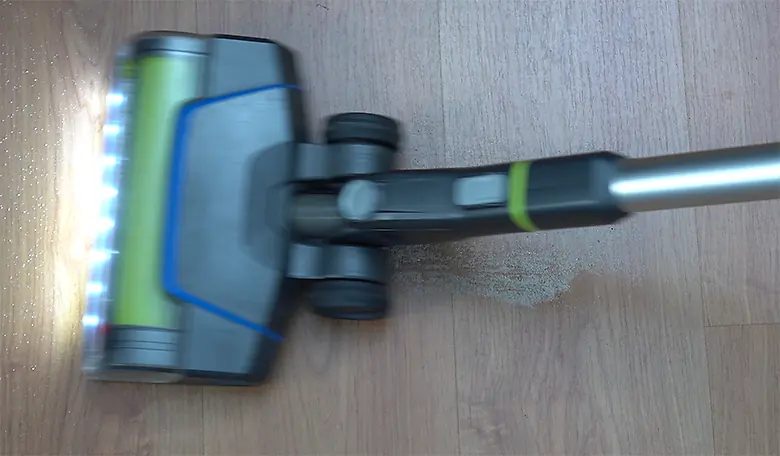
You could see a sand trail behind the nozzle after the forward pass, which is a risk at the lowest setting, especially with heavy debris.
Clearing Performance
- Overall: 95.37%
- Hard Floors: 99.9%
- Sand on Hard Floor: 99.3%
- Carpet: 99.8%
- Deep Cleaning: 82.5%
The surface cleaning numbers are the headline result here. A 99.9% hard floor score and 99.8% on carpet are excellent — this vacuum picks up surface-level debris very effectively. Individual hard-floor results were similarly strong across all four test materials, and both low- and mid-pile carpet tests were near-perfect.
Hard Floor Results
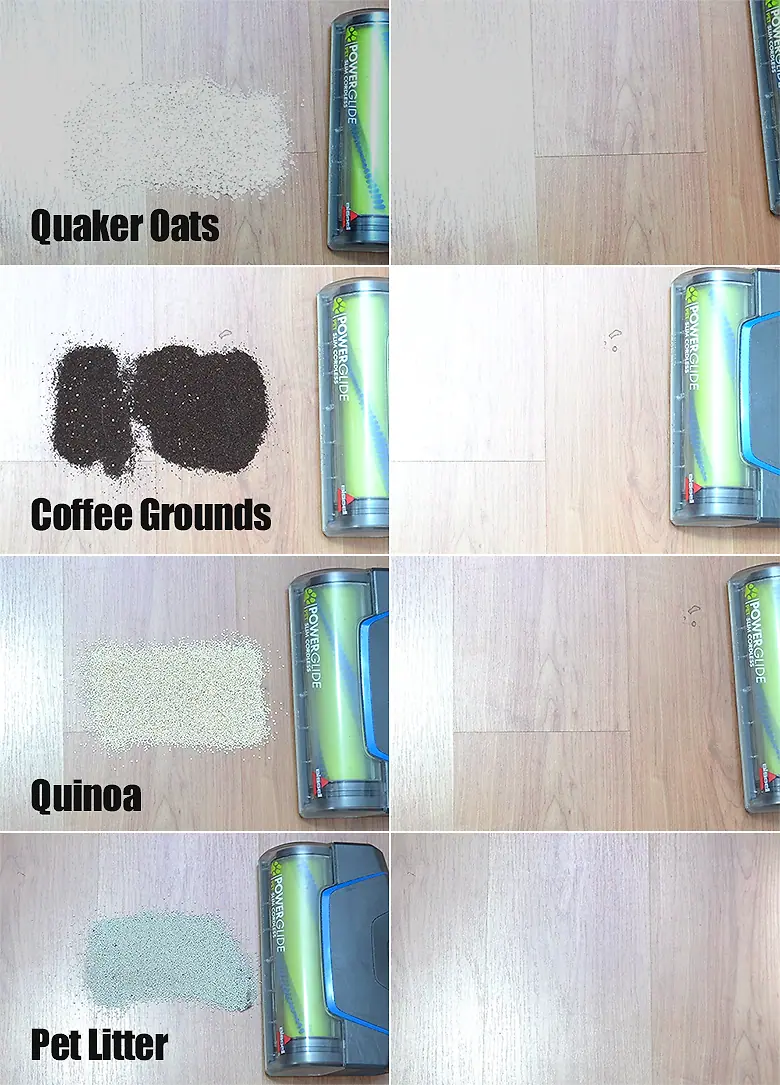
- Quaker oats: 99.8%
- Coffee grounds: 99.8%
- Quinoa: 100%
- Pet litter: 100%
The Bissell PowerGlide performed excellently across all tests, achieving 100% in two and 99.8% in the other two. Please note that I used the max setting in all the tests since it doesn’t have a soft roller.
Without it, there were instances where it pushed debris forward, notably Quaker oats, but it has an opening in the middle where dirt was funneled, and it eventually picked up everything.
Edge Cleaning
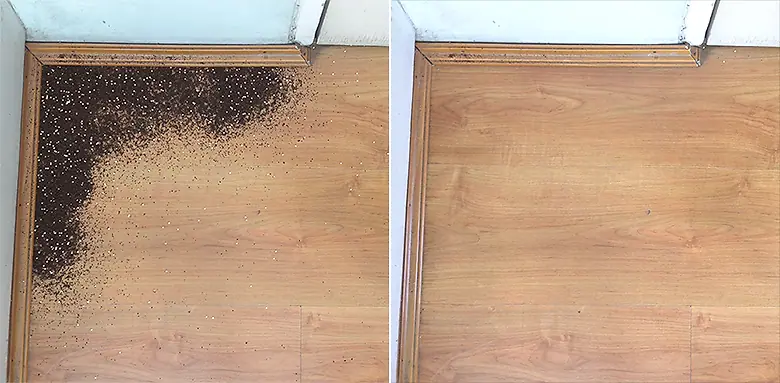
The edge cleaning test surprised me. Despite the bulky nozzle, the PowerGlide Pet Slim handled edge cleaning efficiently, picking up sand along the baseboard in just a few passes. The nozzle geometry works better along edges than the width suggests.
Sand on Hard Floor
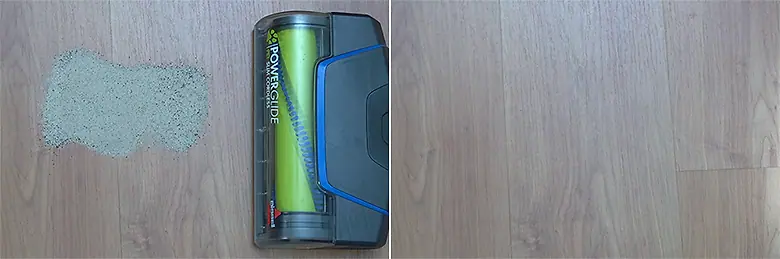
Results of this test were excellent with the PowerGlide picking up a 99.3% average in two tests.
Crevice Pickup Test
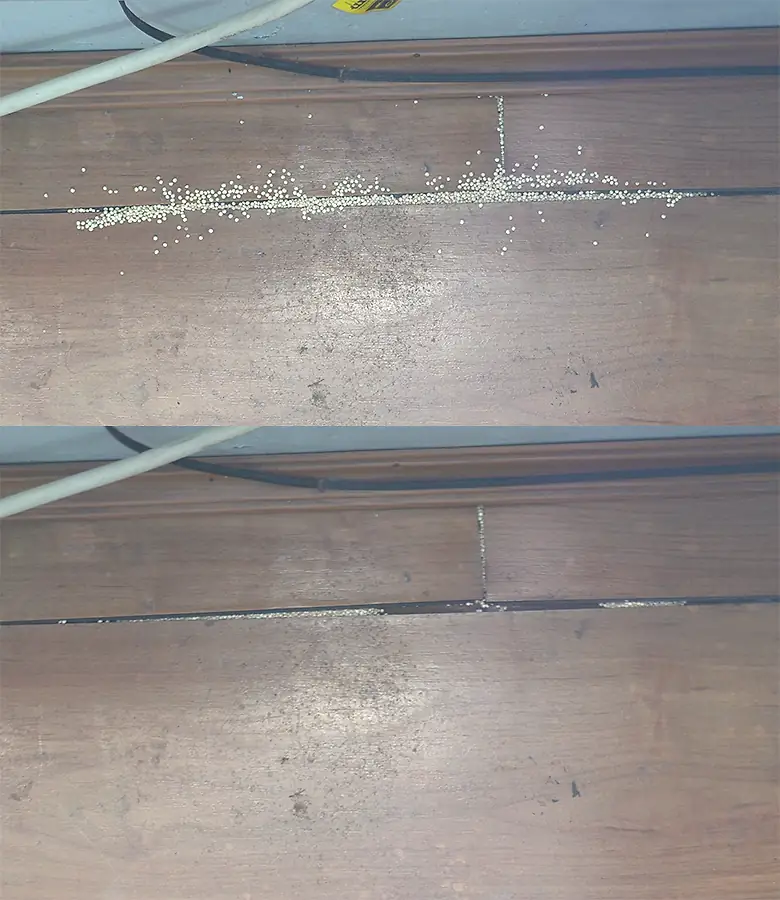
The crevice test tells a different story. I scattered quinoa in a quarter-inch crevice and ran the vacuum over it. The result was poor — only a small percentage of the debris was picked up.
This is a direct consequence of the airflow limitation. Crevice pickup requires concentrated suction pulling debris up and out of a narrow gap. At 29.64 CFM on high, the PowerGlide Pet Slim doesn’t generate enough focused airflow to do that reliably. If you regularly need to clean between floorboards, along tile grout lines, or in similar narrow gaps, this vacuum will leave debris behind.
Hair Wrap Test [Hard Floors]
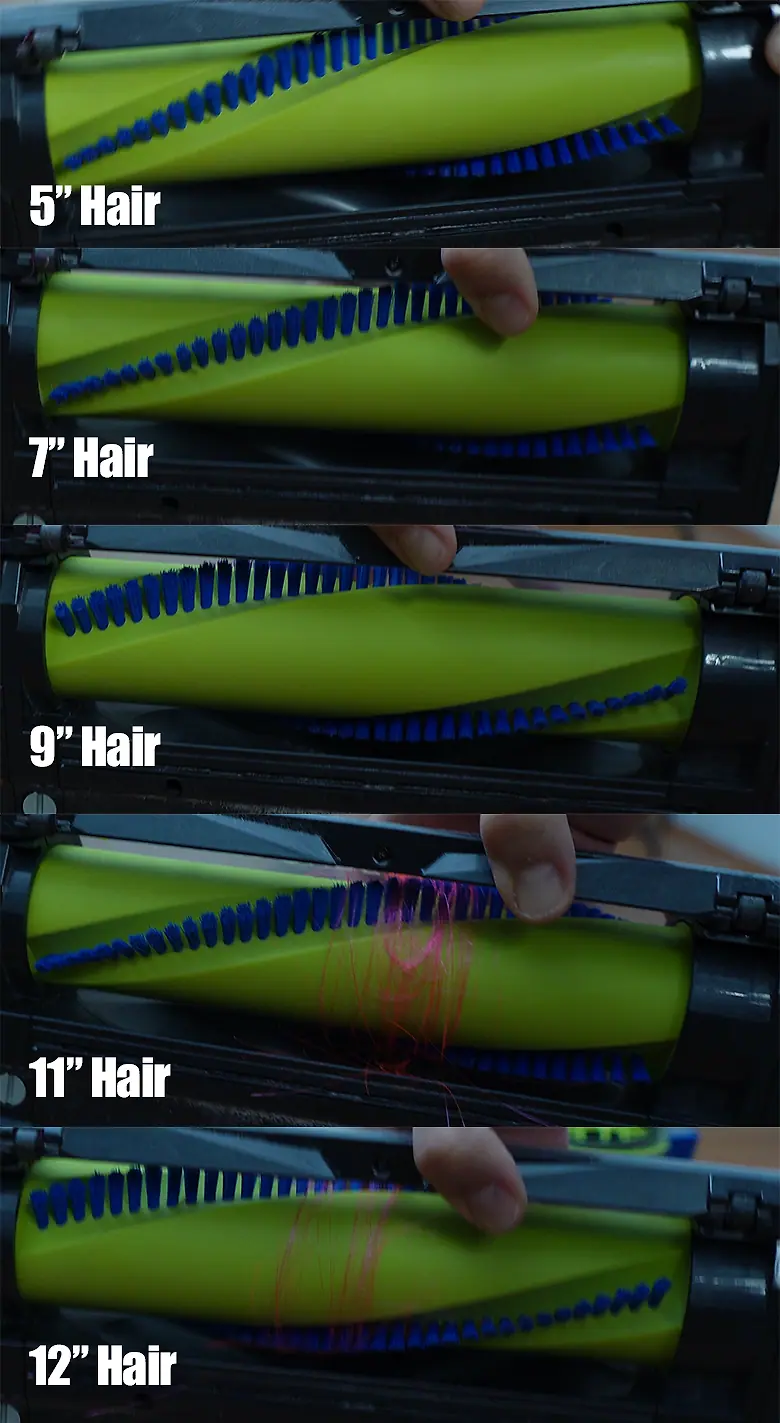
- 5″ strands: 100%
- 7″ strands: 100%
- 9″ strands: 100%
- 11″ strands: 81.3%
- 12″ strands: 97%
The hard floor hair pickup results are one of the strongest aspects of this vacuum. Perfect scores on 5″, 7″, and 9″ strands, and near-perfect on 12″ strands. The 81.3% on 11″ strands is a slight dip — possibly a consistency quirk in brush engagement at that length — but the overall pattern is very good.
For single-pet households dealing with shorter to medium-length hair on hard floors, this brushroll handles it well.
Carpet Results
Low Pile Results
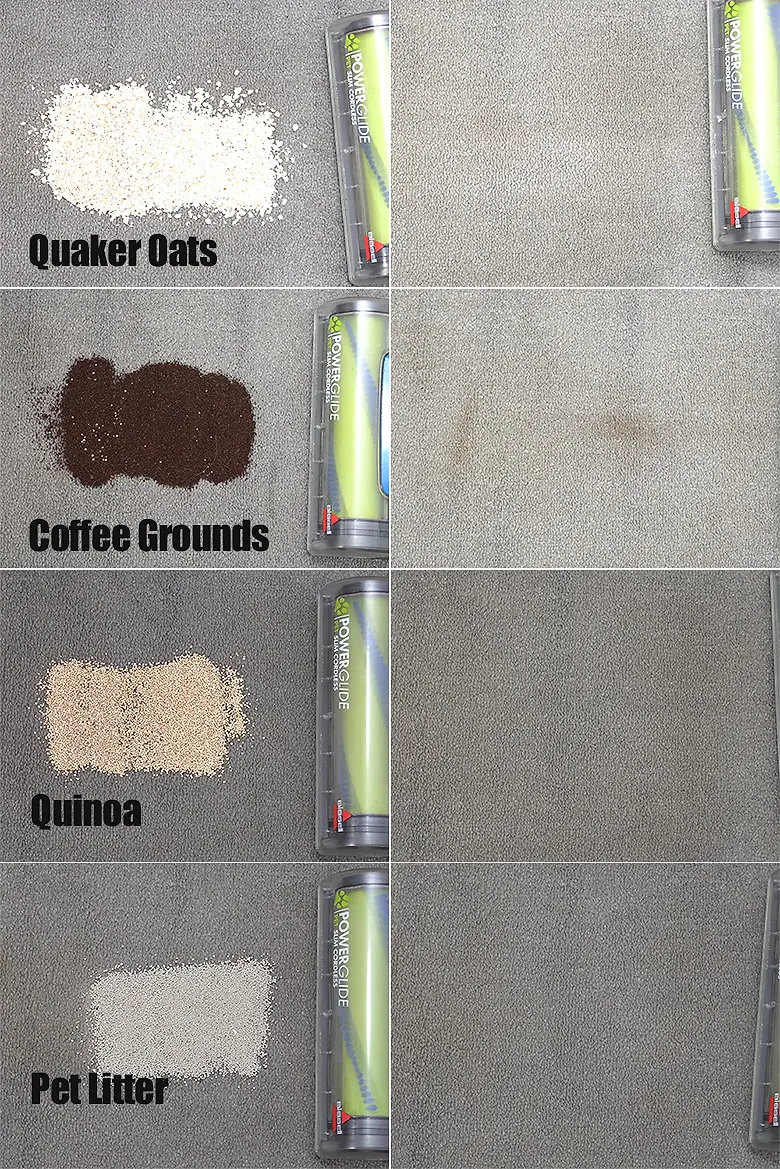
- Quaker oats: 98.6%
- Coffee grounds: 99.8%
- Quinoa: 100%
- Pet litter: 100%
Mid Pile Results
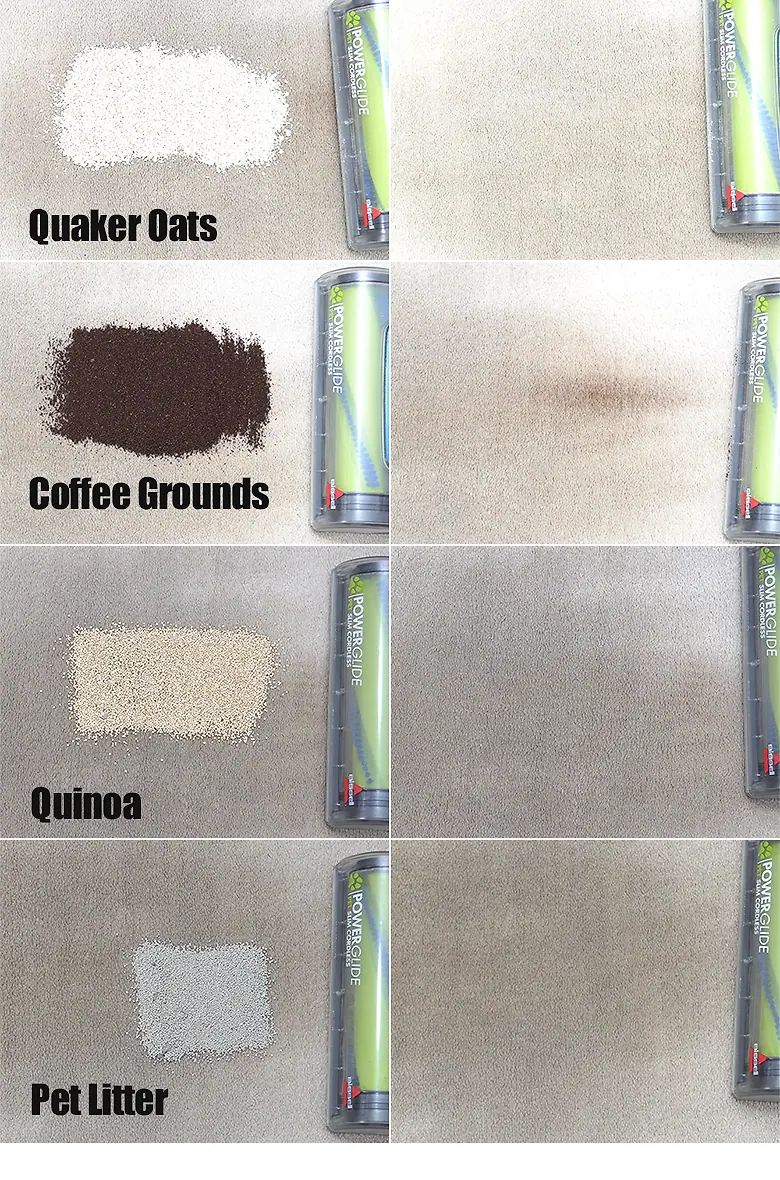
- Quaker oats: 100%
- Coffee grounds: 100%
- Quinoa: 100%
- Pet litter: 100%
The carpet pickup numbers are strong across the board. Mid-pile carpet scores are perfect across all four test materials, and low pile is close behind. Surface debris on carpet is not a problem for this vacuum.
Hair Wrap [on Carpet]
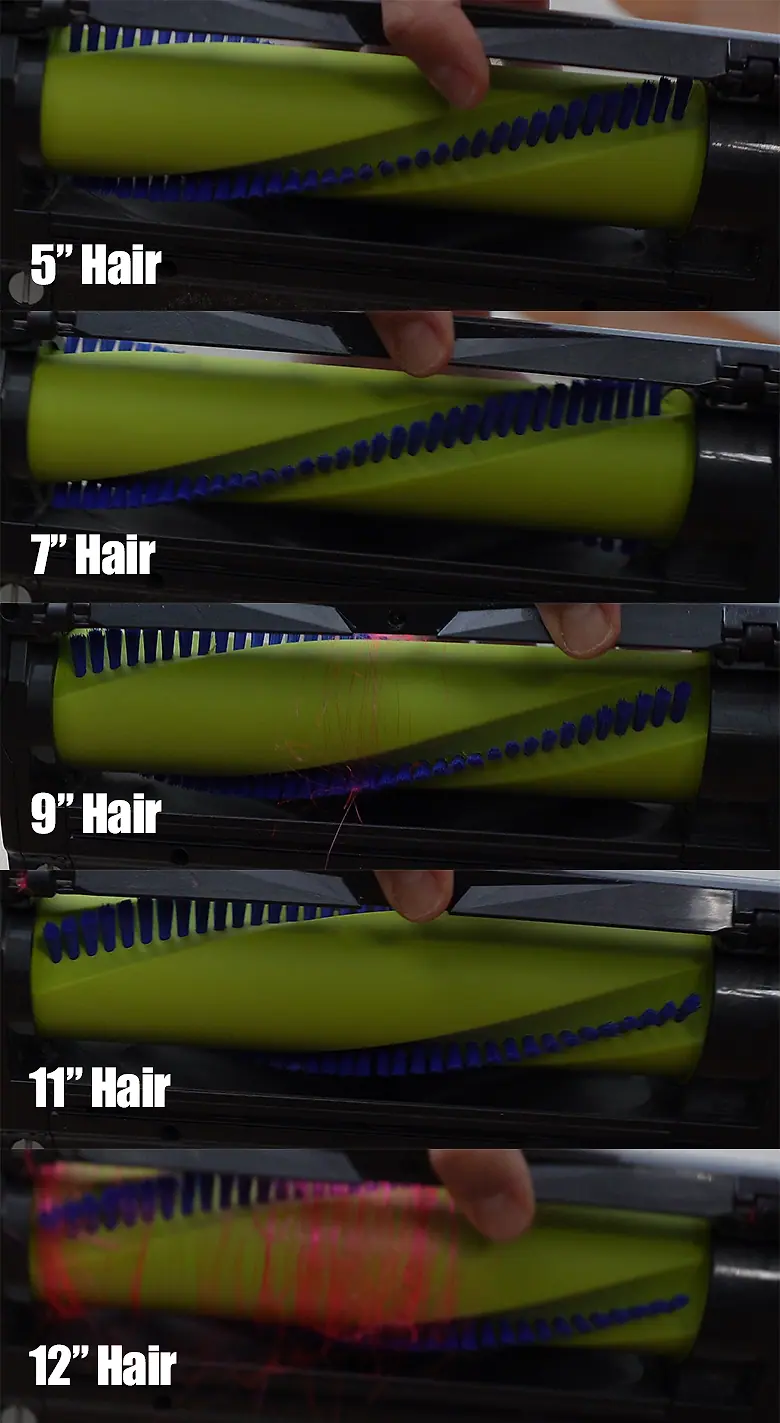
- 5″ strands: 100%
- 7″ strands: 100%
- 9″ strands: 85%
- 11″ strands: 100%
- 12″ strands: 43%
The carpet hair wrap results are more inconsistent than hard floors. The 43% score on 12″ strands is a significant drop — longer hair wraps around the brushroll on carpet, which means you’ll be stopping to clean the brushroll more frequently if you have long hair or a long-haired pet. The 9″ dip to 85% adds to the pattern.
On carpet, this brushroll starts struggling with hair longer than about 9 inches. Worth knowing before buying if long hair is a primary concern.
Deep Cleaning Results
That 82.5% deep cleaning score is where the limited airflow starts to show. Deep cleaning requires enough suction to pull sand that’s been worked into carpet fibers, not just sitting on top. At under 30 CFM on high, the PowerGlide Pet Slim doesn’t have the airflow to extract heavily embedded debris. An 82.5% score is in the lower half of what I’ve seen from cordless vacuums I’ve tested.
Noise Levels
- Low: 73.8 dB
- Max: 80 dB
73.8 dB on low is reasonable — similar to a normal conversation at close range. 80 dB on high is noticeably louder but not extreme for a cordless vacuum at this power level. For perspective, the Dyson V15 on boost measures around 84–86 dB. The PowerGlide Pet Slim is quieter on max than many higher-end vacuums running at full power.
Filtration – Fog Test
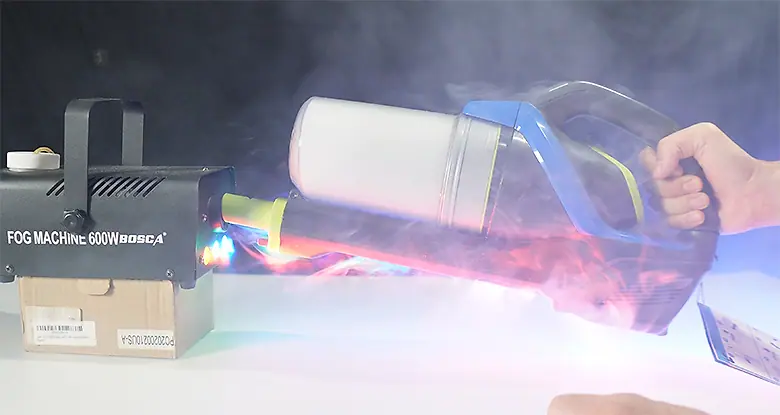
This is the most concerning test result. The fog test exposes filtration leaks by filling the vacuum path with theatrical fog and checking for any smoke escaping through gaps in the body, around filters, or through seams.
The PowerGlide Pet Slim leaked heavily. Fog escaped from multiple points on the vacuum body — not just a minor wisp, but a clear failure. In practical terms, this means fine particles — dust, allergens, pet dander — that the brushroll picks up are being exhausted back into the air through body leaks rather than passing through the filter.
If you or anyone in your household has allergies or asthma, this is a serious problem. A vacuum that leaks this badly during the fog test is redistributing fine particulate matter rather than capturing it. The filter installed is irrelevant when the housing around it doesn’t seal.
Availability of Parts
Bissell parts availability is generally decent compared to off-brand options, but the PowerGlide Pet Slim sits in a product line that Bissell rotates frequently. Replacement filters, brushrolls, and batteries (where applicable) are typically available for a few years after a model is discontinued, but long-term support is not guaranteed.
The fixed battery is the biggest long-term risk here. Once Bissell stops stocking the replacement battery for this specific model — and that will happen eventually — the vacuum’s useful life is over unless a third-party supplier picks it up.
Product Specifications
| Test | Value |
|---|---|
| LED Headlights | Yes |
| Adaptive Suction | No |
| Soft Roller | |
| Soft Roller? | None |
| Battery | 21-volt Lithium Ion |
| Recharge (hrs) | 5 hrs |
| Dustbin Capacity | 0.5 liters |
| Weight | 9.25 lbs |
| Warranty | 2 yrs |
Where to Buy?
Check the current price on Amazon and Walmart before buying — this model has been available below $80 at retail and frequently goes on sale.
- Check Price on Amazon
Disclaimer: I will earn a commission if you click on any of the links above, but at no extra cost, so it’s a win-win for us!
Does The Bissell 1984 PowerGlide Offer Good Value?
At $270, no — not when you look at what else is available at that price.
The Dyson V8 costs around the same or less depending on where you buy it, measures 37 CFM at the nozzle versus 29.64 CFM here, has a sealed filtration system that passes the fog test, comes with a full attachment set, and has a removable battery with replacements readily available. The Shark IZ series sits in a similar range and offers comparable surface cleaning with better runtime.
The surface-cleaning performance is real — 95.37% overall, near-perfect hard-floor scores, and strong carpet pickup across all test materials. That part of this vacuum works. But at $270, strong surface cleaning alone isn’t enough. The fog test failure, the fixed battery, 17-minute high-power runtime, and the weak crevice pickup are problems that competitors at this price range don’t share.
If the price were $100–$120, the value math changes. At $270, you’re paying a premium for a vacuum with budget-tier filtration and a battery that can’t be replaced when it dies.
The Verdict
The Bissell PowerGlide Pet Slim cleans surfaces well — that’s not in dispute. Hard floor scores are excellent, carpet pickup is strong, and hair handling up to 9 inches on hard floors is reliable. If surface cleaning were the only metric, it would be a reasonable option.
But at $270, surface cleaning alone isn’t enough to carry a recommendation.
The fog test failure disqualifies it for use in households with allergies, asthma, or young children. Heavy filtration leaks at this price point aren’t acceptable — competitors at $250–$280 seal properly. The 29.64 CFM airflow ceiling limits deep cleaning to 82.5% and makes crevice pickup essentially useless. Long hair wraps on carpet. The fixed battery will eventually end the vacuum’s useful life with no replacement path.
The Dyson V8 is a better vacuum for the same money. Stronger airflow, sealed filtration, removable battery, full attachment set. If you’re spending $270 on a cordless vacuum, that’s where the data points.