

Performance Breakdown
| Evaluation Criteria | Bissell AirRam 1984 | Cordless Stick Vacuums Avg |
|---|---|---|
| Ergonomics | 8.9 | 9.2 |
| Surface Cleaning | 9.8 | 9.5 |
| Deep Cleaning | 8.0 | 8.7 |
| Mopping | — | 5.0 |
| Quality | 6.0 | 8.9 |
| Design | 7.0 | 9.0 |
| Value | 8.2 | 8.9 |
| Overall Average | 8.0 | 8.5 |
Specification Sheet
| LED Headlights | None |
|---|---|
| Adaptive Suction | None |
| Soft Roller? | No |
| Battery | 2500 mAh |
| Recharge (hrs) | 4 hrs |
| Dustbin Capacity | 0.35 liters |
| Weight | 4.6 lbs. |
| Warranty | 2 yrs |
Pros & Cons
Pros
- Above-average surface debris pick up
- Upright vacuum feel with the motor and battery at the base
- Detachable battery
- Wide cleaning nozzle
Cons
- Bulky nozzle will struggle fitting in tight spaces
- Plastic and rubber parts deteriorate after a few years
- Shallow turning radius
- Noisy
Check Availability
Most cordless vacuums put the motor and dustbin near the handle. The Bissell Air Ram 1984 flips that completely — everything sits at the base, right behind the brush roll.
That one design choice changes almost everything about how this vacuum feels and performs. The handle weighs about a pound. You barely feel like you’re pushing anything. And because the motor sits millimeters from the brush, there’s almost no airflow loss between the two — which is why this thing punches way above its price in cleaning tests.
But there are tradeoffs. No attachments. No handheld conversion. No HEPA filter. This vacuum does exactly one thing: clean floors. So the question is whether it does that one thing well enough to justify the limitations.
After running it through my full test suite — hard floors, carpet, deep cleaning, hair wrap, edge cleaning — I can tell you: it does. A 97.51% overall cleaning score and a 91.45% deep-cleaning result put it in the same conversation as vacuums that cost twice as much.
Features
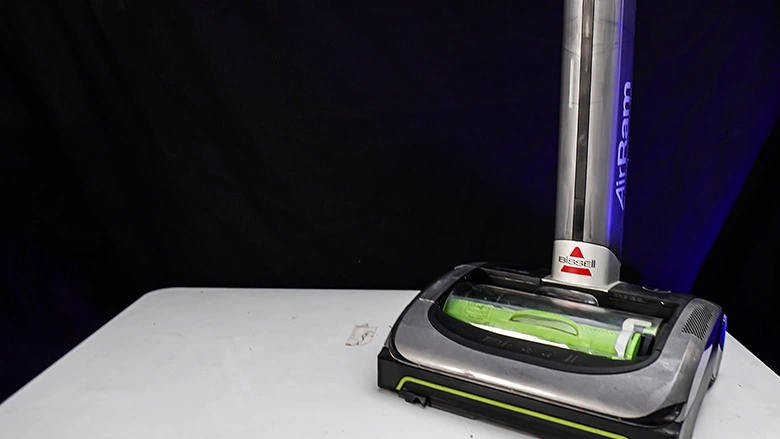
The Air Ram’s design is unlike any other cordless vacuum I’ve tested. The motor, dustbin, filter, and battery are all packed into the cleaning head at the base. Bissell says the handle weighs about one pound — and that tracks with how it feels in use. After an hour of testing, my arm wasn’t as tired as it was after pushing a Dyson V11 around.
A few features stand out:
The gate mechanism on the cleaning head
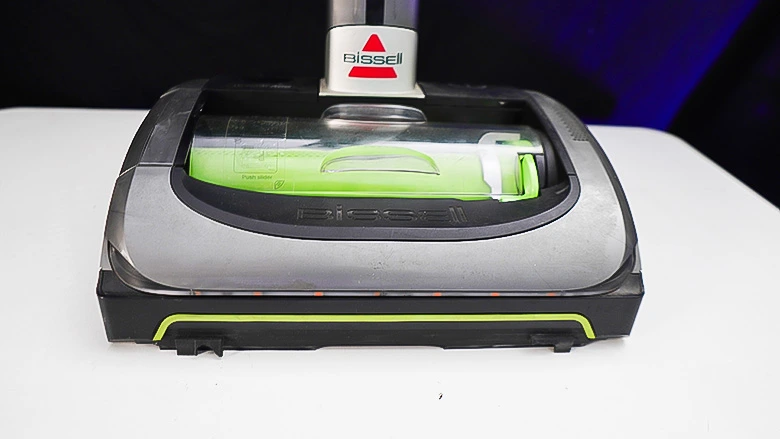
This is the real engineering trick. On the forward push, a gate at the front of the nozzle opens up to let larger debris (cereal, pet litter) pass through. On the backward pull, it closes, creating a tighter seal that helps extract embedded dirt from carpet. It’s a clever mechanical solution that doesn’t require electronics or additional power.
LED headlights — Bright enough to spot fine dust on hardwood, especially under furniture. Not unique to Bissell, but useful.
Self-standing design
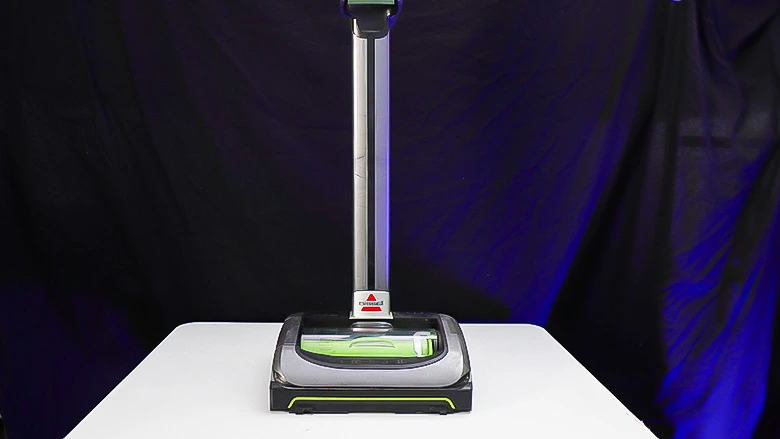
Because the weight is at the base, the Air Ram stands upright on its own. No wall mount, no charging dock needed. You just park it in a corner.
Removable battery
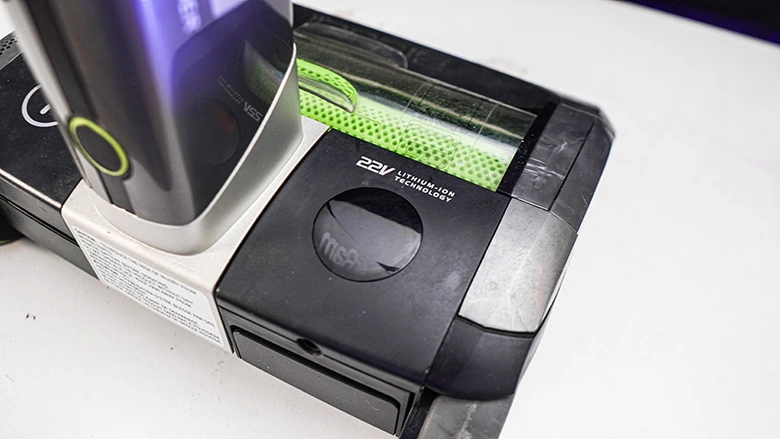
The 22V lithium-ion battery slides out, so you can charge it separately or swap in a replacement. Replacement batteries are still available, which matters for long-term usability.
What’s missing:
No extra tools, no crevice attachment, no handheld mode, no HEPA filter, no sealed filtration system. If you need above-floor cleaning, you’ll need a separate handheld — something like the Bissell 1985, which Bissell designed as a companion piece.
Airflow
The Air Ram registered 28.52 CFM in my airflow test — and it only has one power setting. There’s no boost or max mode to fall back on.
To put that in perspective, the Dyson V8 sits around 37 CFM, and the V10 is in the low 50s. On paper, the Air Ram looks underpowered.
And honestly, for deep cleaning, it is — the 91.45% deep-cleaning score is respectable, but a higher-airflow vacuum would extract more embedded sand from the carpet. Without a max setting to temporarily push more air through the brush roll, what you see is what you get.
For comparison, the Dyson V15 measures 73 CFM and scores 100% on the same deep-cleaning test.
So why does it still score 97.51% overall? Two reasons.
First, the motor sits directly behind the brush roll. On most stick vacuums, air has to travel up a long wand to reach the motor and dustbin near the handle — every joint and bend costs you airflow. The Air Ram eliminates that entire path. So while 28.52 CFM is the measured number at the test point, the airflow that actually reaches the cleaning surface loses very little energy along the way.
Second, surface debris pickup doesn’t need high CFM. Oats, coffee grounds, quinoa, pet litter — these are sitting on top of the floor, not buried in carpet fibers. The gate mechanism and brush agitation do most of the work there, and 28.52 CFM is more than enough to pull that debris into the dustbin once it’s been loosened.
Where the low airflow does hurt is deep cleaning. Extracting sand that’s been worked into medium-pile carpet fibers requires raw pulling power, and 28.52 CFM with no boost mode puts a ceiling on what the Air Ram can achieve.
The 91.45% deep-cleaning score is good for this price range, but vacuums with 50+ CFM will outperform it on embedded dirt. If deep carpet cleaning is your top priority and you have thick carpet, you’ll want more airflow than this.
Run Time
Bissell claims up to 40 minutes of runtime. In my testing, the Air Ram lasted 28 minutes and 44 seconds on hard floor and 30 minutes and 11 seconds on carpet.
That’s shorter than advertised — but the more interesting finding is the order. Almost every cordless vacuum I’ve tested lasts longer on hard floors than on carpet. The brush roll meets more resistance on carpet fibers, which draws more power from the motor and drains the battery faster.
That’s the typical pattern.
The Air Ram did the opposite. It ran about a minute and a half longer on carpet than on hard floor. I didn’t expect that, and I don’t have a definitive explanation for it. My best guess is that the brush roll’s interaction with the hard floor surface creates slightly more friction or resistance at the motor than the carpet fibers do — possibly because the stiff bristles are pressing directly against a rigid surface rather than flexing into carpet pile. But that’s speculation on my part.
Either way, plan for around 29 to 30 minutes of actual runtime. That’s enough for a small to medium-sized home in a single session. For larger spaces, the removable battery is a plus — you can buy a spare and swap it in when the first one dies. Recharge takes about 4 to 5 hours from fully depleted.
For reference, the Dyson V8 lasts around 31 minutes on a motorized head, and the Moosoo K17 ran for 30 minutes.
One thing worth noting: the Air Ram has only one power setting, so there’s no way to extend runtime by dropping to a lower mode. What you get is what you get. The suction stayed consistent throughout both tests — no noticeable fade in the last few minutes, which is a sign that the lithium-ion battery is doing its job properly.
Clearing Performance
The Bissell Air Ram scored a 97.51% overall in my cleaning tests. That’s an impressive number for a vacuum at this price point. Here’s the full breakdown:
- Overall: 97.51%
- Hard Floors: 99.85%
- Sand on Hard Floor: 98.9%
- Carpet: 99.85%
- Deep Cleaning: 91.45%
Hard Floor Results
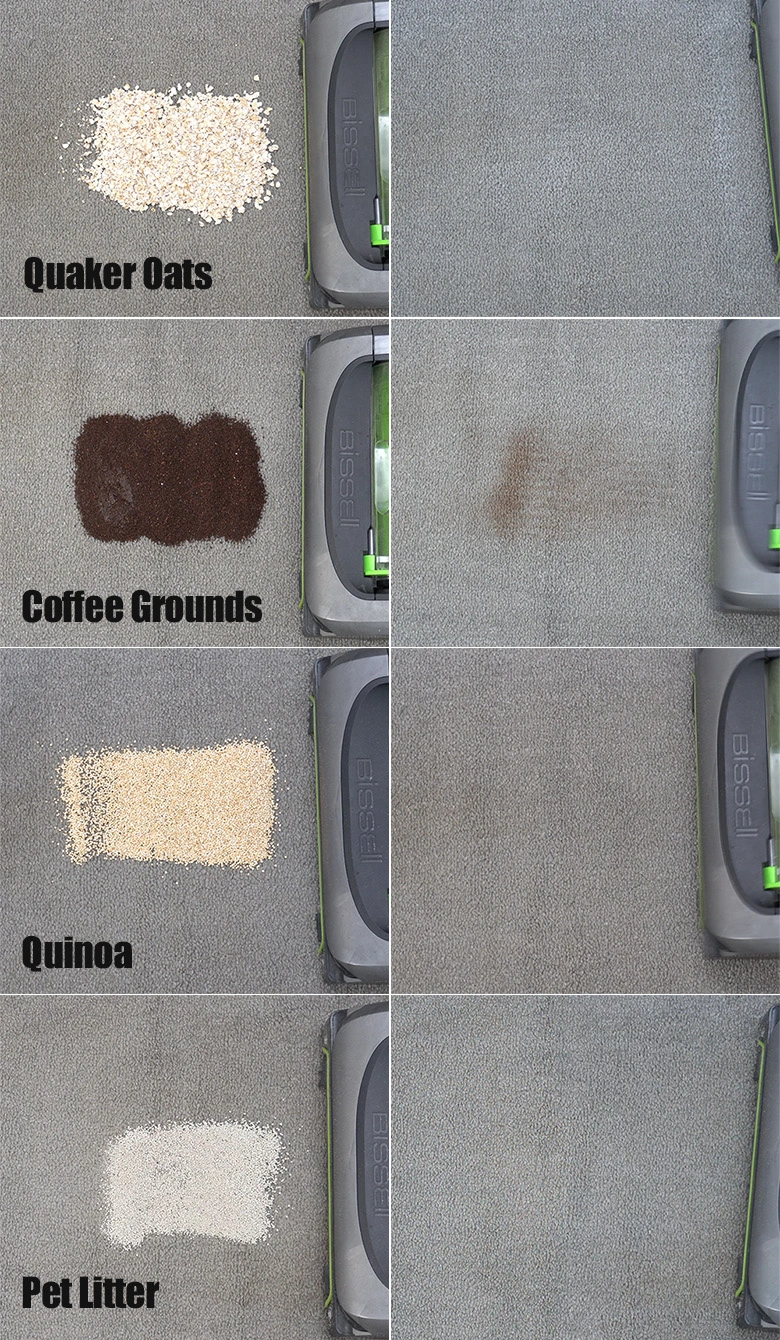
- Quaker oats: 99.8%
- Coffee grounds: 100%
- Quinoa: 100%
- Pet litter: 99.6%
The headline here is consistency. The Air Ram doesn’t have a weak spot on surface cleaning — it handles everything from fine coffee grounds to bulky pet litter without struggling.
The gate mechanism does a lot of the work on hard floors, letting larger debris through on the forward pass rather than pushing it ahead of the nozzle, as many vacuums do.
What makes it interesting is the deep-cleaning score. At 91.45%, it’s extracting embedded sand from medium-pile carpet at a rate that competes with much more expensive machines. That’s a direct result of the motor-at-the-base design — the brush agitation and airflow work together efficiently because there’s no power loss through a long wand.
Edge Cleaning
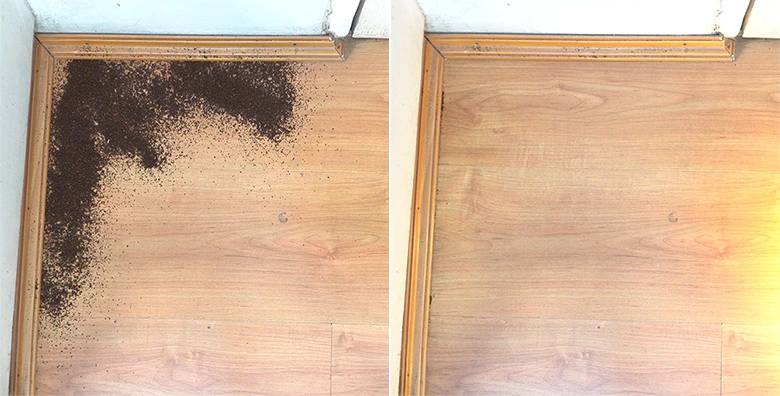
The Air Ram was more efficient at edge cleaning than I expected, given the 28.52 CFM airflow. The wide nozzle covers a lot of ground, and the stiff side bristles on the brush roll reach close to the edges. After the initial forward pass, most of the coffee grounds in my edge test were picked up.
But I did notice a blind spot. There’s an area where the front gate structure slopes down toward the floor — and debris sitting right in that zone doesn’t get picked up on the first pass. You can see it clearly when you look at what’s left behind. It’s not a suction problem. It’s a geometry problem. The shape of the gate creates a small pocket where airflow and brush contact don’t quite reach.
The fix is simple enough — come at the remaining debris from a different angle, and the Air Ram grabs it on the second pass. But it’s something you’d notice in everyday use, especially along baseboards, where debris tends to settle in the same spots.
Overall, I’d call edge cleaning a strength with an asterisk. The wide nozzle and brush design efficiently handle most edge debris, even at this airflow level. But that gate blind spot means you’ll occasionally need a follow-up pass from a different direction to get everything. It’s a minor inconvenience, not a dealbreaker — but it’s worth knowing about before you buy.
Sand on Hard Floor
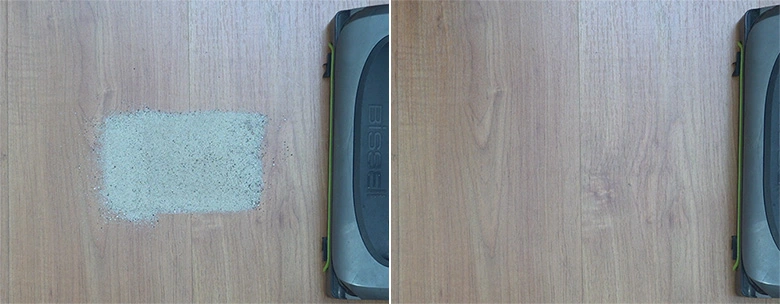
Sand on hard floors is a tougher test than it sounds — fine grains scatter easily, and many vacuums push sand ahead of the nozzle before picking it up. The Air Ram scored 98.9%, which is excellent.
The closed gate on the backward pull creates a tight seal that helps capture sand without scattering it backward. Combined with its short airflow path, the Air Ram delivers enough suction right at the nozzle to capture fine particles on the first pass.
Crevice Pickup Test
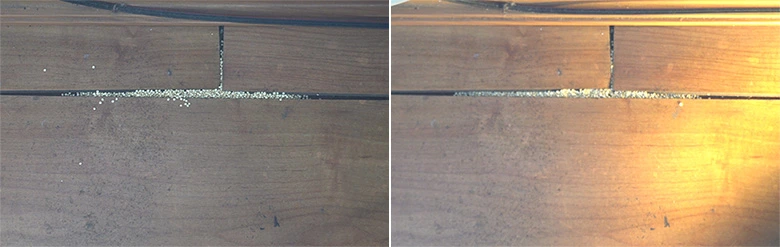
If there’s one test where the Air Ram’s 28.52 CFM airflow shows its limits, it’s the crevice pickup test.
I scatter quinoa into a quarter-inch crevice in my home office floor and check whether the vacuum can lift debris out of the gap. The Air Ram didn’t pick up any of it. Zero. The quinoa stayed sitting in the crevice after multiple passes.
To put that in perspective, I brought out my Dyson V12 Detect to run the same test. On auto mode, the V12 measures 28.52 CFM — the exact same airflow as the Air Ram. On auto, it picked up some of the quinoa. When I switched to max mode at 48.38 CFM, it cleared everything.
So here’s the interesting part. At identical airflow, the V12 still outperformed the Air Ram on crevice pickup. That suggests it’s not purely an airflow problem — the brush roll design likely plays a role too. The Air Ram uses short, stiff, stubby bristles that are spaced fairly far apart.
That works well for surface debris and even for carpet agitation, but it doesn’t create the concentrated sweeping action needed to dig debris out of a narrow crevice. The V12’s brush roll, by contrast, has denser bristle coverage that can agitate debris in tighter spaces more effectively.
Bottom line: if your floors have crevices, gaps between planks, or uneven seams where debris settles in, the Air Ram won’t be able to extract it. This isn’t a vacuum you’d rely on for that kind of deep floor cleaning. For smooth, flat hard floors and carpet, it’s excellent. For floors with texture or gaps, you’ll need something with more airflow or a more aggressive brush roll — or both.
Hair Wrap Test [Hard Floors]
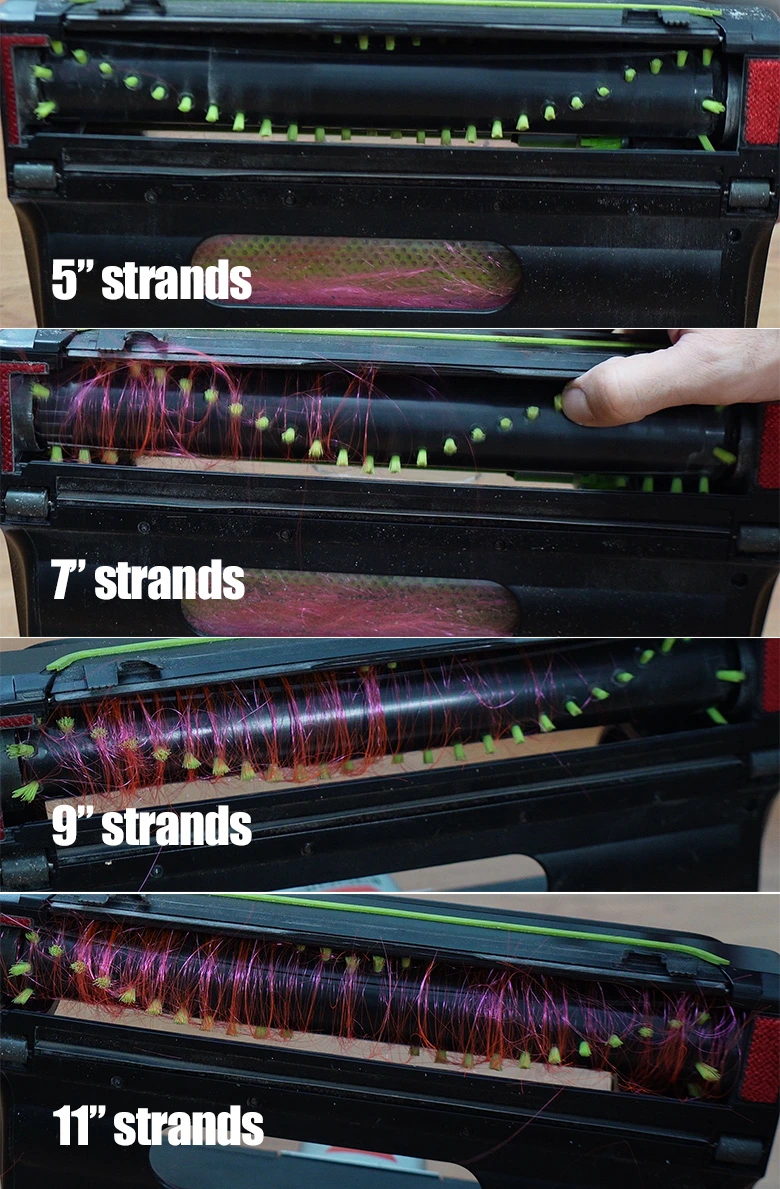
I test hair pickup using strands cut to specific lengths — 5, 7, 9, and 11 inches — to see how a vacuum handles progressively longer hair. The Air Ram’s results tell a clear story:
- 5″ strands: 98%
- 7″ strands: 86%
- 9″ strands: 49%
- 11″ strands: 34%
Short hair is no problem. At 5 inches, the Air Ram picked up nearly everything — the brush roll and airflow combination is more than capable of grabbing shorter strands and pulling them into the dustbin. At 7 inches, it’s still decent. Most of the hair made it into the bin, with some wrapping around the brush roll.
Things fall off sharply after that. At 9 inches, barely half the hair was picked up, and a significant amount wrapped around the brush roll instead of being ingested. At 11 inches, the Air Ram was picking up about a third of the hair — the rest was tangling around the bristles.
I didn’t bother running the 12-inch test. If a vacuum is struggling at 11 inches, there’s no useful data to be gained from going any longer.
The brush roll design is the main factor here. The Air Ram’s short, stiff, stubby bristles work well for debris agitation, but they don’t have any anti-tangle mechanism — no comb, no counter-rotating element, nothing to strip hair off the brush and direct it into the dustbin. Once hair gets long enough to wrap around the full circumference of the brush roll, it stays there.
At 28.52 CFM, the airflow also isn’t strong enough to pull longer hair off the brush and into the bin, as a high-airflow vacuum can. On premium models with 50+ CFM, strong airflow serves as a secondary hair-removal system — the Air Ram doesn’t have that advantage.
If you have short to medium-length hair in the household, the Air Ram handles it fine. If anyone in your home has long hair — or you have pets that shed long strands — you’ll need to clean the brush roll regularly. There’s no way around it with this design.
Carpet Results
Low Pile Results
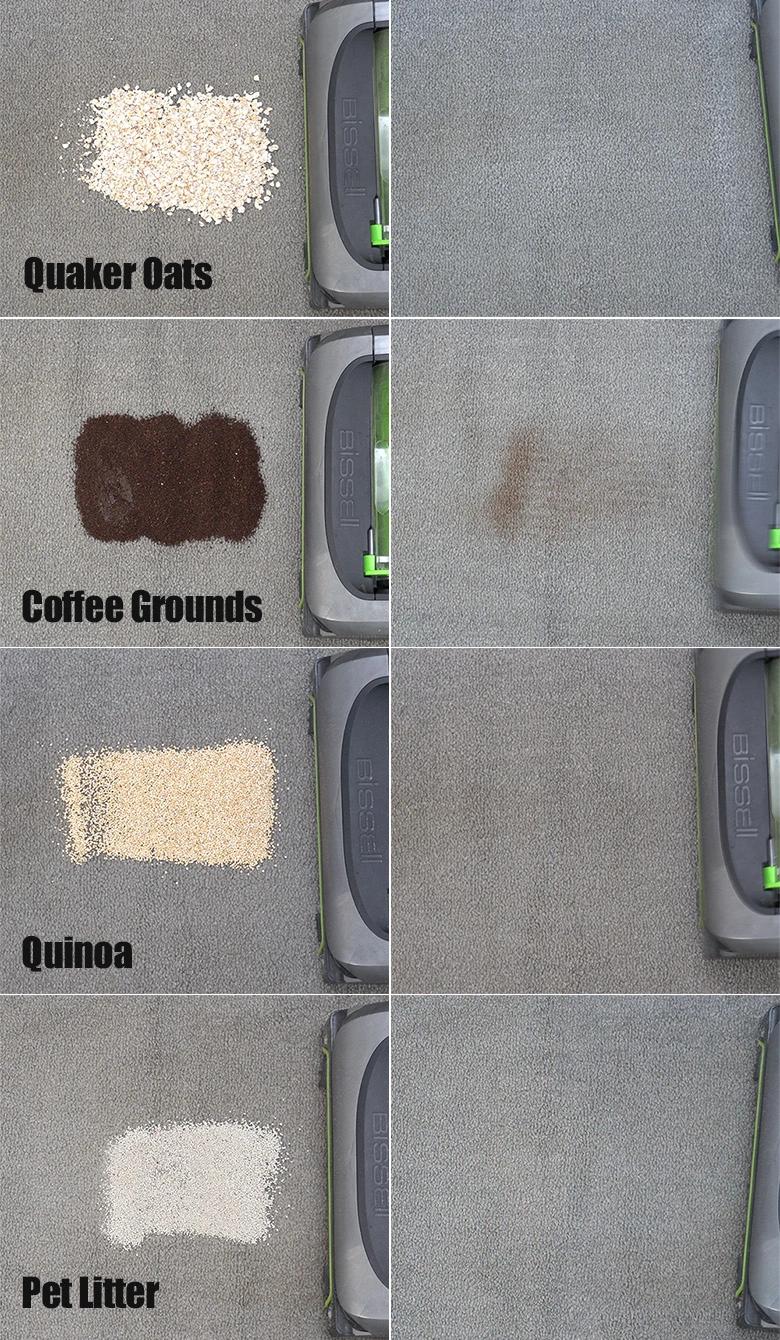
Low-pile carpet results were essentially perfect:
- Quaker oats: 100%
- Coffee grounds: 100%
- Quinoa: 100%
- Pet litter: 98.8%
The stiff bristles on the brush roll provide enough agitation to sweep surface debris from low-pile carpet without issue. The only minor miss was a bit of pet litter, which, being the heaviest debris in the test, occasionally doesn’t get fully picked up on the first pass.
Mid Pile Results
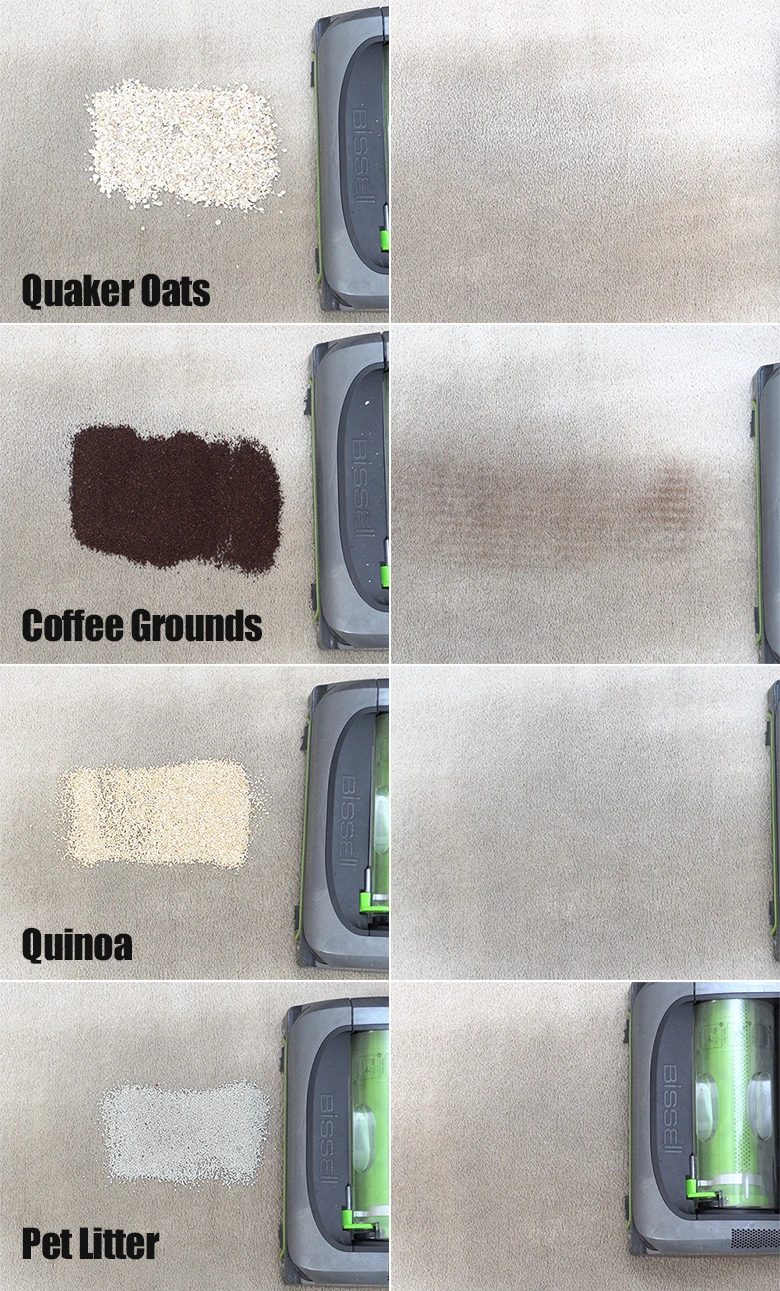
Mid-pile carpet is where many budget cordless vacuums start to struggle. The Air Ram didn’t:
- Quaker oats: 100%
- Coffee grounds: 100%
- Quinoa: 100%
- Pet litter: 100%
A perfect score across all four debris types. The combination of brush agitation and the short motor-to-brush airflow path gives the Air Ram enough cleaning power on medium pile carpet to match vacuums with significantly higher CFM ratings. This result is consistent with the 91.45% deep cleaning score — this vacuum handles carpet better than its price and specs suggest.
Hair Wrap [on Carpet]
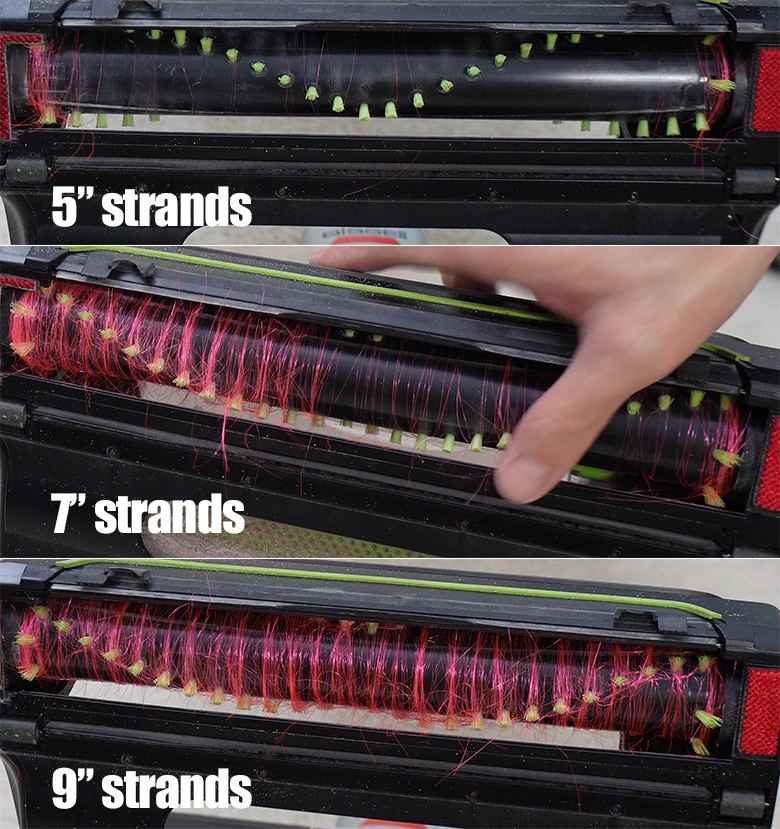
Hair pickup on carpet was significantly worse than on hard floors. Here are the results:
- Quaker oats: 87%
- Coffee grounds: 48%
- Quinoa: 11%
Compare that to the hard-floor results — 98%, 86%, and 49% at the same lengths. The drop-off is dramatic. At 7 inches on carpet, the Air Ram is picking up less than half the hair. At 9 inches, it’s barely getting anything into the dustbin.
I stopped at 9 inches. At 11%, there was no reason to continue to 11 or 12 inches.
The reason for the steeper decline in carpet is friction. On hard floors, hair sits on a smooth surface — the brush roll can sweep it up, and airflow can help pull strands toward the dustbin. On carpet, hair gets tangled into the fibers before the vacuum even touches it. The brush roll has to extract the hair from the carpet and ingest it into the dustbin — two jobs instead of one.
With 28.52 CFM and no max mode, the Air Ram doesn’t have the airflow to yank longer hair off the brush roll and into the bin once it starts wrapping. And the short, widely-spaced bristles don’t have the density to pull hair out of carpet fibers the way a tighter brush roll pattern would. On hard floors, the brush roll’s limitations only showed up at 9 inches. On carpet, they showed up at 7.
If you have pets that shed or anyone in the household with shoulder-length or longer hair, the Air Ram will require frequent brush roll cleaning when you vacuum carpet. On hard floors, it manages medium-length hair reasonably well. On carpet, even medium-length hair is a problem.
Deep Cleaning Results
This is the test that surprised me most. I use 100 grams of sand, embed it in medium-pile carpet using a standardized process, then vacuum and weigh what is extracted.
The Bissell Air Ram scored 91.45% on deep cleaning. To put that in context, this is a vacuum with no boost mode and lower raw airflow than a Dyson V8 — yet it extracts embedded sand at a competitive rate.
The motor placement is doing the heavy lifting here. With no wand to travel through, the airflow reaches the brush roll at near-full strength. The stiff bristles agitate the carpet fibers, loosening embedded sand, and the suction immediately pulls it into the dustbin. It’s a mechanically efficient system.
For anyone with medium-pile carpet who doesn’t want to spend $400+ on a Dyson, this deep cleaning result makes the Air Ram worth serious consideration.
Noise Levels
The Air Ram measured 75.6 decibels in its only power setting.
That’s moderate. It’s not whisper-quiet, but it won’t make you reach for earplugs either. For context, a normal conversation sits around 60 to 65 dB, and most cordless vacuums on their highest setting land somewhere between 75 and 85 dB.
The Air Ram falls at the quieter end of that range — and unlike vacuums with multiple power modes, this is the only noise level you’ll ever hear from it. There’s no sudden jump to a louder boost mode.
You could comfortably vacuum while someone’s watching TV in the next room. I wouldn’t run it during a phone call in the same room, but it’s far from the loudest cordless vacuum I’ve tested.
Availability of Parts
This is an underrated consideration. Replacement batteries, filters, and brush rolls for the Air Ram 1984 are still readily available through both Bissell directly and Amazon. The washable filter means ongoing costs are minimal — you rinse it periodically rather than buying replacements.
Bissell has kept parts in stock even for this older model, which is a good sign for long-term ownership. Not all brands do this — I’ve reviewed vacuums where finding a replacement battery two years later was nearly impossible.
Long Term Use
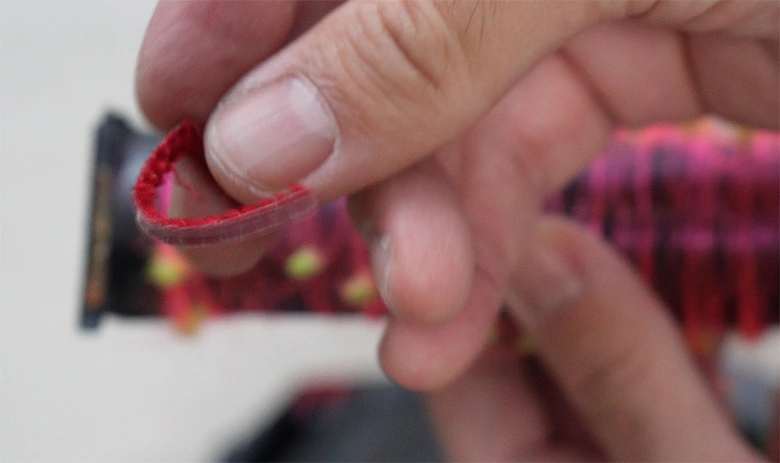
I need to be upfront about something. I bought this vacuum in 2023 but didn’t get to test it until now due to unforeseen circumstances. So this isn’t a long-term use review in the traditional sense — I haven’t been running the Air Ram daily for two years. But what I can tell you is what happened to the materials over that time, and what happened during the testing process itself.
Even sitting mostly unused, the rubber and plastic components have deteriorated noticeably. The felt seal on the brush roll system came off after I removed the brush roll several times during testing. That seal is supposed to stay in place — it helps maintain suction around the brush chamber. Once it detaches, you’re losing some airflow efficiency at the cleaning head. On a vacuum that already measures 28.52 CFM, you can’t afford to lose any.
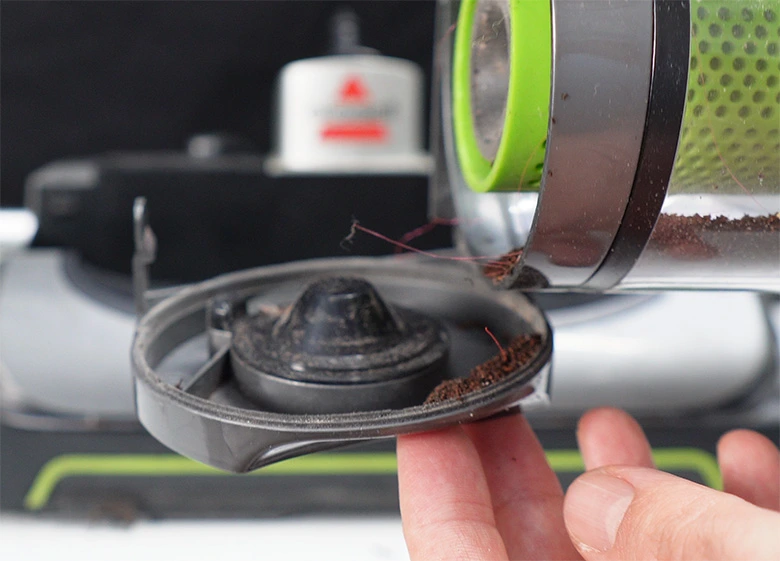
Part of the dustbin seal also came off during testing. That’s a bigger concern. A compromised dustbin seal means fine dust and debris can escape the bin — which is already a weak point on a vacuum with no HEPA filter and no sealed filtration system. If the seals are degrading on a unit that wasn’t used heavily, I’d expect more significant wear on one that’s been in daily rotation.
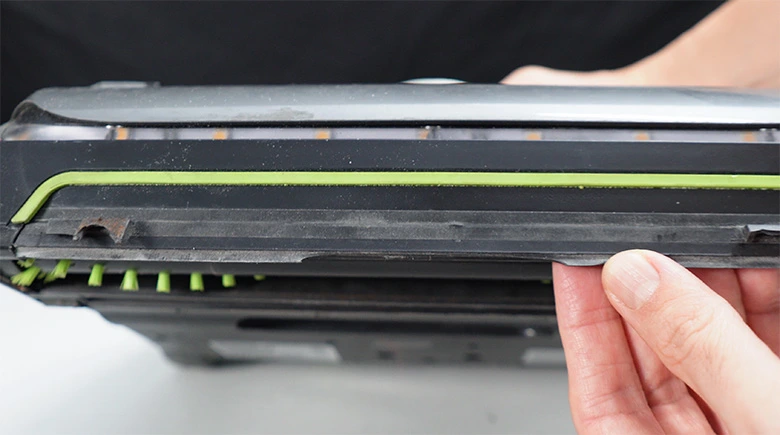
These aren’t performance issues that show up in a quick unboxing review. They’re material quality issues that only surface with time — exactly the kind of thing I look for in long-term assessments. The Air Ram cleans well. The question is how long the components hold up, and based on what I’ve seen, Bissell used materials that don’t age gracefully even under light use.
This is consistent with what I’ve read in consumer reviews. The most common long-term complaint is about the plastic lock mechanism that holds the handle in place — it can crack or wear out with regular use. If you buy the Air Ram, the extended warranty is worth considering. The cleaning performance is solid, but the build quality has a shelf life.
Product Specifications
| Test | Value |
|---|---|
| LED Headlights | Yes |
| Adaptive Suction | No |
| Soft Roller | |
| Soft Roller? | No |
| Battery | 22-volt Lithium Ion |
| Recharge (hrs) | 5 hrs |
| Dustbin Capacity | 0.6 liter |
| Weight | 7.75 lbs |
| Warranty | 2 yrs |
Where to Buy?
The Bissell Air Ram 1984 is available on Amazon and directly from Bissell.com.
- Bissell Air Ram on Amazon
Disclaimer: I will earn a commission if you click on any of the links above, but at no extra cost, so it’s a win-win for us!
Does The Bissell 1984 Air Ram Offer Good Value?
On cleaning performance alone, the Air Ram looks like a bargain. A 97.51% overall score and 91.45% deep cleaning at this price point is hard to argue with. If you only looked at the test numbers, you’d think this was a no-brainer.
But value isn’t just about how well a vacuum cleans on day one. It’s about how well it holds up and how it fits into your actual routine.
The runtime is one consideration. At roughly 29 to 30 minutes of actual use, you’re on a clock. That’s enough for a small apartment or a quick pass through a medium-sized home, but if you’ve got a larger space or you like to do a thorough job in one session, you’ll feel the pressure. The removable battery helps — you can buy a spare — but that’s an additional cost that chips away at the value equation.
Then there’s the cleaning head. It’s wide, which is great for coverage on open floor space. But that same width makes it harder to maneuver into tight spots — between chair legs, around low clearance bases, in narrow hallways. In a smaller home where tight spaces are common, the large nozzle can slow you down rather than speed you up.
And then there’s the durability question. The felt seal on the brush roll system and part of the dustbin seal deteriorated on my unit — and I wasn’t even using it daily. If you’re buying this as an everyday vacuum, those materials may wear out faster than the motor and battery do. Replacing seals and dealing with compromised filtration on a vacuum that already lacks HEPA and a sealed system isn’t ideal. The extended warranty starts to look less like an option and more like a requirement.
The lack of versatility also plays a role. No attachments, no handheld mode. If you need cleaning above the floor, you’re buying a second device. A Bissell 1985 handheld is the natural companion piece, but once you add that cost, you’re approaching the price of a more versatile all-in-one cordless vacuum that does everything with a single battery.
So does the Air Ram offer good value? It depends on how you define value. If you need a dedicated floor vacuum for a small to medium home with mixed surfaces, and you’re comfortable with the durability tradeoffs and the need for a second device for above-floor cleaning, yes, it’s a strong buy. The cleaning performance punches well above the price.
But if you factor in potential replacement parts, a spare battery, and a separate handheld, the total cost of ownership climbs. And at that point, you should be comparing the Air Ram package against a single mid-range cordless vacuum that covers all of those jobs in one tool.
The Verdict
The Bissell Air Ram 1984 is one of the most unusual cordless vacuums I’ve tested — and one of the hardest to give a simple recommendation on.
The cleaning performance is legitimately impressive. A 97.51% overall score, near-perfect surface pickup on both hard floors and carpet, and a 91.45% deep cleaning result from a vacuum with 28.52 CFM and no boost mode. The motor-at-the-base design works. The gate mechanism on the cleaning head is a clever piece of engineering. And the handle weighs about a pound, which makes it one of the least tiring cordless vacuums to push around.
But every strength comes with a corresponding limitation.
The same single power setting that gives it a consistent 30-minute runtime means there’s no max mode to dig deeper into carpet or clear crevices. The wide nozzle covers ground quickly on open floors but struggles in tight spaces. The short, widely-spaced bristles agitate carpet well but can’t manage hair longer than about 7 inches on carpet before wrapping becomes a serious issue. And the materials — the felt seals, the dustbin seal, the plastic components — showed signs of deterioration on my unit even without daily use.
No HEPA filter. No sealed filtration. No attachments. No handheld mode.
Who this vacuum is for: Someone with a small to medium home, a mix of hard floors and carpet up to medium pile, who wants strong floor cleaning performance at a reasonable price — and who either already has a handheld for above-floor jobs or doesn’t need one. If that’s you, the Air Ram delivers where it counts.
Who should look elsewhere: Anyone with long hair or heavy-shedding pets who frequently vacuum carpets. Anyone with allergies who needs sealed HEPA filtration. Anyone with a larger home who needs more than 30 minutes of runtime. Anyone who wants a single vacuum that handles floors, furniture, stairs, and car interiors.
The Air Ram does one thing and does it well. Just make sure that one thing is what you actually need.