

Quick Comparison: Dyson V12 vs Samsung Jet 75
These results come from real-world testing, not spec sheets or marketing claims. The Dyson V12 and Samsung Jet 75 were tested side by side for fine dust pickup, debris control, battery performance, and everyday usability to show how they handle typical messes at home. Before choosing between them, it helps to know where each one performs best. If you’re planning an upgrade, see our cordless vacuum buying guide to choose the right model.
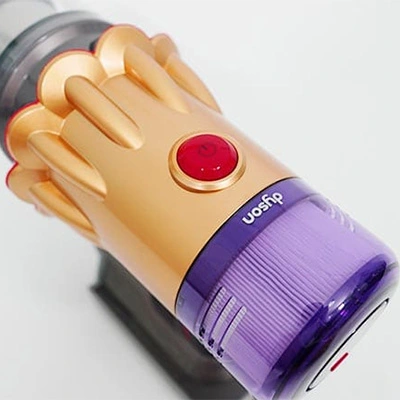
Dyson V12 Detect
Best For: buyers who want a lightweight, intelligent all-around vacuum with strong performance on both hard floors and carpets—without the bulk of larger models.
- Lighter frame
- Green laser offers better dust tracking
- More tool variation
- Better at cleaning pet hair (on upholstery)
- Slightly better deep cleaning performance
- More expensive option
- Smaller dustbin
- Airflow [Max at Nozzle]: 48.38 CFM
- Cleaning [Overall]: 98.31%
- Deep Cleaning: 94.1%
- Run Time: 63:00 mins
- Noise: 80.7 dB
- Dirt Capacity: 0.35 liters
- Weight: 5.2 lbs (w/ tube & nozzle)
Samsung Jet 75
Best For: buyers who want dependable everyday cleaning at a lower price, without the smart features.
- Premium-level performance on surface debris
- More budget-friendly option
- Solid deep-cleaning performance
- Larger dustbin capacity
- Leaked during the fog test
- Bulkier cleaning nozzle
- Struggles with long hair on carpet
- Shorter run time
- Smaller dustbin
- Airflow [Max at Nozzle]: 40.66 CFM
- Cleaning [Overall]: 98.26%
- Deep Cleaning: 93.25%
- Run Time: 41:10 mins
- Noise: 82.3 dB
- Dirt Capacity: 0.8 liters
- Weight: 6 lbs (w/ tube & nozzle)
⚡ Quick Verdict
👉 Choose the Dyson V12 Detect if: you want stronger smart features, dust detection, longer run time, and better all-around cleaning across hard floors and carpets.
👉 Choose the Samsung Jet 75 if: you want a cheaper cordless vacuum with a larger dustbin and solid everyday cleaning performance.
Bottom line: The Dyson V12 Detect is the better pick for smart cleaning and overall performance, while the Samsung Jet 75 offers better value and more dustbin capacity for less money.
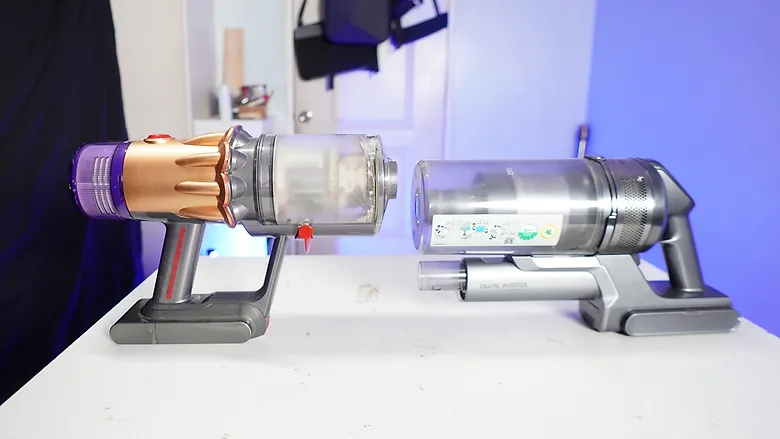
Similarities
Before diving into performance differences, it’s important to understand what the Dyson V12 and Samsung Jet 75 have in common.
1. Versatility
Both vacuums can be used as a stick vacuum or handheld vacuum, thanks to their interchangeable tools. The Dyson V12 Detect does have an edge here because it usually includes more attachments out of the box, though this can vary by model, so it’s worth checking what’s included before buying.
2. Trigger-less Design
Both models use a triggerless design, so you don’t have to keep squeezing a trigger while cleaning. Instead, each vacuum has a power button that turns the motor on and off.
The main difference is button placement.
The Dyson V12 Detect has its power button above the motor, with suction settings controlled through the LCD screen. The Samsung Jet 75 places its controls above the handle, making them easy to reach while vacuuming.
3. Detachable Battery

The Samsung Jet 75 and Dyson V12 Detect both have removable batteries, which gives users the option to buy a spare and extend cleaning time.
However, the Jet 75 has one drawback: the battery cannot be charged directly with the charger.
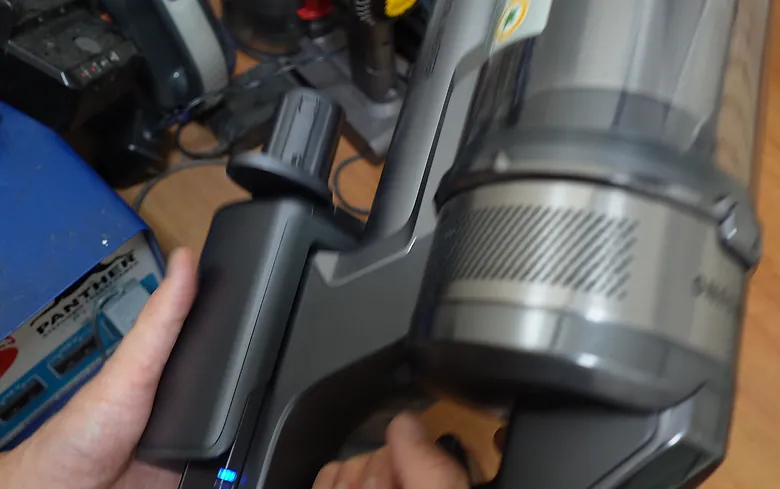
It has to be attached to the dock, which means you can’t charge a spare battery while using the vacuum unless you have a separate charging setup. This limits the usefulness of buying an extra battery.
4. Separate Nozzles for Hard Floor and Carpet
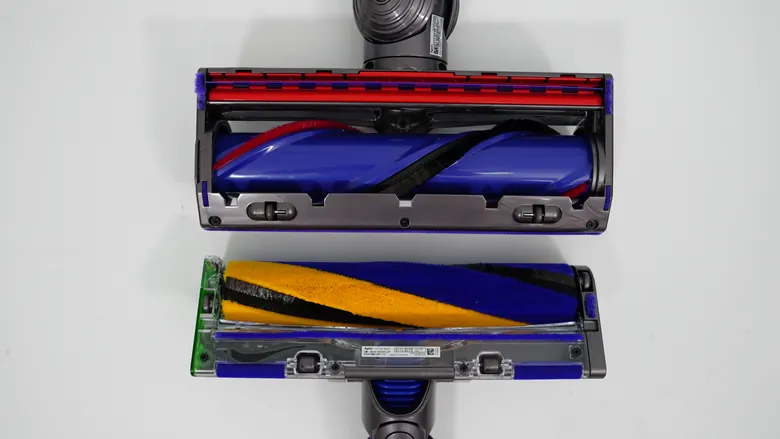
Both models come with separate cleaning heads for hard floors and carpet: a soft roller for hard surfaces and a bristled brush roll for carpet.
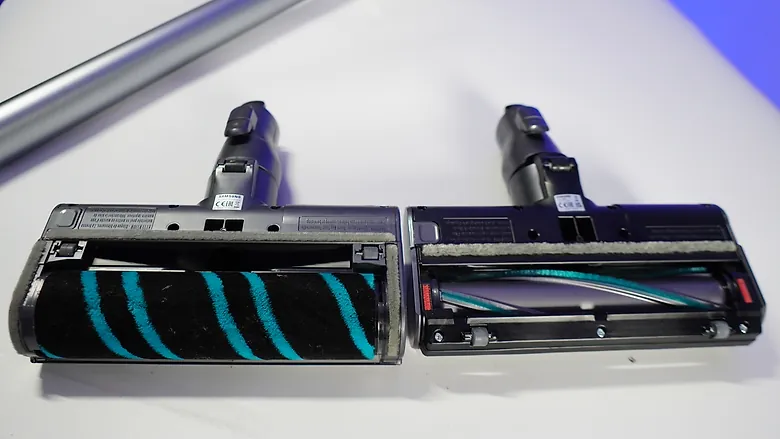
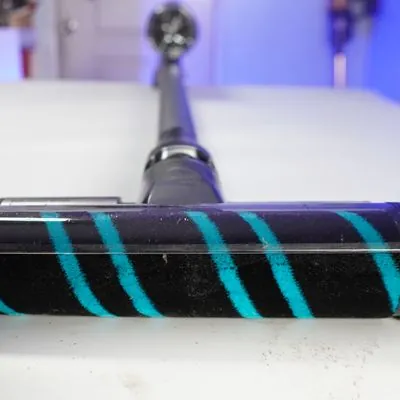
The Dyson V12 Detect has the advantage on hard floors because it uses the Laser Slim Fluffy head. It’s smaller and has a bright green light that makes dust easier to see. The Samsung Jet 75’s soft roller is bulkier and doesn’t have any built-in lighting.
Differences
The Dyson V12 Detect and Samsung Jet 75 take two different approaches to cordless vacuum design. The Dyson is lighter and more advanced, with laser dust detection, particle counting, and a compact body.
The Samsung is more of a practical mid-range cleaner, with a larger dustbin, detachable battery, and strong all-around cleaning performance.
Below, we’ll compare the key differences between the Dyson V12 and Samsung Jet 75 based on our test results, so you can decide which one fits your home better.
1. Weight
On their own — without the extension tube and floor nozzle attached — the Samsung Jet 75 is slightly heavier than the Dyson V12 Detect. The Jet 75 comes in at 3 lbs 9.6 oz, compared to the V12’s 3 lbs 4.2 oz.
Once you add those attachments, the gap widens. The V12 Detect stays relatively light at just over 4 pounds, while the Jet 75 climbs past 6 pounds due to its bulkier floor nozzle.
That said, the extra weight of the Jet 75 isn’t as noticeable during everyday floor cleaning. Samsung positioned the handle behind the dustbin and motor, which keeps the balance point lower and makes it feel less front-heavy than the numbers suggest.
2. Interface
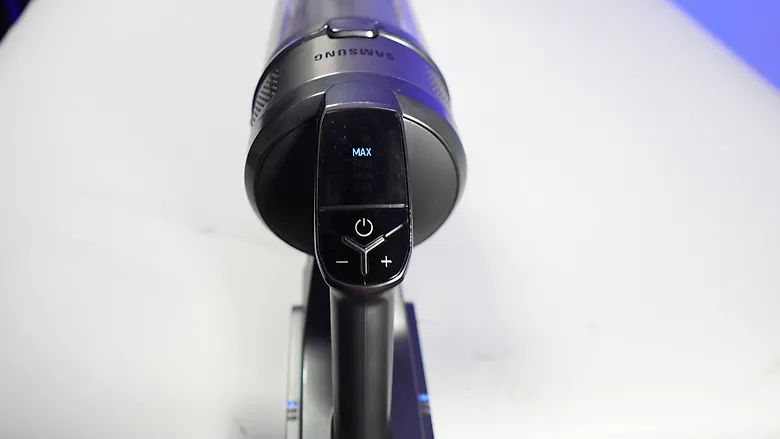
Both vacuums have an onboard display, but they’re not doing the same thing.
The Dyson V12 Detect’s screen is actually useful mid-clean — it shows real-time particle counts from the Piezo sensor and tells you how much battery life you have left.

The Jet 75 keeps it simple, only displaying your current power setting. There’s no runtime estimate or live feedback of any kind.
3. Dirtbin Capacity
The Samsung Jet 75 has a noticeably larger dustbin, holding 0.8 liters — more than twice the capacity of the Dyson V12 Detect’s 0.35-liter bin.
The Jet 75 also wins on the emptying experience: its wider opening makes dumping debris straightforward, whereas the V12 Detect’s narrower bin can be a bit more fiddly to clear out.
4. Tools
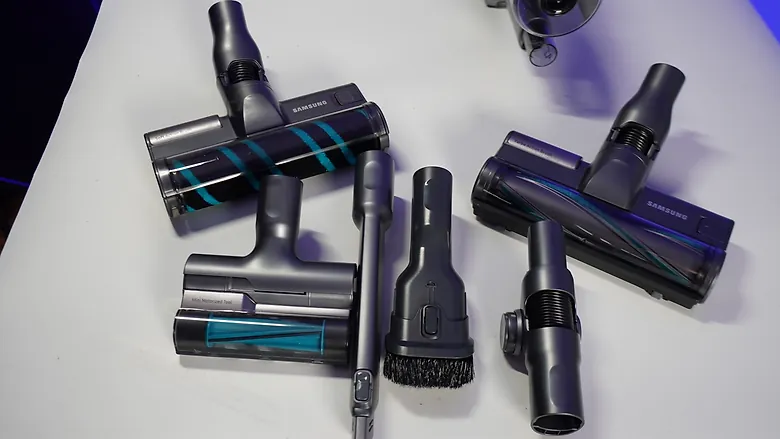
The Dyson V12 Detect comes with more tools out of the box. The standout is the hair screw tool, which has been the most effective attachment I’ve tested for pulling long hair off upholstery — nothing else I’ve tried comes close.
Here’s everything included with the Dyson V12 Detect.

And here’s what comes with the Samsung Jet 75.
Run Time Comparison
| Power Setting | Dyson V12 | Samsung Jet 75 |
|---|---|---|
| Hard Floor | ||
| Low (hh:mm:ss) | 1:03:00 | 41:10 |
| Mid/Auto (hh:mm:ss) | 37:50 | 24:05 |
| High (hh:mm:ss) | 9:46 | |
| Carpet | ||
| Low (hh:mm:ss) | 42:00 | 41:11 |
| Mid/Auto (hh:mm:ss) | 27:31 | 22:09 |
| High (hh:mm:ss) | 6:25 | 9:22 |
I tested the runtime of both the Dyson V12 Detect and Samsung Jet 75 on hard floor and carpet, across each power setting. The Dyson V12 Detect comes out ahead in overall runtime.
On hard floors, the gap is significant. On low power, the V12 ran for a full hour and three minutes — the Jet 75 managed just 41 minutes, a difference of over 20 minutes.
On the middle setting (or auto for Dyson), the V12 again pulled well ahead, lasting nearly 14 minutes longer. I wasn’t able to record a max power result for the V12 on hard floor, so only Samsung’s 9 minutes and 46 seconds is noted there.
On carpet, the results are closer. On low, the two are nearly identical — 42 minutes for the V12 and 41 minutes for the Jet 75. The V12 holds a modest edge on mid power, running about five minutes longer.
The one area where the Samsung wins is max power on carpet. The Jet 75 lasted 9 minutes and 22 seconds versus the V12’s 6 minutes and 25 seconds — almost three minutes more. If you do a lot of high-power carpet cleaning, that difference is worth keeping in mind.
Airflow Comparison
| Power Setting | Dyson V12 | Samsung Jet 75 |
|---|---|---|
| Airflow at the Nozzle | ||
| Low (CFM) | 24.00 | 24.35 |
| Mid/Auto (CFM) | 28.52 | 29.64 |
| High (CFM) | 48.38 | 40.66 |
| Airfow at the Wand | ||
| Low (CFM) | 27.43 | 27.00 |
| Mid/Auto (CFM) | 32.23 | 35.59 |
| High (CFM) | 58.74 | 62.82 |
I measured airflow for both vacuums at the nozzle and at the wand across all three power settings. The results are more mixed than you might expect.
At the nozzle, the Samsung Jet 75 leads on low and mid power, though only by a small margin — less than 2 CFM in both cases. On high power, however, the Dyson V12 Detect pulls ahead by a noticeable amount, hitting 48.38 CFM compared to the Jet 75’s 40.66 CFM. That’s roughly an 8 CFM gap in the V12’s favor when it matters most.
At the wand, the story flips somewhat. On low, the two are virtually tied. On mid and high power, the Samsung takes the lead — by about 3.4 CFM on mid and 4 CFM on high.
What this tells you in practice: the V12 Detect moves more air through the nozzle at max power, which is where cleaning performance really counts on carpet and stubborn debris. The Jet 75’s advantage at the wand is less relevant in day-to-day tasks, since most cleaning happens at the nozzle end.
Cleaning Performance
| Surface Tested | Dyson V12 | Samsung Jet 75 |
|---|---|---|
| Overall (%) | 98.31 | 98.26 |
| Hard Floor (%) | 99.80 | 100.00 |
| Sand on Hard Floor (%) | 99.90 | 99.80 |
| Carpet (%) | 99.45 | 100.00 |
| Deep Cleaning (%) | 94.10 | 93.25 |
| Hair Pickup (Overall) (%) | 89.44 | 82.36 |
Both the Dyson V12 and Samsung Jet 75 scored incredibly close in my tests — 98.31% vs 98.26% overall. Honestly, on hard floors and carpet, you’d be splitting hairs trying to call a winner.
The Samsung actually hit a perfect 100% on carpet and came in at 100% on hard floors, while the Dyson wasn’t far behind at 99.45% and 99.80%.
Where the gap opens up is hair pickup. The V12 picked up 89.44% of hair overall compared to the Jet 75’s 82.36% — a 7-point difference that’s hard to ignore if you have pets or long hair in the house. Deep cleaning on thick carpet also went to the Dyson, though both scores were in the low 90s.
Which Option is Better on Hard Floors?
The Samsung Jet 75 scored a perfect 100% on hard floors, while the Dyson V12 came in at 99.80%. That 0.2% gap is so small it’s basically a wash in real-world cleaning.
Both vacuums handled bare floors extremely well — dust, debris, and fine particles weren’t a problem for either one. If hard floors are your main surface, you really can’t go wrong with either vacuum.
Sand on Hard Floor

This is where the Dyson V12 flips the result — it scored 99.90% compared to the Jet 75’s 99.80%. Again, we’re talking about a tenth of a percent difference, so both are cleaning up nearly everything.
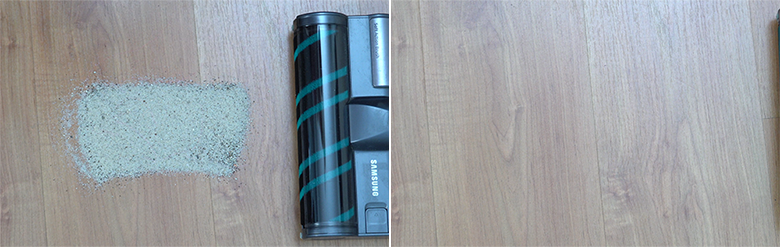
Fine particles like sand can be tricky for some vacuums to pick up without blowing it around, but neither of these had much trouble.
Edge Cleaning Comparison

Dyson V12 before and after edge cleaning photos
Edge cleaning is one of those things that looks simple but separates good vacuums from great ones. Dirt along baseboards tends to get pushed around rather than picked up if the airflow isn’t strong enough.
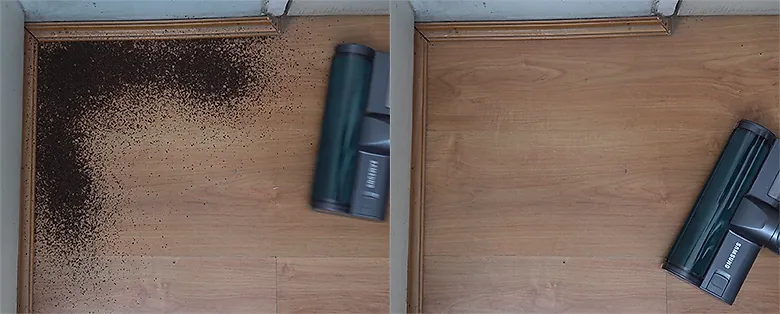
Samsung Jet 75 edge cleaning before and after photos
Both the V12 and Jet 75 handled this well. Debris along the walls cleared up quickly without needing a lot of extra passes. The one thing that stood out with the V12 is its Auto mode — it has a sensor that detects dirt and bumps up the suction automatically.
So when you hit a particularly dirty stretch of baseboard, it adjusts on its own without you having to manually switch modes. The Jet 75 doesn’t have that, but it still performed at the same level in testing.
Crevice Pickup
Both the V12 and Jet 75 did well in the quarter-inch crevice test — each one had enough suction to pull dirt out of a tight space like that. That said, neither was perfect.
Both left a few stray pieces of quinoa right at the very edge of the crevice.
It wasn’t a lot, but it was consistent with both vacuums, so it’s more of a limitation of the brush head design than anything specific to one model.

Samsung Jet 75 crevice pick up before and after

Dyson V12 crevice pick up before and after photos
Hair Wrap on Hard Floors
Dyson V12

- 5-inch strands: 96%
- 7-inch strands: 100%
- 9-inch strands: 92.5%
- 11-inch strands: 98%
- 13-inch strands: 100%
Samsung Jet 75
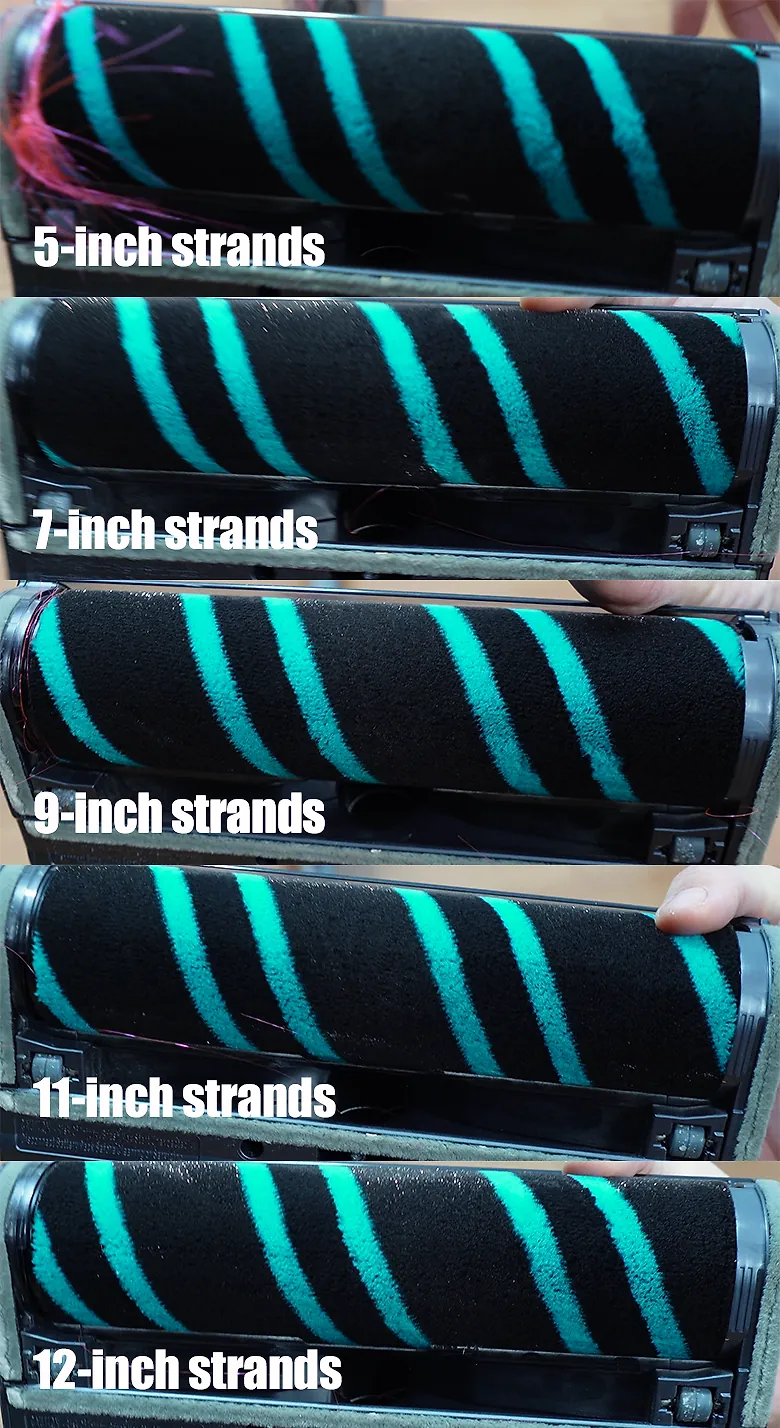
- 5″ strands: 79%
- 7″ strands: 100%
- 9″ strands: 61.3%
- 11″ strands: 100%
- 12″ strands: 100%
This is one of the bigger differences between these two vacuums. The Dyson V12 was consistent across every strand length — its lowest score was 92.5% on 9-inch strands, and it hit 100% on both 7-inch and 13-inch strands. It never dropped below 92%.
The Samsung Jet 75 is a different story. It did great on 7-inch, 11-inch, and 12-inch strands, hitting 100% on all three. But it struggled with 9-inch strands, picking up only 61.3%, and came in at 79% on 5-inch strands. That inconsistency is hard to overlook.
In practice, hair isn’t going to be a uniform length on your floors. You’ll have a mix of short and long strands, and that’s where the V12 holds up better.
The Jet 75 can handle certain lengths really well, but that 9-inch result shows it has a weak spot. If hair is a big concern in your home — pets, long hair, whatever the case — the V12 is the safer bet here.
Which Option is Better On Carpet?
The Samsung Jet 75 scored a perfect 100% on carpet, while the Dyson V12 came in at 99.45%. Like the hard floor results, that gap is small enough that you’d never notice the difference in day-to-day cleaning. Both vacuums did an excellent job pulling debris out of carpet fibers without needing multiple passes.
If you have carpet as your main surface, either one will do the job well — the Jet 75 just has a slight edge on paper.
Deep cleaning result
The Dyson V12 scored 94.10% on deep cleaning compared to the Samsung Jet 75’s 93.25%. The V12 wins this one, though the margin is less than a point.
Deep cleaning tests how well a vacuum pulls embedded dirt out of carpet — the kind of debris that’s worked its way down into the fibers over time.
Both vacuums performed well here, but if deep cleaning is a priority for you, the V12 has a slight advantage.
Hair Wrap on Carpet
Dyson V12 Results

- 5-inch strands: 96%
- 7-inch strands: 100%
- 9-inch strands: 92.5%
- 11-inch strands: 30%
Samsung Jet 75 Results
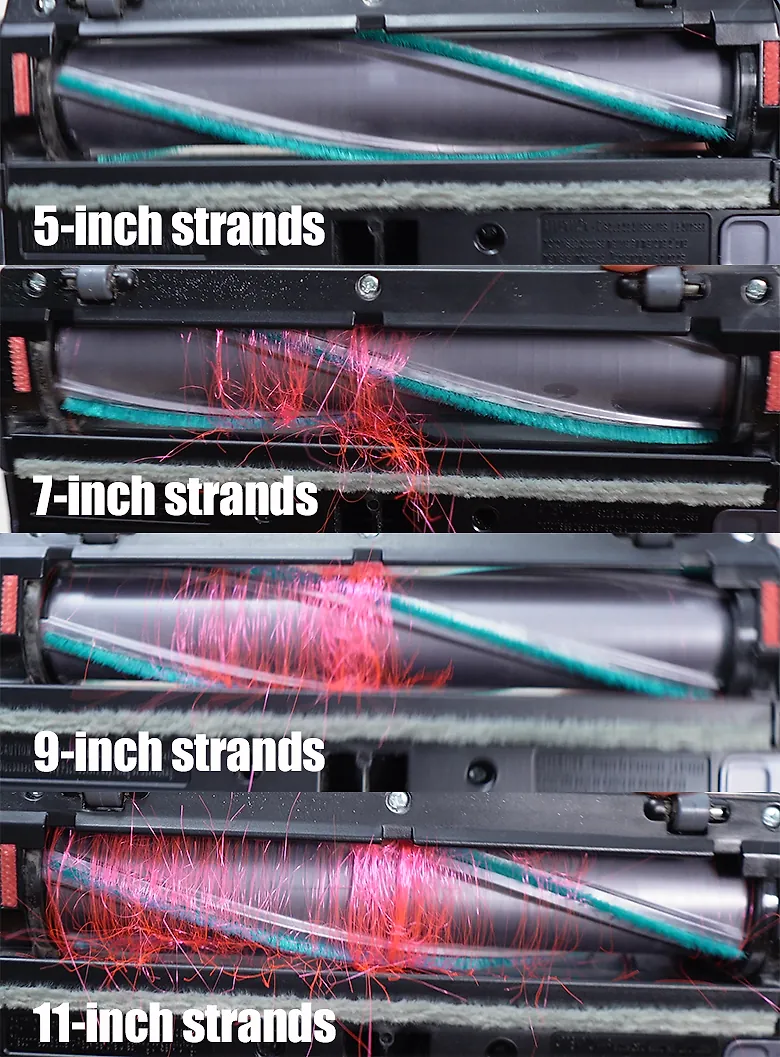
- 5″ strands: 100%
- 7″ strands: 95%
- 9″ strands: 68%
- 11″ strands: 40%
The V12 was consistent through the shorter lengths — 96% on 5-inch, 100% on 7-inch, 92.5% on 9-inch — then dropped to 30% at 11-inch. The Jet 75 started with a perfect 100% on 5-inch but faded steadily, hitting 68% at 9-inch and 40% at 11-inch.
With the 11-inch hair, both vacuums struggle. The V12 holds up better through the mid-range lengths, but neither is a strong performer once hair gets long on carpet.
Noise Comparison
| Power Setting | Dyson V12 | Samsung Jet 75 |
|---|---|---|
| Low (dB) | 70.10 | 73.50 |
| Mid/Auto (dB) | 72.50 | 81.70 |
| High (dB) | 80.70 | 82.30 |
On low, the V12 runs at 70.10 dB versus the Jet 75’s 73.50 dB. On high, they’re close — 80.70 dB against 82.30 dB. The biggest gap is at mid, where the V12 sits at 72.50 dB, and the Jet 75 jumps to 81.70 dB — a 9 dB difference on the setting most people use most.
If noise matters to you, the V12 is the quieter option, particularly at mid power.
Product Specifications
| Model | Dyson V12 | Samsung Jet 75 |
|---|---|---|
| LED Headlights | Yes | None |
| Adaptive Suction | Yes | None |
| Soft Roller | ||
| Soft Roller? | Yes | Yes |
| Battery | 2500 mAh | 21.6-volts |
| Recharge (hrs) | 3 hrs | 3 to 4 hrs |
| Dustbin Capacity | 0.35 liters | 0.8 liter |
| Weight | 5.2 lbs | 12.6 lbs |
| Warranty | 2 yrs | 10 yr motor |
Where Can I Purchase These Cordless Vacuums?
You could purchase the Dyson V12 Detect and Samsung Jet 75 in online stores like Amazon. Check the links below for the latest pricing information.
- Dyson V12 Detect on Amazon
- Samsung Jet 75 on Amazon
- Samsung Jet 75 on Samsung Store
Disclaimer: I will earn a commission if you click on any of the links above, but at no extra cost, so it’s a win-win for us!
Which Option Offers Better Value?
On the surface, these two vacuums are neck and neck. Both clean hard floors and carpet extremely well, and the overall scores are less than a point apart.
The Dyson V12 edges ahead on deep cleaning, sand pickup, and hair — but none of those margins are dramatic except for hair, where the V12 is noticeably more consistent across different strand lengths, especially on carpet.
Where the V12 starts to pull away is everything outside of raw cleaning numbers. It passed the fog test with zero visible leaks, meaning the filtration is properly sealed.
The laser slim nozzle shines a bright green laser on the floor that makes dust you’d normally walk past visible. It’s quieter — particularly on the mid setting, where it runs nearly 10 dB lower than the Jet 75. And while it costs more, you get more tools and more usability features than what the Samsung offers at its lower price point.
The Samsung Jet 75 is cheaper, and it cleans well enough to justify the price. But the battery situation is a real drawback. You can’t charge the battery independently — it has to stay attached to the vacuum body while it charges.
If you buy a spare battery to extend your runtime, you’ll still need to swap it out and dock the whole unit to charge it. It adds more hassle than it should.
The Verdict
Both vacuums clean well. On hard floors and carpet, the differences are tiny — we’re talking fractions of a percent that won’t matter in real life. If straight cleaning performance was the only thing on the scorecard, this would basically be a tie.
But cleaning performance isn’t the whole picture. The V12 is better at picking up hair, runs quieter, has a sealed filtration system, and comes with the laser nozzle that actually makes a difference when you’re cleaning in normal lighting. It also gives you more tools and more flexibility out of the box.
The Samsung Jet 75 is the better option if you’re working with a tighter budget and primarily clean hard floors and carpet without much hair involved. It performs well for the price.
If you can stretch the budget, the Dyson V12 is worth it. The extra cost buys you a more complete package — better hair pickup, better noise levels, better filtration, and more accessories to work with.