

Quick Comparison: Dyson V15 vs Samsung Jet 75
These results come from real-world testing, not spec sheets or marketing claims. The Dyson V15 Detect and Samsung Jet 75 were tested side by side for fine dust pickup, debris control, battery performance, and everyday usability to show how they handle typical messes at home. Before choosing between them, it helps to know where each one excels. If you’re planning an upgrade, see our cordless vacuum buying guide to choose the right model.
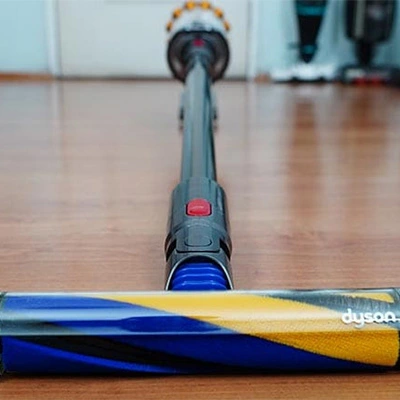
Dyson V15 Detect
Best For: you want the best cleaning performance, laser dust detection, real-time particle counting, and a vacuum that adapts to every surface automatically.
- Longer run time
- Laser reveals fine dust invisible to the naked eye
- Piezo sensor counts particles in real time
- Auto-mode adapts suction to each surface
- Better deep cleaning performance on carpet
- Most expensive option
- Heavier than the Samsung Jet 75
- Smaller dustbin
- Airflow [Max at Nozzle]: 69.19 CFM
- Cleaning [Overall]: 99.91%
- Deep Cleaning: 100%
- Run Time: 84:19 mins
- Noise: 80.8 dB (w/ tube & nozzle)
- Weight: 6.8 lbs
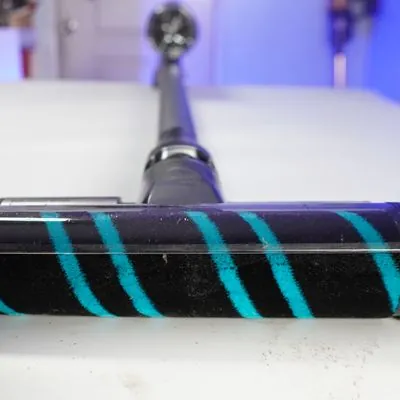
Samsung Jet 75
Best For: homes that want premium-level surface and hard floor cleaning without paying a premium price — a capable everyday vacuum at a lower cost than flagship models.
- More budget-friendly option
- Larger dustbin capacity
- Solid surface debris pickup
- Handle placement offers better ergonomics
- No smart features or auto-mode
- Shorter run time
- Struggles with long hair on carpet
- Bulkier cleaning nozzle
- Failed the fog test
- Airflow [Max at Nozzle]: 40.66 CFM
- Cleaning [Overall]: 98.26%
- Deep Cleaning: 93.25%
- Run Time: 41:10 mins
- Noise: 82.3 dB
- Dirt Capacity: 0.8 liters
- Weight: 6 lbs (w/ tube & nozzle)
⚡ Quick Verdict
👉 Choose the Dyson V15 Detect if: you want the best cleaning performance, laser dust detection, longer run time, real-time particle counting, and a vacuum that adapts to every surface automatically.
👉 Choose the Samsung Jet 75 if: you want premium-level surface cleaning at a lower price point and don't need laser dust detection, auto-mode, or the extended run time of the V15.
Bottom line: The Dyson V15 Detect is the stronger performer with smarter technology, but you'll pay a premium for it. The Samsung Jet 75 is a capable, no-frills option that gets the job done without the added cost.
Similarities
The Dyson V15 Detect and Samsung Jet 75 have more in common than you’d expect at first glance. Here’s where they overlap.
1. Interchangeable Tools
Both vacuums work as a stick or handheld — detach the floor head, clip on a smaller attachment, and you can clean furniture, car seats, or tight corners without pulling out a separate device. It’s a practical setup that makes either vacuum more useful around the house.
Here’s what you’ll get with the V15 Detect.

And the Samsung Jet 75.
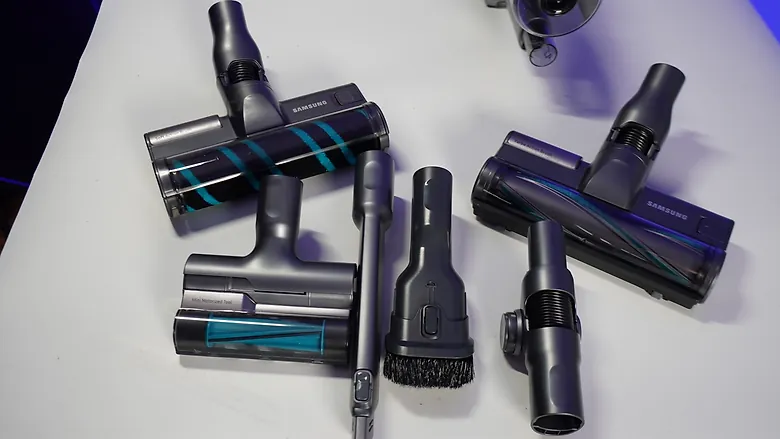
2. Floor-Specific Tools

You get two separate floor heads with each vacuum — a soft roller for hard floors and a brush roll for carpet. You’re not stuck choosing one or the other. It’s also part of why the Jet 75 held up well in our surface debris tests.
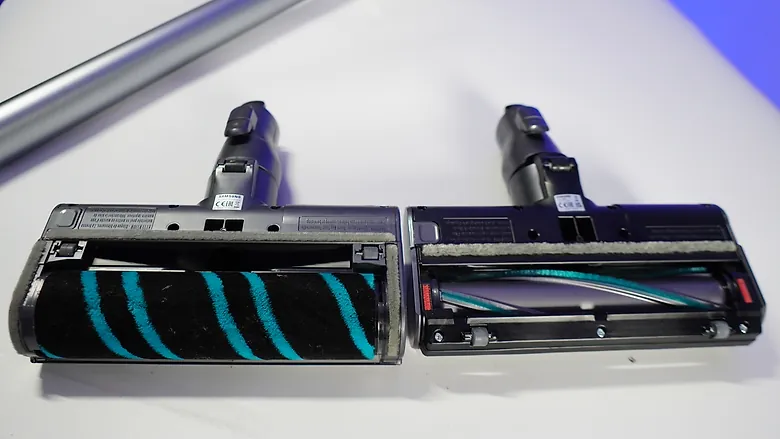
3. Multiple Power Modes
Three suction levels on each vacuum. Low handles everyday messes, high is there when you need it for thick carpet or bigger debris — and mid covers most situations in between.
The difference is in how mid works. The V15’s mid setting uses sensors to ramp up suction when it detects more dirt, then backs off. The Jet 75’s is a fixed level — it works well, but you’re the one deciding when to push it harder.
Differences
This is where the two vacuums start to pull apart. Some gaps are minor, others are hard to ignore — especially if you’re buying for the long run.
1. Dustbin Capacity
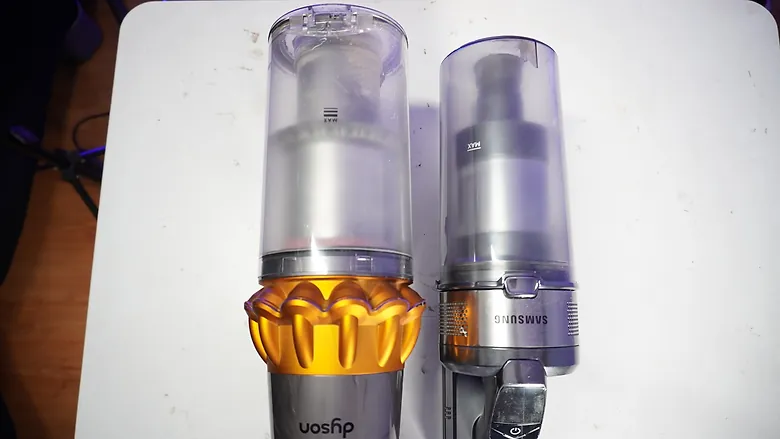
The Jet 75 holds slightly more at 0.8 liters versus 0.75 on the V15 — a 0.05 liter difference that won’t matter much day to day. What does matter is how each empties.
The Jet 75’s entire dustbin assembly detaches from the body and has a wider opening, so emptying it is cleaner and more straightforward. The V15’s bin is fine, just a bit more fiddly by comparison.
2. Dust Tracking

The V15 Detect’s laser slim roller has a bright green laser built into the floor head that lights up dust you’d otherwise miss — the kind of fine particles that blend right into hardwood.
It sounds gimmicky until you see it in action. The Jet 75 has no equivalent, so you’re relying on what you can see with normal lighting.
3. Run Time
This one isn’t close. The V15 Detect runs for over 80 minutes, nearly double what the Jet 75 can manage. But the bigger advantage is flexibility — the V15’s battery charges independently, so you can run one battery while a spare charges on the side.
The Jet 75’s battery is technically detachable, but there’s no charging port on the battery itself, so it has to be attached to the vacuum to charge. That largely defeats the point of having a removable battery in the first place.
4. Filtration
In the fog test — where you run the vacuum through smoke to check for leaks — the V15 Detect came through clean with no visible escape.
The Jet 75 wasn’t as tight, showing leaks around the dustbin and battery areas. If filtration matters to you, especially for allergies, that’s a meaningful difference.
5. Power Switch
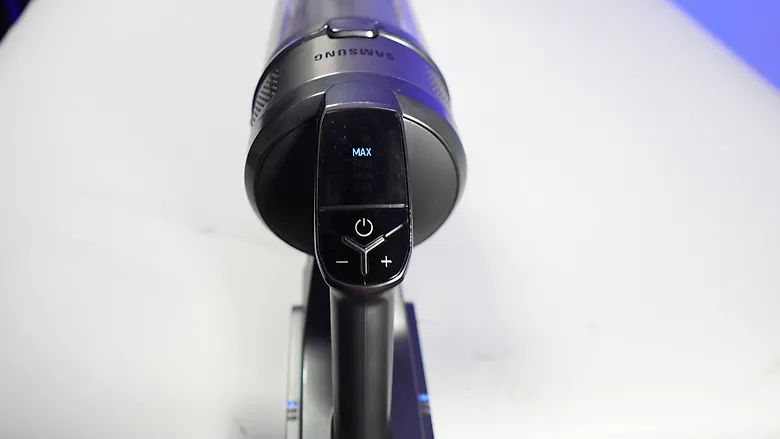
The V15 Detect uses a trigger switch to run the motor — hold it to clean, release to stop. Dyson moved away from this with the V12 and Gen5 Detect, both of which use a push-button switch instead.
The Jet 75 uses three buttons — one to power on and two to toggle between suction levels.
Run Time Comparison
| Power Setting | Dyson V15 | Samsung Jet 75 |
|---|---|---|
| Hard Floor | ||
| Low (hh:mm:ss) | 1:24:19 | 41:10 |
| Mid/Auto (hh:mm:ss) | 41:30 | 24:05 |
| High (hh:mm:ss) | 13:44 | 9:46 |
| Carpet | ||
| Low (hh:mm:ss) | 56:58 | 41:11 |
| Mid/Auto (hh:mm:ss) | 17:23 | 22:09 |
| High (hh:mm:ss) | 11:02 | 9:22 |
The gap is biggest at low power on hard floors — the V15 ran for 1 hour 24 minutes, the Jet 75 managed 41. At mid on hard floors it’s a similar story: 41 minutes versus 24.
Carpet at mid is the one exception. The Jet 75 lasted 22 minutes, the V15 only 17 — because the auto mode detects carpet resistance and pushes harder, draining the battery faster. At high power, both land around 10-13 minutes regardless of surface.
The other advantage is charging. The V15’s battery comes off and charges separately, so you can run one while a spare tops up. The Jet 75’s battery detaches too, but has no charging port of its own — it only charges while connected to the vacuum, making the removable design more useful for replacement than anything else.
Airflow Comparison
| Power Setting | Dyson V15 | Samsung Jet 75 |
|---|---|---|
| Airflow at the Nozzle | ||
| Low (CFM) | 29.98 | 24.35 |
| Mid/Auto (CFM) | 36.32 | 29.64 |
| High (CFM) | 69.19 | 40.66 |
| Airfow at the Wand | ||
| Low (CFM) | 34.55 | 27.00 |
| Mid/Auto (CFM) | 42.38 | 35.59 |
| High (CFM) | 73.00 | 62.82 |
At low and mid power, the gap between the two is there but not dramatic — 29.98 vs 24.35 CFM at the nozzle on low, 36.32 vs 29.64 on mid. Day-to-day cleaning on either setting, you won’t feel the difference.
High power is where it separates. The V15 hit 69.19 CFM at the nozzle versus the Jet 75’s 40.66 — nearly 70% more airflow. At the wand, the gap closes a bit, 73.00 vs 62.82, because the floor head adds resistance that affects the nozzle reading more than the wand.
That high-power difference showed up in the cleaning tests too. The V15 cleared debris more consistently on carpet, particularly with larger or heavier particles that need stronger suction to dislodge.
The Jet 75 did well on surface debris — hard floors especially — but on carpet with embedded dirt, the lower airflow at high power was a factor in why it didn’t match the V15’s scores in those specific tests.
Cleaning Performance
| Surface Tested | Dyson V15 | Samsung Jet 75 |
|---|---|---|
| Overall (%) | 99.91 | 98.26 |
| Hard Floor (%) | 99.85 | 100.00 |
| Sand on Hard Floor (%) | 99.80 | 99.80 |
| Carpet (%) | 100.00 | 100.00 |
| Deep Cleaning (%) | 100.00 | 93.25 |
| Hair Pickup (Overall) (%) | 97.76 | 82.36 |
Both vacuums scored well across the board, and on surface debris they’re essentially equal — the Jet 75 actually hit a perfect 100% on hard floors, and both tied on carpet.
The overall scores diverge because of deep cleaning. The V15 scored 100% there versus the Jet 75’s 93.25%, pushing the V15 to a 99.91% overall against 98.26%. The Jet 75 is a strong surface cleaner — embedded dirt is where it loses ground.
Which Option is Better on Hard Floors?
On paper, the Jet 75 wins this one — 100% on hard floors versus the V15’s 99.85%, and both tied at 99.80% on sand. Close enough that in real use, you wouldn’t notice a difference in what either picks up.
What the scores don’t capture is the V15’s laser-slim roller. The green laser highlights fine dust that’s otherwise invisible on hardwood — the Jet 75 cleans it too, you just won’t see what you’re missing.
For most people, the cleaning results are a wash. But if you want to actually see what you’re cleaning, the V15 has an edge the numbers can’t show.
Sand on Hard Floor Test
Both vacuums tied at 99.80% — as close as it gets without hitting perfect. The photos below show the before and after for each.

Before/After photos — V15 Detect
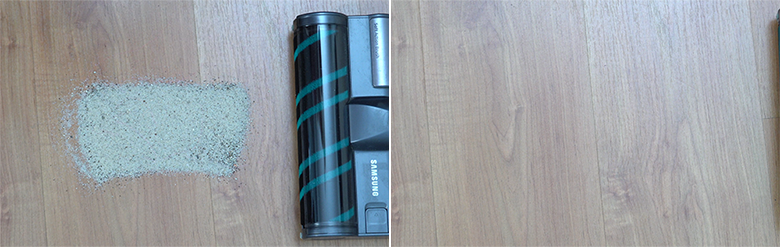
Before/After photos — Jet 75
Edge Cleaning Comparison
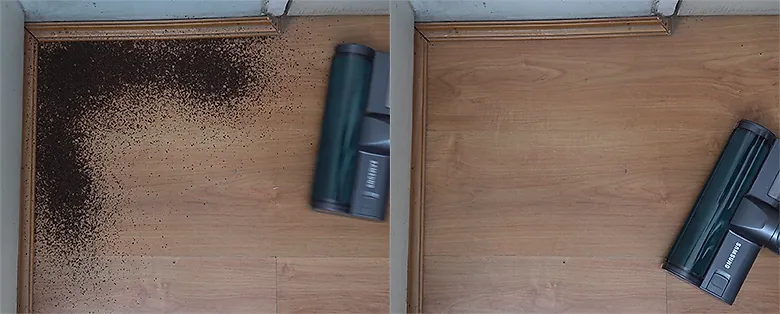
Before and after photo – edge cleaning (Samsung Jet 75)
Neither vacuum struggled here. Both cleared the coffee grounds along the edges in just a few passes, with no real difference between them in this test. The photos below show the before and after.

Before and after photo – edge cleaning (Dyson V15 Detect)
Crevice Pickup
Both vacuums handled this test well, but the V15 cleared the debris in fewer passes. The higher airflow gave it more pull in the tighter space, so it didn’t need multiple runs over the same area. The Jet 75 got there too, but it just took a bit more work to get everything out.
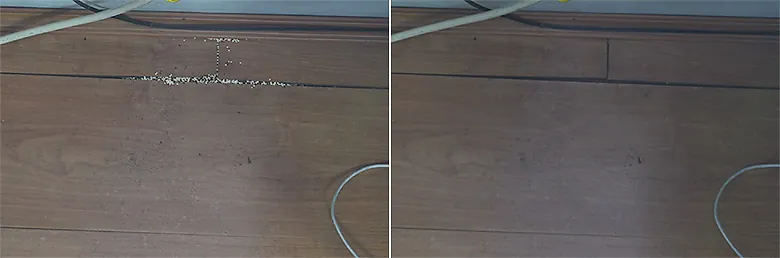
Before and after photos – crevice pickup test (Dyson V15 Detect)
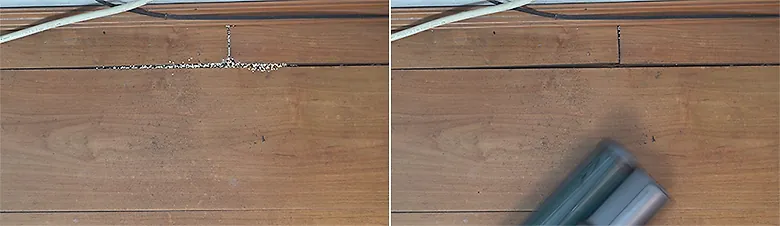
Before and after photos – crevice pickup test (Samsung Jet 75)
Hair Wrap on Hard Floors
The V15 scored better overall, but neither vacuum is completely free of hair wrap issues.
Dyson V15 Detect

- 5″ strands: 100%
- 7″ strands: 100%
- 9″ strands: 100%
- 11″ strands: 100%
- 12″ strands: 80.6%
Samsung Jet 75
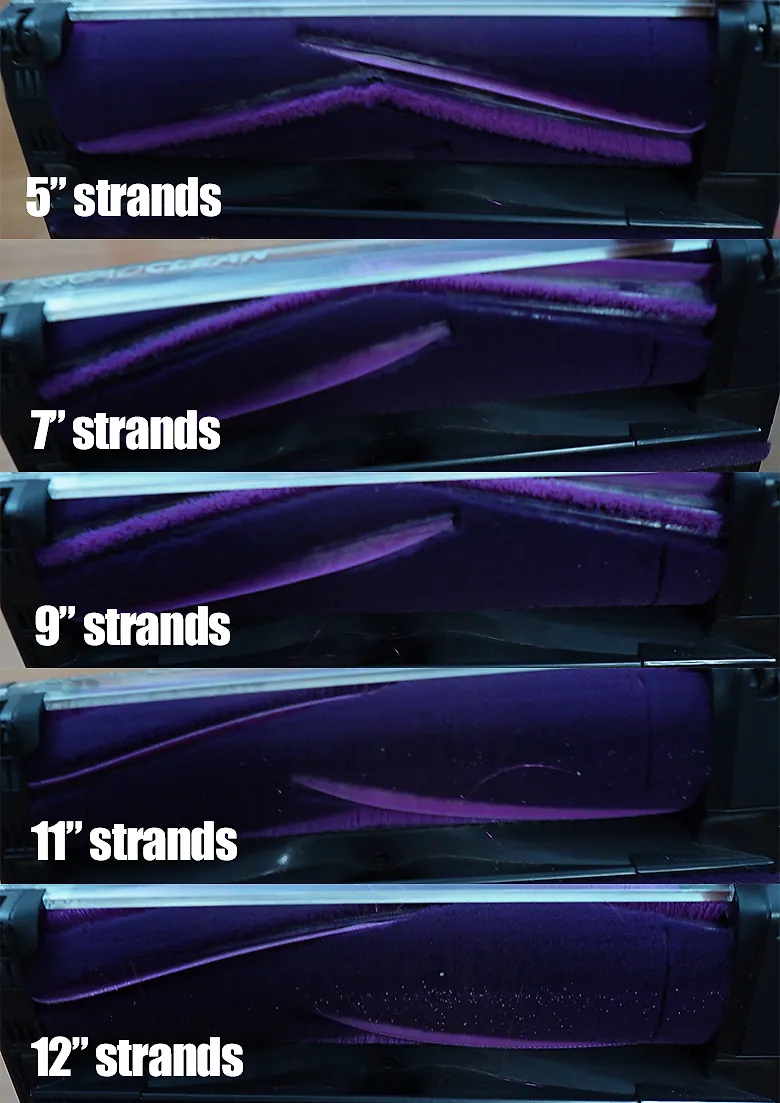
- 5″ strands: 79%
- 7″ strands: 100%
- 9″ strands: 61.3%
- 11″ strands: 100%
- 12″ strands: 100%
The Jet 75 had hair wrapping on the axle more often, but it comes off without much effort — the hair doesn’t bind tightly, so you can pull it free by hand.
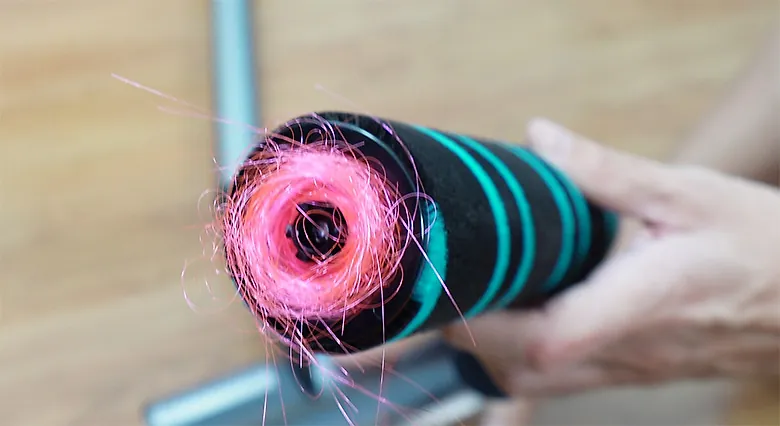
The V15 wraps less frequently, but when it does, it’s a different story. Hair gets wound tight enough around the axle that you’ll need scissors to cut it loose before you can remove it.

So while the V15 wins on pickup percentages, the Jet 75 is easier to maintain if hair wrap is something you deal with regularly.
Which is Better on Carpet?
Both vacuums scored 100% on carpet surface cleaning — no difference between them on everyday debris sitting on top of the carpet pile. Either one will handle regular carpet cleaning without issue.
Where they split is deep cleaning.
Deep Cleaning
The V15 scored a perfect 100% versus the Jet 75’s 93.25%. That 6.75% gap comes down to suction — embedded dirt needs enough airflow to pull it out of carpet fibers, and the V15’s higher CFM at high power is what made the difference here.
The Jet 75 is solid on carpet, but if deep cleaning is a regular priority — pet owners, high-traffic areas, thick pile — the V15 handles it more thoroughly.
Hair Wrap on Carpet
Dyson V15 Detect
- 5″ strands: 100%
- 7″ strands: 100%
- 9″ strands: 100%
- 11″ strands: 99%
- 12″ strands: 98%
Samsung Jet 75
- 5″ strands: 100%
- 7″ strands: 95%
- 9″ strands: 68%
- 11″ strands: 40%
The V15 held up well across the board, only dropping slightly at 11″ and 12″. The Jet 75 started even but fell apart with longer strands — 68% at 9″, then 40% at 11″.
Testing stopped at 11″ for the Jet 75 — the results at that point made a 12″ test unnecessary.
Noise Comparison
| Power Setting | Dyson V15 | Samsung Jet 75 |
|---|---|---|
| Low (dB) | 70.30 | 73.50 |
| Mid/Auto (dB) | 72.30 | 81.70 |
| High (dB) | 80.80 | 82.30 |
On low and high, the two are reasonably close — 70.30 vs 73.50 dB on low, 80.80 vs 82.30 dB on high. Mid is where they separate. The V15 runs at 72.30 dB while the Jet 75 hits 81.70 dB — a 9.4 dB gap.
Worth noting though: the V15’s mid setting is auto mode, so it ramps up when it detects dirt. The 72.30 dB reading is the baseline — it’ll get louder as it picks up more.
Product Specifications
| Model | Dyson V15 | Samsung Jet 75 |
|---|---|---|
| LED Headlights | Yes | None |
| Adaptive Suction | Yes | None |
| Soft Roller | ||
| Soft Roller? | Yes | Yes |
| Battery | 3600 mAh | 21.6-volts |
| Recharge (hrs) | 4.5 hrs | 3 to 4 hrs |
| Dustbin Capacity | 0.77 liters | 0.8 liter |
| Weight | 6.8 lbs | 12.6 lbs |
| Warranty | 2 yrs | 10 yr motor |
Where Can I Purchase These Cordless Vacuums?
Both are available on Amazon — check the links below for current pricing.
- Dyson V15 Detect on Amazon
- Samsung Jet 75 on Amazon
- Samsung Jet 75 on Samsung Store
Disclaimer: I will earn a commission if you click on any of the links above, but at no extra cost, so it’s a win-win for us!
Which Offers Better Value?
The V15 Detect sits at a premium price point while the Jet 75 lands in the high-end mid-range — and that gap is worth thinking about before buying.
The Jet 75 is an excellent surface cleaner on both hard floors and carpet, and holds up decently on deep cleaning. For most households that don’t deal with heavily soiled floors, it covers the basics well.
Where the V15 separates itself is deep cleaning. If you have thick carpet, pets, or high-traffic areas that need more than a surface pass, the V15 handles it more thoroughly — and the stronger filtration and longer runtime add to that case.
If your home needs solid everyday cleaning, the Jet 75 offers strong performance without the premium price. If deep cleaning is a regular necessity, the V15 is worth the step up.
The Verdict
The Samsung Jet 75 is a capable vacuum. It cleans hard floors and carpet surfaces as well as the V15; the dustbin detaches fully from the body for easier emptying, and hair wrap on the axle pulls off by hand rather than needing scissors. At its price, it delivers.
The Dyson V15 Detect is the better vacuum overall — longer runtime, stronger deep cleaning, quieter at mid power, and it passed the fog test where the Jet 75 showed visible leaks around the dustbin and battery areas. If filtration matters to you, that alone is worth noting. The laser slim roller is a practical bonus on hard floors too.
For everyday cleaning on hard floors and carpet, the Jet 75 holds its own. If deep cleaning, filtration, or longer battery life are priorities, the V15 is the stronger choice.