

Pet hair is one of the most challenging types of debris for any cordless vacuum. It’s lightweight, static-prone, and tends to wrap around brush rolls or get stuck in narrow pathways.

Many vacuums can pick up surface debris — but struggle when dealing with longer strands or larger volumes of hair. That’s why I designed this test to evaluate not just pickup, but how efficiently a vacuum handles hair from start to finish.
This page covers my testing method, the equipment I use, and the ranked results from every cordless vacuum I’ve tested.
That’s why this test is designed to evaluate not just pickup, but how efficiently a vacuum handles hair from start to finish.
What This Test Measures
This test evaluates three aspects of performance that together determine whether a vacuum actually solves the hair problem — or just moves it around:
Pickup efficiency measures how much hair the vacuum collects compared to the amount laid down, expressed as a percentage. A vacuum that picks up 0.95g out of 1g scores 95%.
Hair wrap resistance measures how much hair tangles around the brushroll instead of reaching the dustbin. This matters because a vacuum can pick up 100% of the hair from the floor — but if 40% of it wraps around the brush, that’s hair you’ll need to manually remove, and it degrades performance over time.
Bin transfer efficiency measures how effectively hair moves through the system and into the dustbin. Some vacuums lift hair off the floor but trap it in the nozzle, wand, or along the airflow path. I weigh what reaches the bin, not just what leaves the floor.
A vacuum can score well on pickup but poorly overall if it wraps excessively or clogs before the hair reaches the bin. That’s why I measure all three.
How I Test Hair Pickup: Step by Step
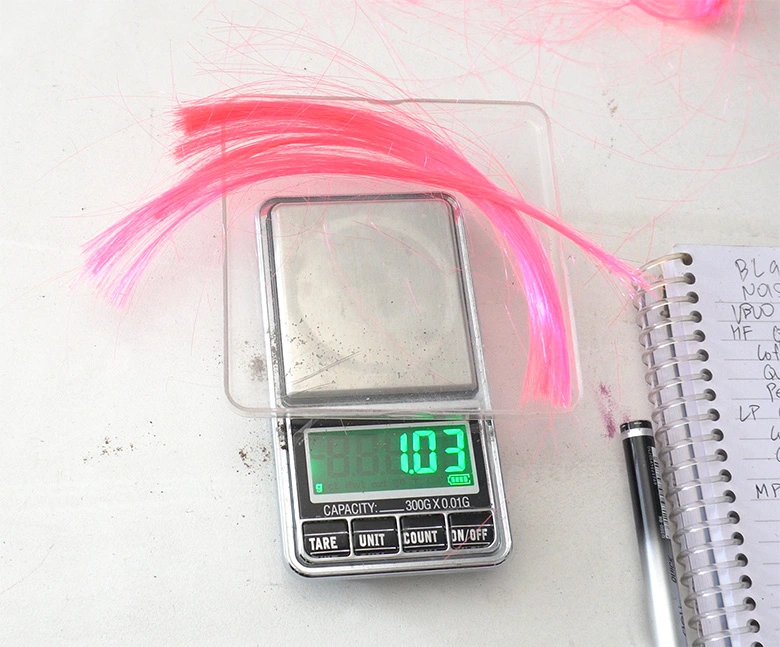
Weighing hair on the precision scale before each test
Equipment
- Precision digital scale (0.01g accuracy)
- Pre-cut human hair strands in five lengths: 5, 7, 9, 11, and 12 inches
- Hard floor test surface (consistent across all tests)
- Mid-pile carpet test surface (consistent across all tests)
- Clean dustbin and freshly cleaned brushroll for each test run
Procedure
- Weigh the hair. I measure at least 1 gram of hair per strand length on the precision scale. Some tests use more depending on the scenario.
- Distribute evenly. The hair is spread across the test surface in a consistent pattern — no clumps, no piles.
- Vacuum the area. The vacuum is run over the test area until all visible hair is collected. I note the number of passes required.
- Weigh the collected hair. I remove hair from the dustbin and weigh it. Then I inspect the brushroll, nozzle, and wand for any trapped strands.
- Calculate the results. Pickup percentage = (collected weight ÷ initial weight) × 100. I record both “floor pickup” (hair removed from the surface) and “bin transfer” (hair that actually reached the dustbin).
- Repeat and average. Each test is run at least twice, and results are averaged for consistency.
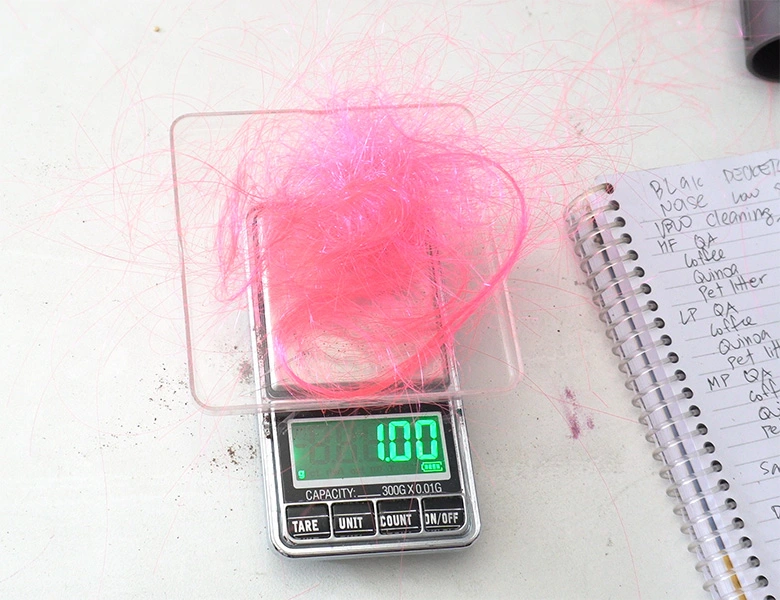
Weighing hair collected from the dustbin after the test
How I Score Results
The final score is the average pickup across all tested hair lengths for each surface. Each vacuum gets separate scores for hard floor and carpet performance.
Not all vacuums are tested at every strand length. If a model already struggles significantly with shorter strands (5 or 7 inches), I note this, and it factors into the overall rating rather than running it through longer-length tests where it will clearly fail.
How This Test Compares to Other Review Sites
I’ve studied the testing methods used by Consumer Reports, Vacuum Wars, and GearLab. Here’s how my approach differs and why:
Consumer Reports uses 2.5 grams of cat hair and gives the vacuum 5 seconds to pick it up. This is fast and standardized, but it only tests one hair type and one length.
Vacuum Wars uses 1 gram of 7-inch hair with two passes. Their method is consistent, but a single strand length doesn’t reveal how a vacuum handles the range of hair lengths found in real homes.
My approach tests five different strand lengths (5 to 12 inches) on both hard floors and carpet. This takes more time per vacuum, but it captures something the other methods miss: many vacuums perform well with short hair but fall apart with longer strands.
Pet owners with long-haired dogs or households with long-haired family members need to know this. The trade-off is that my test takes longer per model, but the results give a more complete picture of real-world performance.
Hair Pickup Results From My Testing
| Model | 5" strands (%) | 7" strands (%) | 9" strands (%) | 5" strands (%) | 7" strands (%) | 9" strands (%) | Anti Tangle | Hair Pickup (Overall) (%) |
|---|---|---|---|---|---|---|---|---|
| Shark WS632 WandVac | 100.00 | 100.00 | 100.00 | 100.00 | 100.00 | 100.00 | Yes (Fins + Combs) | 100.00 |
| DreameTech T30 | 100.00 | 100.00 | 100.00 | 100.00 | 100.00 | 100.00 | Yes (Combs) | 100.00 |
| Dyson Gen5 Detect | 100.00 | 100.00 | 100.00 | 100.00 | 100.00 | 100.00 | Soft Roller: No Brushroll: Yes (Combs) | 98.30 |
| Dyson V15 Detect | 100.00 | 100.00 | 100.00 | 100.00 | 100.00 | 100.00 | Soft Roller: No Brushroll: Yes (Combs) | 97.76 |
| Dyson V15S Detect Submarine | 99.00 | 100.00 | 81.00 | 99.00 | 100.00 | 100.00 | Soft Roller: No Brushroll: Yes (Combs) | 96.50 |
| Dyson Gen5 Outsize | 100.00 | 66.00 | 100.00 | 100.00 | 100.00 | 100.00 | Soft Roller: No Brushroll: Yes (Combs) | 95.80 |
| Shark Vertex IZ462H | 100.00 | 99.05 | 99.50 | 99.00 | 100.00 | 99.80 | Yes (Fins + Combs) | 95.36 |
| Shark Vertex Pro Powered Lift-Away | 100.00 | 100.00 | 100.00 | 100.00 | 100.00 | 90.90 | Yes (Fins + Combs) | 95.09 |
| Shark IZ682H Vertex Pro | 100.00 | 100.00 | 86.00 | 100.00 | 100.00 | 89.00 | Yes (Fins + Combs) | 94.10 |
| Dyson V9 Motorbar | 100.00 | 100.00 | 100.00 | 100.00 | 100.00 | 100.00 | Soft Roller: No Brushroll: Yes (Combs) | 93.77 |
| LG CordZero A9 Ultimate | 98.00 | 81.00 | 86.00 | 99.00 | 100.00 | 100.00 | No | 93.26 |
| Tineco Pure One S12 | 88.00 | 100.00 | 100.00 | 100.00 | 100.00 | 51.00 | No | 92.37 |
| Dyson Micro 1.5KG | 96.00 | 88.00 | No | 92.00 | ||||
| Dyson V12 Detect Slim | 96.00 | 100.00 | 92.50 | 96.00 | 100.00 | 92.50 | No | 89.44 |
| Dyson V7 | 100.00 | 99.00 | 100.00 | 100.00 | 99.00 | 38.00 | No | 89.00 |
| Moosoo K17 | 100.00 | 81.00 | 99.00 | 71.00 | No | 87.75 | ||
| Tineco A10 | 100.00 | 100.00 | 100.00 | 97.00 | 85.00 | 51.00 | 86.87 | |
| Lupe Pure Cordless | 82.00 | 98.00 | 78.00 | No | 86.00 | |||
| Dyson V8 Absolute | 100.00 | 100.00 | 100.00 | 100.00 | 100.00 | 100.00 | No | 85.10 |
| Dyson V10 Absolute | 100.00 | 95.00 | 91.00 | 100.00 | 100.00 | 91.00 | No | 84.87 |
| Simplicity S65 Cordless | 100.00 | 100.00 | 100.00 | 94.00 | 53.00 | No | 84.85 | |
| Tineco A11 | 100.00 | 100.00 | 100.00 | 95.00 | 72.00 | 59.00 | Yes | 80.85 |
| Dyson V11 Torque Drive | 100.00 | 100.00 | 80.00 | 100.00 | 100.00 | 85.00 | No | 80.62 |
| Roidmi X30 | Yes (Combs) | 80.00 | ||||||
| Miele Triflex HX1 | 98.00 | 84.00 | 53.00 | 100.00 | 98.00 | 37.00 | No | 78.34 |
| Dyson V11 Outsize | 100.00 | 99.00 | 100.00 | No | 78.00 | |||
| Roborock H7 | 100.00 | 100.00 | 30.00 | 100.00 | 100.00 | 100.00 | No | 76.87 |
| Jashen V16 | No | 70.00 | ||||||
| Hoover OnePWR Emerge | 99.00 | 76.00 | 44.00 | 98.00 | 58.00 | 21.00 | No | 66.00 |
| Dyson Omni Glide | 26.00 | No | 26.00 | |||||
| Shark ION P50 | 0.00 | No | 0.00 | |||||
| Dreame V10 | No | |||||||
| Roborock H6 | No | |||||||
| Roidmi NEX X20 |
Top Performers
Three vacuums scored highest in raw hair pickup percentage — but the numbers alone don’t tell the full story.
Shark WandVac WS632 — 100% overall pickup
The WandVac picked up every strand I threw at it across all lengths and surfaces, which is rare. The problem is what happens after pickup. Its dustbin is tiny — one of the smallest I’ve tested — so hair fills it quickly and starts restricting airflow within a single cleaning session. If you’re cleaning a small area or using it as a quick-grab handheld for spot cleanup, the pickup performance is genuinely impressive. But for whole-home cleaning or households with heavy shedding, the bin capacity becomes a bottleneck, offsetting the perfect pickup score.
DreameTech T30 — 100% overall pickup
The T30 matched the WandVac for a perfect pickup score, and it doesn’t have the same dustbin limitation — its bin is a reasonable size with good airflow. The catch is availability: DreameTech has discontinued this model, and remaining stock is drying up. I’m keeping it in the results because the data is valid and it sets a useful benchmark for what’s achievable, but I can’t recommend buying a vacuum you’ll struggle to find replacement parts or filters for down the road. If DreameTech releases a successor with the same airflow characteristics, it could be a strong contender.
Dyson V9 Motorbar — 99% overall pickup
The V9 Motorbar came within 1% of a perfect score, and Dyson’s de-tangling Motorbar head kept hair wrap to a minimum across all strand lengths. At just 4.6 pounds, it’s also the lightest Dyson cordless I’ve tested — so the handling is excellent. The trade-off depends on which configuration you buy. The version I purchased from Amazon came with only the Motorbar head, which is designed for carpet and mixed surfaces. It works on hard floors, but without a soft roller (Dyson’s Fluffy head), it won’t match the gentle efficiency of vacuums designed specifically for bare floors when it comes to fine dust and larger debris. Dyson does sell a bundle that includes both heads, so check which version you’re getting before you buy.
See my Dyson V9 Motorbar review for the full test results.
So what do I actually recommend?
A perfect hair pickup score matters — but a vacuum also needs to work well across your entire home, not just in a controlled hair test. That’s why my top picks factor in dustbin capacity, surface versatility, runtime, and long-term availability alongside the raw pickup numbers.
The Dyson Gen5 Detect didn’t score a perfect 100% in hair pickup, but it came close — and it excels everywhere else. It scored among the highest in my airflow testing, handles both hard floors and carpet efficiently thanks to the included Fluffy and Motorbar heads, and has one of the longest runtimes of any Dyson I’ve tested. The anti-tangle cone works well, and the wider bin design means hair transfers cleanly without clogging. For most households — especially those with a mix of hard floors and carpet — this is the vacuum I’d reach for. See my full Dyson Gen5 Detect review for the complete breakdown.
The Shark Vertex Pro IZ682H is the pick if you need a vacuum that can handle large volumes of hair and debris without stopping to empty the bin every few minutes. Its dustbin is one of the largest I’ve tested, and the DuoClean nozzle with Zero-M anti-tangle handles long hair strands well — Shark’s system resisted tangling with strands up to 14 inches in my testing, the best performance I’ve seen for very long hair from any anti-tangle design.
The nozzle is also more forgiving with large debris, where some Dysons with tight nozzle clearances can struggle. If you have multiple pets or heavy shedding, this is the one I’d look at first. See my best cordless vacuums for pet hair for the full ranking.
The takeaway: Raw hair pickup percentage is important, but it’s only one piece. A vacuum that scores 95% but transfers hair cleanly to a large bin, works on all your floor types, and resists tangling at every strand length will serve you better day-to-day than one that scores 100% but fills up in two minutes or can’t handle your hard floors.
Worst Performers — Vacuums to Avoid for Hair
If you’re dealing with pet hair or long hair in your home, these models will create more frustration than they solve. The common thread is low airflow combined with no anti-tangle system — a combination that guarantees heavy wrapping and poor bin transfer.
Dyson Omni-Glide — 26% pickup on 5-inch hair
The Omni-Glide is one of the worst vacuums I’ve tested for hair, and it’s not close. Its dual soft roller design is excellent for fine dust on hard floors — that’s what it was built for — but it’s a disaster with hair. In my test using just over 1 gram of 5-inch strands, it picked up only 26%, with nearly all the collected hair wrapping around the roller axles rather than reaching the dustbin. The twin rollers lack an anti-tangle system, and the low airflow means there’s nothing pushing hair through.
To be fair, Dyson designed the Omni-Glide specifically for hard floor dust, not hair. It’s not trying to be a pet hair vacuum. But consumers don’t always read the fine print, and the Dyson name creates an expectation of all-around performance. If your home has any amount of hair — human or pet — this vacuum will wrap up and clog after a few passes. The rollers are removable for cleaning, but you’ll need to do that constantly. For a lightweight Dyson that actually handles hair, the Dyson V12 Detect Slim is a far better option — it picked up in the high 90s across most strand lengths in the same test.
Shark ION P50 — 26% overall pickup
The P50 is an otherwise capable vacuum — it has a massive 1.29-liter dustbin, DuoClean nozzle, and decent performance on surface debris. But hair is its weak point. The DuoClean head on the P50 predates Shark’s Zero-M anti-tangle technology, so both the bristle brush and soft roller wrap hair aggressively. In my testing with 7-inch strands, hair tangled heavily around both brushrolls, and I didn’t continue to longer lengths because the results at 7 inches were already poor.
This is a good example of why checking the generation of anti-tangle technology matters when buying a Shark vacuum. Newer Shark models like the Vertex Pro IZ682H include Zero-M, which actively cuts through tangled hair as you vacuum. The P50 doesn’t have this — it uses the earlier DuoClean design, which lacks tangle resistance. If you already own a P50, expect to manually cut hair off the brush rolls regularly. If you’re shopping and hair is a priority, look at Shark’s newer models with Zero-M instead.
Hoover OnePWR Emerge — 66% overall pickup
The Hoover OnePWR Emerge struggled with hair for the same fundamental reasons as the other two: insufficient airflow to carry hair through the system and a traditional brush roll without an anti-tangle mechanism. Hair wrapped tightly around the brush, starting with the shortest strands, and performance dropped further on carpet, where the already limited airflow was further restricted.
The OnePWR Emerge is positioned as a budget-friendly cordless option, and at its price point, the lack of anti-tangle technology isn’t surprising — that feature typically appears in mid-range and premium models. But budget or not, if you have pets or long-haired family members, this vacuum will create a maintenance headache. You’ll spend more time cutting hair from the brush than actually vacuuming. For a budget option that handles hair better, see my best cordless vacuums for pet hair — there are affordable models that score significantly higher in this test.
The pattern across all three
These three vacuums represent different brands and price points, but they all failed the hair test for the same two reasons:
First, low airflow. Without enough air moving through the system, hair doesn’t travel from the nozzle to the dustbin. It lifts off the floor, then immediately wraps around the nearest contact point — usually the brushroll or axle. This is why airflow matters more than raw suction for hair performance.
Second, no anti-tangle system. Traditional bristle brushes and basic soft rollers have nothing to prevent hair from coiling around them. Anti-tangle designs — whether Dyson’s anti-tangle combs, Shark’s Zero-M, or Samsung’s rubber-fin approach — aren’t marketing gimmicks. In my testing, they achieve a measurable 50% or more reduction in hair wrap compared to these older designs.
If your current vacuum matches either of these traits — low CFM and a standard brushroll — hair performance will be a persistent problem, regardless of brand.
Hard Floor vs Carpet Breakdown
Carpet consistently exposes weaknesses that don’t show up on hard floors. Across all models I’ve tested, the average hair pickup score drops by approximately __% when moving from hard floor to carpet.
The reasons are predictable: carpet fibers grip hair strands, especially shorter ones, making them harder to lift. Lower effective airflow at the nozzle (carpet restricts airflow more than hard floors) means less suction force pulling hair into the bin. And brushroll agitation that works well on smooth surfaces can push hair deeper into carpet pile instead of lifting it.
Why Some Vacuums Handle Hair Better Than Others
After running this test across 30+ models, clear patterns emerge. The difference between a vacuum that handles hair well and one that doesn’t comes down to three design factors.
Airflow vs Suction: What Actually Moves Hair
This is the most misunderstood factor. Strong suction (measured in water lift) helps pull hair off surfaces — but it’s airflow (measured in CFM) that carries hair through the system and into the dustbin.
Low-airflow models often pick up hair from the floor but can’t move it through the wand and into the bin. The hair gets stuck partway through, clogging the system and reducing performance with each pass. In my testing, models with higher CFM consistently transferred more hair to the bin, even when their suction numbers were lower.
I cover the airflow vs suction distinction in depth in my airflow vs suction guide.
Anti-Tangle Brushroll Designs Compared
Not all anti-tangle systems are equal. Here’s how the major designs performed in my tests:

Dyson’s anti-tangle combs (found on the V15, V12, Gen5) are located behind the brushroll and untangle hair from the bar. In my tests, this reduced hair wrap by approximately 23%. It worked best with strands up to 9 inches and still performed well with 12-inch strands.
Shark’s Zero-M uses a comb-like mechanism integrated into the brush roll to actively untangle hair. In my tests, it resisted tangles with strands up to 12 inches — the best of any system I’ve tested for very long hair.
Traditional bristle brushes (found on older Dysons like the V7 and budget models like [specific model]) wrapped hair aggressively, starting at 5-inch lengths. By 9 inches, some models had the brushroll fully wrapped after a single test run.
Why Bin Design Matters for Hair Transfer
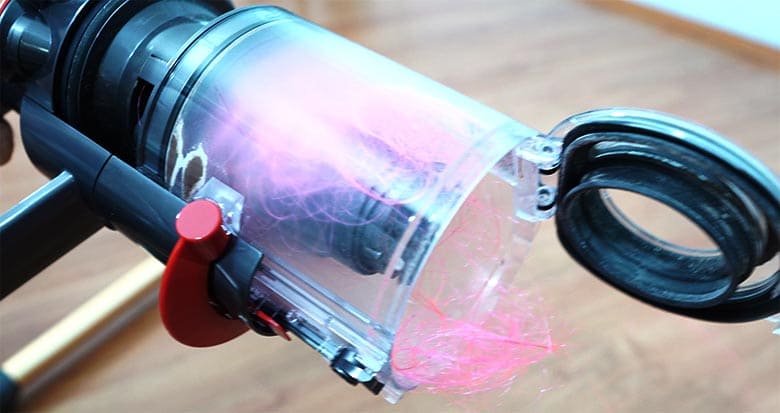
This is often overlooked. Even if a vacuum picks up hair cleanly, a narrow dustbin with tight airways can trap hair before it reaches the bin. Hair is sticky — it clings to plastic surfaces, catches on edges, and accumulates at narrow points.
Bin design doesn’t affect whether hair reaches the dustbin as much as I initially expected. Even models with smaller, narrower bins still managed to pull hair in — provided they had an active anti-tangle system pushing strands through.
The real problem with narrow bins shows up after vacuuming, when you try to empty them. Hair clings to the interior walls, and the tight pathway makes it difficult to get out. You end up shaking the bin, reaching in with your fingers, or pulling clumps free by hand.
Wider bins are easier to live with. A quick tap on the shell is usually enough to dislodge trapped hair, and if something stubbornly sticks, there’s enough room to reach in and pull it out. You also don’t need to empty as often — smaller bins fill up fast with hair because strands take up more volume per gram than dust or fine debris.
In a household with pets or long-haired family members, a narrow-bin vacuum may need emptying two or three times during a single cleaning session, slowing you down and interrupting the workflow.
Common Failure Points I’ve Seen in Testing
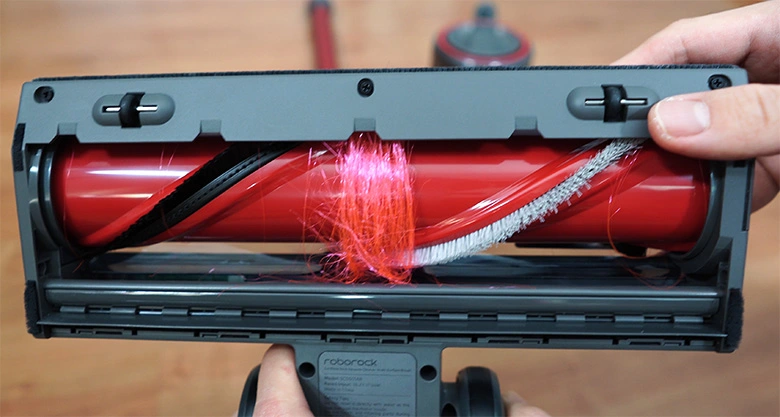
Based on testing 30+ models, these are the most frequent issues:
Hair wrapping around the brush roll is the most common problem, especially with strands over 7 inches long on models without anti-tangle features. Once hair wraps tightly, it reduces brush contact with the floor and requires manual removal.
Hair getting stuck in the nozzle or wand happens when airflow is insufficient to carry strands the full distance to the bin. I’ve seen this most often in models with long, narrow wand designs and low CFM ratings.
Partial pickup occurs when hair is lifted from the surface but not fully transferred to the bin. It’s easy to think the floor is clean — the hair is gone — but it’s actually trapped inside the vacuum, reducing airflow and performance.
Performance drops as the bin fills. Hair takes up more volume per gram than dust or debris. Even a half-full bin can start to restrict airflow if hair is compacted against the filter or blocks the inlet. This is especially noticeable on models with smaller dustbins.
How Hair Wrap Affects Long-Term Performance
Hair wrap isn’t just an inconvenience — it actively degrades your vacuum’s performance over time.
When hair accumulates on the brushroll, it restricts rotation, which reduces agitation on carpet. It can also build up around the axle bearings, creating friction that strains the motor and drains the battery faster. In extreme cases, I’ve seen hair wrap so tightly it stalls the brushroll entirely.
Hair trapped in the airflow path reduces the vacuum’s effective CFM, which means less cleaning power even though the motor is working just as hard. And if hair reaches the filter, it can compromise the filtration seal — something I check for in my fog test.
Regular brushroll cleaning is the simplest way to maintain performance. For households with pets or long-haired occupants, I recommend cleaning the brushroll after every 2-3 uses.
How to Test Your Own Vacuum’s Hair Pickup
You don’t need a precision scale to get a rough sense of how your vacuum handles hair. Here are two simple checks:
The visual test: Scatter a small amount of hair (from a hairbrush works fine) across your floor. Vacuum it up, then open the dustbin. Check how much hair actually made it into the bin versus how much is wrapped around the brushroll or stuck in the nozzle. If more than a third of the hair didn’t reach the bin, your vacuum has a transfer problem.
The carpet embedding test: Press some hair into your carpet with your hand, then vacuum over it. Check the carpet afterward—if strands are still visible, your vacuum may lack the airflow or agitation needed to pick up embedded hair.
If your vacuum is struggling, it may not mean you need a new one. Sometimes a clogged filter, a full bin, or a hair-wrapped brush roll is the culprit. Check out our maintenance tips before deciding to upgrade.
How Hair Pickup Fits Into My Overall Testing
Hair pickup is one of six core tests I run on every cordless vacuum. The others cover suction and airflow, surface debris pickup on hard floors and carpet, deep cleaning (embedded sand), filtration, and runtime.
You can see the full breakdown of every test in my testing methodology hub or the detailed review process page.
Hair pickup results are factored into every individual vacuum review on this site, and they’re a key factor in my best cordless vacuums for pet hair and best for carpet rankings.
Have a specific vacuum you’d like me to test? Reach out — I read and respond to every request.
Frequently Asked Questions
Which cordless vacuum is best for picking up long hair?
In my testing, vacuums with anti-tangle brushroll designs and high airflow consistently score highest with long hair. The Dyson Gen5 Detect averaged 98.5% pickup across all strand lengths on both surfaces. For a full ranked list, see my best cordless vacuums for pet hair.
Does an anti-tangle brushroll really work?
Yes, but the results vary significantly between brands. Dyson’s anti-tangle brush reduced hair wrap by approximately 23% in my tests compared to traditional bristle brushes. Shark’s Zero-M performed best with very long strands (up to 12 inches). Not all anti-tangle claims hold up — some budget models advertise the feature but still wrap heavily in testing.
Why does my vacuum wrap hair around the brush?
Hair wrap happens when the brushroll design allows strands to coil around the bar or axle instead of being directed into the dustbin. The main factors are bristle spacing (wider = less wrap), airflow through the nozzle (stronger = hair moves to the bin instead of wrapping), and whether the vacuum has an active anti-tangle mechanism. Older vacuum designs with dense bristle brushes are the worst offenders.
Can hair wrap damage my vacuum?
Yes. Accumulated hair restricts brushroll rotation, reduces airflow, and puts extra strain on the motor. Over time, this leads to reduced cleaning performance, shorter battery life, and in severe cases, motor burnout. Regular cleaning is essential — especially for pet owners.
How often should I remove hair from my vacuum’s brushroll?
For homes with pets or long-haired occupants, check and clean the brushroll after every 2-3 uses. For lighter shedding, a monthly cleaning is usually sufficient. Vacuums with anti-tangle features like the Dyson V15 or Shark Vertex need less frequent maintenance, but still benefit from periodic checks.