

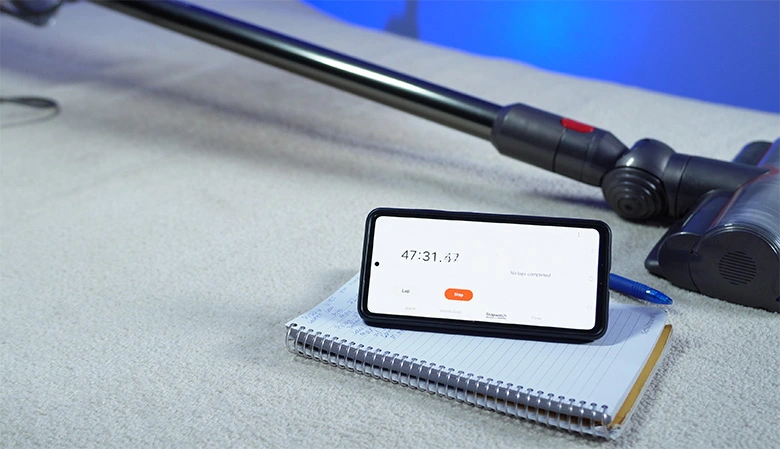
Battery life is one of the most important — and most misunderstood — factors when choosing a cordless vacuum. Manufacturers advertise maximum runtime under ideal conditions that rarely reflect how these vacuums are actually used.
I’ve been testing cordless vacuums since 2017. After running more than 30 models through this same protocol, I’ve found one consistent pattern: real-world runtime on carpet at mid-power is typically 35–50% lower than the number on the box. That’s the gap this test is designed to measure.
Every model reviewed on this site goes through the same standardized runtime test so you can make direct, apples-to-apples comparisons.
Key Findings From Our Runtime Tests
After testing 30+ cordless vacuums with this protocol, here’s what the data consistently shows:
- Boost/Max mode averages only 15–20% of Eco mode runtime — a vacuum rated for 60 minutes on Eco typically lasts 9–12 minutes on Max.
- Carpet reduces runtime by 20–35% compared to hard floors on the same power setting, due to increased motor resistance.
- Motorized heads consume 30–40% more power than non-powered attachments — the main reason advertised specs mislead buyers.
- Mid-power (Auto/Medium) is the most useful number — it’s what you’ll actually use for daily cleaning, and it’s rarely advertised.
- Removable batteries significantly extend usable runtime — a spare battery doubles your cleaning window.
What This Test Measures
Runtime testing evaluates three core questions:
- How long does the vacuum actually run on a full charge — not under lab conditions, but on real floors?
- How does runtime change across power settings (Eco, Medium, Boost)?
- How does surface type (carpet vs. hard floor) affect battery drain?
The goal: give you a realistic expectation of how long a vacuum will last in your home — not just on paper.
Testing Protocol (Step-by-Step)
Each vacuum is tested using a standardized process to ensure results are consistent and directly comparable across models.
- Battery fully charged to 100% — confirmed by the indicator light or display before every run.
- Main motorized cleaning head attached — never a non-powered tool, which would artificially inflate results.
- Vacuum run continuously until automatic shutoff — no pausing, no manual stops.
- Separate run for each power setting — Eco, Medium/Auto, and Boost/Max each get a fresh full charge.
- Tested on both carpet and hard floors — medium-pile carpet and bare hard floor are each used as test surfaces.
- Time recorded in minutes — logged alongside manufacturer’s advertised claim for direct comparison.
Real-World Runtime Results: Tested Models
These are actual results from vacuums I’ve purchased and tested using the protocol above. All tests used the motorized floorhead on medium-pile carpet unless noted.
| Vacuum Model | Eco / Low | Medium / Auto | Boost / Max | Advertised Max | Removable Battery |
|---|---|---|---|---|---|
| Dyson V15 Detect | ~56 min | ~17 min | ~11 min | 60 min | Yes |
| Dyson V12 Detect Slim | ~42 min | ~27 min | ~6 min | 60 min | Yes |
| Shark Vertex Pro | ~47 min | ~28 min | ~11 min | 50 min | Yes |
| Dyson V11 Torque Drive | ~57 min | ~18 min | ~9 min | 60 min | Yes |
| Dyson V8 | ~31 min | N/A | ~8 min | 40 min | No |
Note: Results are from carpet testing with motorized floorhead. Hard floor runtime is typically 15–25% longer. All vacuums purchased independently — no manufacturer samples.
👉 See the full runtime breakdown in each individual review linked above.
Why Manufacturer Runtime Claims Are Misleading
Most brands advertise runtime based on:
- The lowest power setting (Eco/Min mode)
- A non-motorized attachment like a crevice tool
- Hard floors only — minimal resistance scenarios
In a real home, you’ll use a motorized floorhead on carpet, likely at Auto or Medium power. That combination can cut the advertised number by half or more.
This is why the test focuses on usable runtime — the number that actually matches how you clean.
What Affects Runtime (And By How Much)
Power Setting
The biggest single factor. Boost/Max mode can drain a battery 4–6x faster than Eco mode. For daily vacuuming, Auto or Medium is sufficient — reserve Boost for stubborn debris or deep carpet cleaning.
Surface Type
Carpet requires the brushroll motor to work harder against resistance. Expect 20–35% less runtime on carpet vs. hard floors on the same setting.
Motorized Attachments
Powered floorheads (brushrolls) draw significantly more current than suction-only tools. Always check if the advertised runtime is based on a powered head or a basic tool.
Battery Design
Three battery designs affect real-world usability:
- Removable batteries — keep a spare charged and double your cleaning window
- Dual battery systems — some models (e.g., Shark DuoClean) carry two batteries that automatically switch
- Smart power management — Auto modes (e.g., Dyson Auto) adjust suction dynamically to extend runtime while maintaining cleaning performance
Battery Age
Lithium-ion batteries lose capacity over time. A vacuum rated for 60 minutes when new may deliver 45–50 minutes after 2–3 years of regular use. Removable battery designs let you replace the battery rather than the whole vacuum.
How to Interpret Runtime Results
When comparing vacuums, focus on these three numbers:
- Mid-power (Auto/Medium) runtime — the most realistic number for everyday use. This is the one that matters most.
- Consistency across carpet vs. hard floor — a vacuum that handles both surfaces well without a dramatic runtime drop is more versatile.
- Battery flexibility — is the battery removable? Is a replacement available and reasonably priced?
A vacuum with slightly lower max runtime but better mid-power consistency is often the better choice for whole-home cleaning.
Using Runtime Data in Your Buying Decision
Here’s a practical rule of thumb based on our test data:
- Small apartment (under 600 sq ft): 20+ minutes on medium is sufficient
- Average home (600–1,500 sq ft): 25–35 minutes on medium, or a removable battery
- Large home (1,500+ sq ft): 35+ minutes on medium, or dual battery / replaceable battery design is essential
Watch the Runtime Test in Action
The video below shows exactly how I run this test — vacuum plugged in to charge fully, motorized head attached, running continuously on carpet until shutoff, with the timer visible throughout.
Related Testing Methods
Runtime is one part of how we evaluate cordless vacuums. To understand the full picture:
- How We Test Cordless Vacuums — the complete CVG Testing Lab overview
- Airflow vs. Suction Guide — why both numbers matter and how we measure them
- Carpet Cleaning Test Method — how we measure deep-clean performance on medium-pile carpet
Vacuums Tested With This Method
Every review below includes a runtime section based on this exact protocol:
- Dyson V15 Detect
- Dyson V12 Detect Slim
- Dyson V11 Torque Drive
- Dyson V8
- Shark Vertex Pro IZ682H
- View All Reviews →
Ready to Find the Right Vacuum?
Use our runtime data alongside performance scores to find the best fit for your home:
- Best Cordless Vacuums — our top picks across all categories
- Best for Carpet — highest performers on medium and deep pile
- Best for Hardwood Floors — top picks for bare floors and fine dust
- Best for Pet Hair — anti-tangle brushrolls and strong suction for fur