

Latest Updates
This comparison is regularly updated with new testing data and performance insights.
: Added a “Quick Verdict” section to help you decide which model is the better fit. Added a “Quick Comparison” section to highlight the key differences based on real-world testing. Also updated the table layout for airflow, runtime, cleaning performance, and noise to make comparisons easier.
Quick Comparison: Dyson V11 vs V12
This comparison is based on side-by-side testing of the Dyson V11 and Dyson V12—not specs or marketing claims. Each model was evaluated using the same real-world tests, including suction, airflow, runtime, and cleaning performance, so you can quickly see how they actually differ in everyday use. Before choosing between them, it’s important to understand what drives performance—especially how power, airflow, and design differences impact real-world cleaning. If you’re considering upgrading, see our cordless vacuum buying guide to choose the right model.
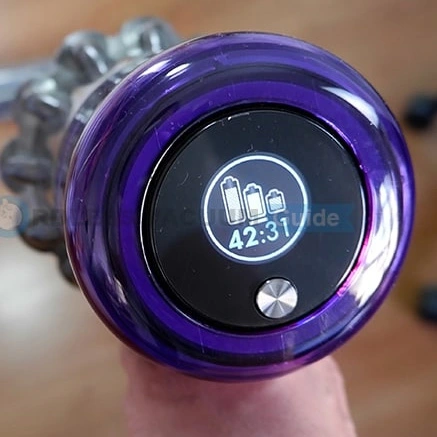
Dyson V11
Best For: bigger homes and deeper, longer cleaning sessions
- Larger dustbin = fewer trips to empty
- Longer real-world runtime (especially in Eco/Auto)
- Better for whole-home cleaning sessions
- Superior deep cleaning performance
- Heavier and bulkier in hand
- Older design and less refined ergonomics
- Hair handling not as optimized as newer heads
- Airflow [Max at Nozzle]: 53.58 CFM
- Cleaning [Overall]: 99.66%
- Deep Cleaning: 100%
- Run Time: 74:58 mins
- Noise: 78.9 dB
- Weight: 6.68 lbs (w/ tube & nozzle)
- Dustbin capacity: 0.77 liters
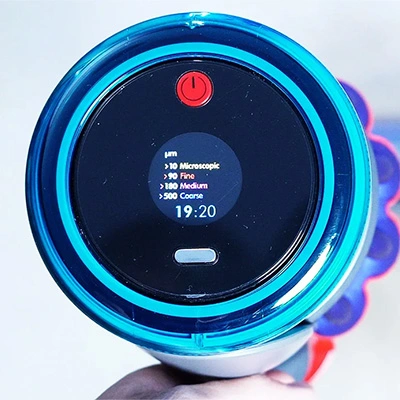
Dyson V12
Best For: lightweight cleaning with smart dust detection
- Ultra-lightweight—easier for daily use and quick cleans
- Laser head reveals fine dust you’d normally miss
- Excellent maneuverability and low-profile cleaning
- Detachable battery-easier to extend run time
- Smaller dustbin fills up fast
- Slightly less raw suction vs V11
- Shorter runtime on higher modes
- Not ideal for large homes or heavy-duty cleaning
- Airflow [Max at Nozzle]: 48.38 CFM
- Cleaning [Overall]: 98.31%
- Deep Cleaning: 94.1%
- Run Time: 63:00 mins
- Noise: 78.9 dB
- Weight: 5.2 lbs (w/ tube & nozzle)
- Dustbin capacity: 0.35 liters
⚡ Quick Verdict
👉 Choose the Dyson V11 if: you want stronger raw suction and better deep-cleaning performance—especially on carpets and larger debris where power makes a noticeable difference.
👉 Choose the Dyson V12 if: you want a lighter, more advanced vacuum with laser dust detection, better ergonomics, and easier everyday cleaning—especially for hard floors.
Bottom line: The V11 is the better performer for power and deep cleaning, while the V12 Detect is the smarter, more refined choice for everyday use and convenience.
Watch Video Comparison
Introduction to the Dyson V12 Detect and V11 Torque Drive
Before the V15 Detect and Outsize, the V11 Torque Drive was Dyson’s flagship. It had the highest air flow and was one of the best cordless stick vacuums for cleaning carpets.
The V12 Detect is a brand new category for Dyson, between the Micro 1.5KG and V15 Detect – larger and more potent than the lightweight Micro but lighter than the full-sized V11.
Lighter and Better Ergonomics: Dyson V12 Detect

Dyson’s product line expanded with the addition of the V12 Detect series.
Nope, this model isn’t a V15 refresh; it’s a different category – lighter than the V11 series but without the limitations of the Dyson Micro 1.5KG.
It uses different connecting ports, such as the V10, V11, Outsize, and V15, so the attachments aren’t interchangeable.

The resulting product is (something) lighter with a push-button switch, something Dyson customers have been clamoring for years! It’s finally here!
These improvements make the V12 ergonomically better than the V15 and V11 Torque Drive, but with some compromises.
The biggest one is its dustbin size, which is (slightly) more than half that of the V11 (0.35 vs. 0.77-litters).
Another is the smaller battery (3600 vs. 2500 mAh), so run time is (somewhat) compromised, but not by a lot (74 vs. 63-minutes).
It’s got similar features as the V15 Detect, but at a more reasonable cost without the limitations of the Dyson Micro or Omni-Glide.
In the Dyson V12 and V15 Detect comparison, I mentioned that the V12’s surface debris performance is as good as the V15 but lags with deep cleaning carpets.
However, the cost savings, ergonomic benefits, and attachments give it better value for money than the V15.
The only reason to opt for the V15 is if you need something capable of cleaning carpets or long hair on carpets.
Better for Deep Cleaning Carpets: Dyson V11 Torque Drive
 The Dyson V11 Torque Drive was once a flagship Dyson option. It was the first equipped with a dynamic LCD screen found in most high-end options, except the Omni-Glide and Micro.

It shows the run time status and power setting with the round button underneath to toggle between the three suction levels.
Also, it has a similar designed standard brush roll as the V15 Detect minus the brush tweak and combs.

The photo above is a side-by-side of the V8 and V11 brush rolls. I used the photo because the V12 uses a similar design to the V8.

As you can see in the photo above, there isn’t much difference between the two.
The V12 standard brush has five slots for large debris to flow through compared to the V8’s two (and two smaller ones at the edges).
These slots should prevent the V12 from snowplowing large debris piles, but it won’t be as good as the V11 since it has two adjustable gates.
Going back to the V11, this is the standard brush’s most significant advantage if you get the variant with only the standard brush.
It has better agitation and will pick up large dirt piles because of the two gates.
Similarities between the Dyson V11 Torque Drive and V12 Detect
Next, we’ll look at the similarities between these stick vacuums, starting with the framework.
1. Framework

These vacuums utilize the same framework Dyson popularized – a top-mounted dustbin, motor, and battery configuration.
This design makes both products top-heavy, but the V12 Detect, with its more compact frame, is the lighter and more ergonomic option.
2. Dustbin Alignment

The Dyson V11 Torque Drive and V12 Detect utilize horizontally aligned dustbins, with the V11 doubling the V12’s capacity (0.77 vs. 0.35-liters).
It has the same sized dustbin as the V15 and V10, so it’s better suited inside larger homes.
Dyson had to reduce the V12’s capacity because it’s the easiest method of reducing weight and bulk.
3. Filter Design and Placement
Another similarity is the filter placement at the back of the motor. All full-sized Dyson stick vacuums, starting with the V10, use a similar design but with varying sizes.
 The V12’s filter is similar but much smaller due to the smaller body.
4. Sealed System

Most Dyson stick vacuums (except for V7 variants without a post-motor filter) utilized a full-sealed system.
I tested the V12 and V11 – both passed the fog test, where I use a fog machine to see if it’ll leak.
There’s nothing scientific about this test, only a visual check to see if the vacuum can hold fog inside without leaking.
4. Versatile Functionality
These cordless vacuums are usable as a handheld or stick vacuum, thanks to their interchangeable tools.
It’s been a Dyson hallmark since the first model was introduced several decades ago.
Being a newer variant, the V12 has more attachments than the latest ones, like the light pipe crevice tool and torque screw tool.

The torque screw tool (photo above) is excellent at picking up large quantities of long hair strands without anything wrapping up the brush.

And the light pipe crevice tool is another Dyson innovation with an LED strip, illuminating its path, helping consumers clean dark areas without an external light source.

Differences between the Dyson V11 Torque Drive and V12 Detect Slim
Next, we’ll look at how these cordless stick vacuums are different.
1. Size
One variance between the V11 Torque Drive and V12 Detect is the size difference. Look at this side-by-side photo to see what I mean.

The V11 Torque Drive is visibly larger than the V12, so it feels much heavier in its handheld configuration.
2. Power Switch

You’ll notice that the V12 Detect has a red push-button switch on top, which Dyson is slowly implementing into its product line, starting with the Omni-Glide and then Micro 1.5KG.

This enhancement has bled over to the V12 Detect, a welcome change from the trigger Dyson has used for many years.

Ditching the trigger adds to its ergonomic benefits since there’s no need to squeeze the trigger.
It lessens your wrist and arm strain using this for long stretches.
You’ll see the biggest benefit in its handheld configuration, cleaning tight quarters.
3. Battery
The next difference is the battery, specifically the V12’s detachability. Most of Dyson’s new releases offer a detachable battery, something absent before the V11 Outsize came out.
Though some new V11 variants have a detachable battery, consider those if you want to purchase this option.
The V12 sub-model I got comes with two batteries AND two chargers!

So charging them all together is possible, and the plug is located where consumers can charge them detached.
4. Interface
While the V11 Torque Drive and V12 Detect have LCD screens, what they display is different.

Since the V15 was launched, all V15, V12, and specific Outsize variants have the Piezo sensor showing the debris-size picked up through the screen.
The V11 utilizes a more basic screen showing the range left and the power setting.
Both have a button underneath for toggling between three suction settings (low, auto, and boost).
5. Tools Out Of The Box
The Dyson V12 Detect comes with more tools out of the box, with over ten. It’s one of the best value offers by Dyson because of it.

- Dyson V12 unit
- Motorbar cleaner head
- Laser slim fluffy
- Hair screw tool
- Light pipe crevice tool
- Mini soft dusting brush
- Stiff bristled brush
- Combination tool
- Under bed attachment
- Extra battery
- Extension wand
- Two battery chargers
The V11 Torque Drive doesn’t have as much (at least when I bought it several years ago).

- V11 vacuum unit
- Mini-turbo brush
- Mini soft dusting brush
- Crevice tool
- Combination tool
- Stiff bristled tool
- Tool clip
- Charging dock
- Extension tube
One advantage of the V12 Detect is that it has the latest attachments from Dyson – like the light pipe crevice and torque screw tool.
Ergonomic Comparison
Even with the Dyson V11 and V12 utilizing the same design, the V12’s lighter frame makes it a better ergonomic option.
You’ve seen it with the photos above; the size and the weight variance (the V11 is heavier by more than a pound).

The V11’s dustbin, motor, and battery are heavier, making it more cumbersome, significantly above floors. So the advantage goes to the V12 in this aspect.

Interface Comparison
Another plus for the V12 Detect since it has the Piezo sensor that detects quantities of various debris sizes (four to be exact), while the V11 Torque Drive uses the more basic interface.

It was the first cordless stick vacuum Dyson introduced with this feature.
Run Time Comparison
Due to the smaller battery (2500 vs. 3600 mAh), the Dyson V12 has a shorter run time than the V11 Torque Drive (63 vs. 74-minutes), but the variance isn’t as much as the V15 Detect (over 80-minutes).
| Power Setting | Dyson V11 | Dyson V12 |
|---|---|---|
| Nozzle on Hard Floor or Non-Powered Tool Only | ||
| Low (hh:mm:ss) | 1:14:58 | 1:03:00 |
| Mid/Auto (hh:mm:ss) | 46:11 | 37:50 |
| High (hh:mm:ss) | 7:14 | |
| Nozzle Only or Nozzle on Carpet | ||
| Low (hh:mm:ss) | 57:16 | 42:00 |
| Mid/Auto (hh:mm:ss) | 18:33 | 27:31 |
| High (hh:mm:ss) | 9:46 | 6:25 |
The V11’s larger battery enables it to run further – over 74 minutes on hard floors and 57 minutes on carpets – more than 10 minutes more than the V12 Detect.
It can be a deciding factor for consumers looking for a better range and a cordless vacuum for cleaning a large carpeted space.
Airflow Comparison
Another side effect of the smaller motor for the V12 Detect is the lower airflow. It’s closer to the Dyson V8 than the V11 Torque Drive or V15 Detect.
| Power Setting | Dyson V11 | Dyson V12 |
|---|---|---|
| Airflow at the Nozzle | ||
| Low (CFM) | 28.52 | 24.00 |
| Mid/Auto (CFM) | 31.94 | 28.52 |
| High (CFM) | 53.58 | 48.38 |
| Airfow at the Wand | ||
| Low (CFM) | 34.55 | 27.43 |
| Mid/Auto (CFM) | 41.91 | 32.23 |
| High (CFM) | 66.13 | 58.74 |
There’s around a 12% variance in airflow at the max setting, helping the V11 pick up more sand in the deep cleaning tests.
However, the airflow variance doesn’t affect the surface debris cleaning performance as much because the V12 has excellent agitation for this task.
Another advantage of the V12 is the torque screw tool, which is excellent at cleaning large quantities of hair on fabric upholstery.
Cleaning Comparison
| Surface Tested | Dyson V11 | Dyson V12 |
|---|---|---|
| Overall (%) | 99.66 | 98.31 |
| Hard Floor (%) | 99.72 | 99.80 |
| Sand on Hard Floor (%) | 99.40 | 99.90 |
| Carpet (%) | 99.26 | 99.45 |
| Deep Cleaning (%) | 100.00 | 94.10 |
| Hair Pickup (Overall) (%) | 80.62 | 89.44 |
Despite the airflow variance, the V12 Detect was better in most of the cleaning experiments, except deep cleaning, where the V11’s higher airflow is reflected.
These results indicate that the V12 Detect has excellent agitation, especially on hard floors, thanks to the laser slim roller nozzle.
So cleaning performance shouldn’t be a deciding factor for consumers choosing between these models.
Which option is better on hard floors?
Since it has the laser slim roller, the winner in this category is the V12 Detect.
It picks up dirt more efficiently and has a green laser, amplifying almost invisible dust as it pops when the green light illuminates.

Not even the brightest LED-equipped stick vacuum can compare with this feature.
Also, the V12 picked up more sand on hard floors (99.9% vs. 99.4%) – one barometer I use for determining the best hard floor stick vacuums.
Edge Cleaning Comparison
There isn’t much variance with edge cleaning between the V11 and V12. Both were efficient at picking up debris in this space.
Here’s a before and after photo for the V11 Torque Drive.

And the V12 Detect.

Hair Wrap Comparison (on Hard Floors)
Surprisingly, even with the lower airflow, the V12 Detect was better than the V11 Torque Drive at resisting hair tangles on this surface, picking up in the 90s in all the experiments.

- 5-inch strands: 96%
- 7-inch strands: 100%
- 9-inch strands: 92.5%
- 11-inch strands: 98%
- 13-inch strands: 100%
It was (actually) perfect in two of the tests (seven and thirteen-inch strands).
Despite the airflow advantage, the V11 Torque Drive wasn’t as good on this surface.
- 5-inch strands: 100%
- 7-inch strands: 100%
- 9-inch strands: 80%
- 13-inch strands: 19%
Which option is better on carpets?
The answer here is two-fold. While the V11 Torque Drive picked up more sand in the deep cleaning test (100% vs. 94.1%), the V12 Detect was better at cleaning surface debris, picking up a higher percentage (99.45% vs. 99.26%).
It could be the seal behind the brush roll or the additional slots on the brush roll, but these are the results from the tests.
The V11 Torque Drive is better at embedded debris, while the V12 is (slightly) better with surface dirt.
Hair Wrap Comparison (on Carpets)
Again, the advantage goes to the Dyson V12 Detect, which got 100% in the five, seven, and nine-inch experiments.

- 5-inch strands: 96%
- 7-inch strands: 100%
- 9-inch strands: 92.5%
- 11-inch strands: 30%
However, it struggled with eleven-inch stands, only getting 30%.
The Dyson V11 Torque Drive struggled at the nine-inch mark, picking up 80%, and only got 61% with eleven-inch hair, which is better than the V12’s score (30%).
- 5-inch strands: 100%
- 7-inch strands: 100%
- 9-inch strands: 85%
- 11-inch strands: 61%
Noise Comparison
Next, we’ll look at the noise comparison, where I tested both cordless vacuums using a sound meter.
Here are the results.
| Power Setting | Dyson V11 | Dyson V12 |
|---|---|---|
| Low (dB) | 66.50 | 70.10 |
| Mid/Auto (dB) | 68.70 | 72.50 |
| High (dB) | 78.90 | 80.70 |
Surprisingly, the V11 Torque Drive had better results, with a max reading of 78.9 decibels.
One reason could be that I used a different testing method where the sound meter was farther away, while I placed the sound meter next to the V12 during the recent review.
Maintenance Comparison
As with all cordless stick vacuums, upkeep is needed to function at their peak.
You’ll be spending at least $500 for these machines, so ensuring they last as long as possible makes sense.
- Primary brush roll: This component is (easily) the most abused one for any vacuum cleaner. It’s tasked to agitate and pick up debris from various surfaces, funneling them toward the inlet.
- Dustbin: Emptying it after every cleaning cycle to prevent dust mites from breeding and to maintain efficiency.
- Filter: Dyson recommends washing the filter once a month, but avoid getting water on the pleated paper element behind the washable zone.
- Battery: Avoid using the max setting for long stretches to prevent the battery from overheating and potentially shortening its life span.
- Other tools: Wipe excess dust accumulation for the other tools using a microfiber towel.
Product Specifications
| Model | Dyson V11 | Dyson V12 |
|---|---|---|
| LED Headlights | No | Yes |
| Adaptive Suction | Yes | Yes |
| Soft Roller | ||
| Soft Roller? | No | Yes |
| Battery | 3,600 mAh | 2500 mAh |
| Recharge (hrs) | 5 hrs | 3 hrs |
| Dustbin Capacity | 0.77 liters | 0.35 liters |
| Weight | 6.68 lbs | 5.2 lbs |
| Warranty | 2 yrs | 2 yrs |
Where can I purchase the Dyson V11 Torque Drive and V12 Detect?
These cordless vacuums are available in online stores like Amazon. Please check the links below for the latest pricing information.
Disclaimer: I will earn a commission if you purchase through any of the links above. But at no additional cost to you, it’s a win-win for us!
Which Option Offer Better Value?
The Dyson V12 Detect, with its feature upgrades and surface debris performance, offers more value than the V11 Torque Drive.
It picked up a (slightly) higher percentage of surface debris without sacrificing too much on run time and deep cleaning.
Plus, consumers will benefit from the new tools like the torque screw brush that’s excellent on long hair strands.
The V11 Torque Drive is the better option for folks looking for a stick vacuum that can deep clean carpet well with above-average run time.
3 Reasons to choose the Dyson V11 Torque Drive
- Better at deep cleaning: The V11’s higher airflow enables it to pick up more sand in the deep cleaning experiment (100% vs. 94.1%).
- Longer run time: It can run for over 70-minutes with the torque drive nozzle on hard floors – more than 10 minutes better than the V12 Detect.
- Larger dustbin: The V11 has a 0.77-liter capacity, more than doubling the V12’s volume.
5 Reasons to choose the Dyson V12 Detect
- Newer technology: The V12 Detect comes with Dyson’s latest technology like the Piezo sensor, laser slim roller, and torque screw tool absent in the V11.
- Efficient at cleaning surface debris: Despite the airflow disparity, the V12 cleans surface debris better than the V11 Torque Drive based on tests.
- Detachable battery: It has a detachable battery, making it easy to extend run time by purchasing extra batters. The sub-model I have has two out of the box – doubling the run time to over 120-minutes!
- A lighter frame (with a push-button switch): The V12’s lighter frame and new power switch make it more ergonomic than the heavier V11.
- Dust particles can’t hide: The laser slim roller’s bright green LED amplifies almost-invisible dust like no other stick vacuum.
The Verdict: The Dyson V12 is the Better Option
Despite the V11’s airflow and run time advantages, the V12 offers better value since it has Dyson’s latest technology, namely the Piezo sensor, laser slim roller, and torque screw tool, all in a more compact and lighter package.
The reduced range and downgraded deep cleaning performance weren’t much of an issue because the difference wasn’t that significant versus the enhancements and ergonomic improvements.
The V12 Detect, surprisingly, was better than the V11 Torque Drive at cleaning surface debris, even with the lower airflow.
And the reduced run time is negated by its detachable batteries, plus, some sub-variants come with two of them!
Lastly, to seal the deal is the price difference, which isn’t much.